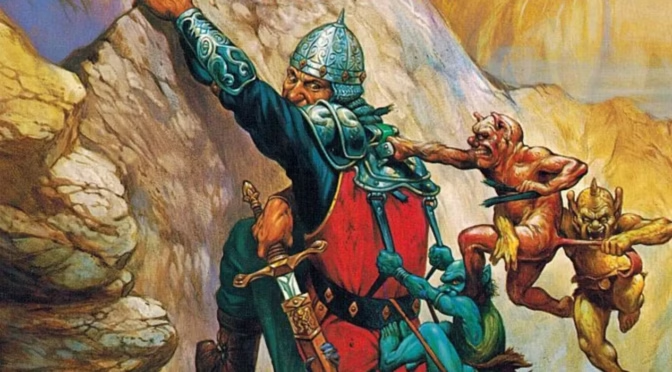
One question that shows up in my inbox again and again is simple on the surface but surprisingly loaded underneath. What is your favorite edition of Dungeons and Dragons?
I have done broader best RPG lists before, but that is not really what people are asking. They are not looking for my thoughts on the entire hobby. They want to know which banner I fly when it comes to D&D. Which version sits closest to my heart? Which books I reach for when someone says, do you want to play.
So I decided to answer properly.
Instead of naming a single winner, I pulled together a top 10 list that includes not just official editions, but also variants, clones, and offshoots that belong to the larger D&D family. Some are obvious. Some are unexpected. All of them, in one way or another, carry the torch of dungeon-crawling fantasy adventure.
It turned out to be a fun exercise. And with so much debate swirling around modern Dungeons and Dragons right now, it feels like a good time to zoom out a little. There is a vast landscape beyond the latest edition war. Plenty of roads to travel. Plenty of dragons to slay.
10. Forbidden Lands

I will start with what might be the most controversial entry on this list. Controversial only because it is the least mechanically related to D&D of anything here. Its core system comes from a completely different lineage. It does not descend from TSR or the d20 tree.
And yet, thematically, Forbidden Lands often feels more like classic D&D than some official editions. If we are willing to call 5th edition D&D, then I say by right, Forbidden Lands deserves a seat at the table.
What makes it unique is that it is tightly bound to its setting and intended campaign style. This is not a generic fantasy engine. It is a game about survival in a harsh and broken land, well defined, illustrated, and presented in beautiful detail. The players are not chosen heroes destined for greatness. They are desperate adventurers trying to carve out a place in a world that does not care if they live or die.
The mechanics are not perfect. There are a few rough edges, oddly familiar if you play a lot of D&D-style games. But what it does extremely well is align rules with tone. The system reinforces scarcity, risk, and tension. It avoids the incoherent sprawl that some classic D&D editions suffered from while still capturing that old school edge.
It is brutal. Life is cheap. Characters can and will struggle to survive. That feeling is deeply reminiscent of early D&D, when survival was not assumed and advancement had to be earned the hard way. Maybe it is not quite as unforgiving as the earliest editions, but it carries that same weight. Every journey into the wild feels risky. Every campfire feels temporary.
The boxed set presentation helps enormously. Forbidden Lands is largely self-contained. Yes, there are expansions, but the core box gives you everything you need. System, setting, campaign framework. It is all there, cohesive and focused. There is something refreshing about that. No endless stream of mandatory supplements. No sprawling library required. Just a complete experience in one package.
I have not played as much Forbidden Lands as some of the other games on this list, but the campaign I did experience was enough to convince me. It had that unmistakable D&D flavor. Exploration. Danger. Treasure. Hard choices. The difference was simply that the tone leaned darker and the system carried its weight more cleanly.
For that reason alone, it earns its place here. It may not share D&D’s mechanical ancestry, but in spirit it absolutely belongs to the same school of adventure.
9. Pathfinder 2nd Edition

I am not entirely sure I am a natural fan of the tactical RPG genre. I appreciate it. I respect it. But it is not my default preference. That said, when it comes to D&D style tactical systems, Pathfinder 2nd edition is undeniably solid.
I spent a fair amount of time running and playing it, and for good reason. It answers a very specific question. What happens if you take 3rd edition, modernize it completely, and then dive even deeper into tactical precision and character customization?
The answer is a beast.
Pathfinder 2e is enormous. Over six hundred pages of tightly engineered rules. Layers of customization. Class feats, ancestry feats, skill feats, archetypes, options within options. It likely contains more meaningful character choices in a single core rulebook than most of the other games on this list combined.
And yet, for all that weight, it is remarkably well organized. If you love deep mechanical play, Pathfinder 2e executes it in the most streamlined and optimized way possible. It is complex, but it is disciplined complexity. The math works. The action economy is elegant. The system is balanced with almost obsessive care.
What I admire most is something it shares with Pathfinder 1e. It takes a core concept and refines it relentlessly. Then it builds outward with themed expansions, adventure paths, and supplemental books that feel purposeful rather than random. It supports its own vision thoroughly.
At the same time, it is simply too heavy for me to run these days. I do not have the time I once did. There is no winging Pathfinder 2e. You cannot improvise your way through it casually and expect the system to carry you. To run it well, you need to put in the hours. Real preparation. Real system mastery. Without that effort, the experience suffers.
In my current stage of life, that level of demand is hard to justify.
As a player, however, I am far more open. If someone else is willing to do the work behind the screen, I am happy to show up and engage with the system. From the player side, Pathfinder 2e is a rewarding tactical experience. Fights are dynamic. Choices matter. Encounters can be genuinely challenging. And when paired with one of its strong adventure paths, it can deliver some truly memorable campaigns.
The Kingmaker adaptation for Pathfinder 2e is a great example. A massive kingdom-building saga, packed with depth and scale. As a player, I would gladly dive into something like that.
As a Game Master, though, I have to be honest. It is a hard no. Not because it fails, but because it demands more than I am willing to give at this point. Pathfinder 2e absolutely earns its place on this list. It is a masterfully engineered system. It is just one that requires a level of commitment I have long since outgrown.
8. Castles and Crusades

There are games on this list that I have spent years playing, systems that shaped entire eras of my D&D life. Castles and Crusades is not one of them. And yet it still earns a place here, because it fills a very specific role in the broader world of Dungeons and Dragons.
It covers a niche that I do not often need, but once in a while, it is exactly the right tool for the job.
Castles and Crusades emerged at a time when 3rd and 3.5 edition Dungeons and Dragons had grown increasingly complex. Character builds became intricate, rules interactions multiplied, and system mastery was often rewarded over good old-fashioned adventuring fun. Castles and Crusades stepped in as a lighter alternative, a rebuttal to the question, what does modern D&D look like. It felt like a modern continuation of 2nd edition AD&D, but with a cleaner and more unified core mechanic. In another timeline where TSR had remained in control and refined AD&D using a more streamlined approach, this might have been the result.
It was clearly dedicated to preserving the feel of classic AD&D. The classes, the tone, and the emphasis on medieval fantasy adventure all remained intact. The goal was not to reinvent Dungeons and Dragons, but to refine it. To keep the spirit while trimming away the layers of complexity that 3rd edition became known for.
For me the difficulty has always been the audience. The people I play with tend to fall into one of two camps. They are either committed old school players who want early TSR editions or faithful retro clones, or they prefer whatever the latest official version happens to be. At one time, that was 3rd edition, then Pathfinder, then 4th edition, and so on.
Castles and Crusades sits squarely in the middle. It preserves early D&D while presenting it in a modern framework. In theory, that should make it a perfect compromise. In practice, D&D players are rarely looking for compromise. They usually know exactly what they want.
As a result, my copy has often stayed on the shelf. A bit of a dust collector.
That said, from a design perspective, I have a great deal of respect for it. The system is elegant, focused, and confident in what it is trying to do. It is unapologetically both old school and modern at the same time, and it manages to pull that off remarkably well.
I’m not sure I love the Siege Engine, which is the core resolution system for C&C’s answer to skill checks. I always found the dice odds and results of that particular rules mechanic off, but as I tend to avoid the use of skills in my games whenever possible, it’s not that big of a deal. I think the game would have been better off either using the D20 skill system or the AD&D non-weapon proficiencies, but the middle ground kind of didn’t work as well as either one of those did.
That caveat aside, if you have a group that enjoys modern Dungeons and Dragons but is willing to simplify things a bit, and you are a Dungeon Master who prefers the feel of classic adventures without all the classic mechanical baggage, Castles and Crusades can be an excellent choice. It may not be the game I reach for most often, but I am glad it exists; it earns its rightful place on this list.
7. 5th Edition Dungeons and Dragons

I know some of my old school D&D friends will raise an eyebrow at this one. Especially after the 2024 update and all the noise that surrounded it. But here is the simple truth. I am a gamer. I care about what happens at the table far more than what happens on social media. I am here to roll dice, tell stories, and have a good time. The rest is just background chatter.
For me, 5th edition is the most polished and efficient power fantasy version of Dungeons and Dragons ever made. It knows exactly what it is doing. You are not a struggling adventurer scraping by with four hit points and a rusty sword. You are a force of nature. A fantasy superhero with spells, abilities, and enough resilience to stare down a fantasy monster without breaking a sweat.
And that is fun.
5th edition is about bold moves and dramatic victories. It is about kicking in the door and believing you might actually survive what is on the other side. The system is flexible, easy to learn, and offers a huge range of character options without drowning players in mechanical detail. It gives you variety without demanding spreadsheets.
That matters.
It also matters that this style of play speaks to a lot of people, especially younger players. My kids love it. They want to charge into battle against multiple dragons and come out standing. They want big moments and spectacular powers. 5th edition delivers that in a way that feels smooth and accessible.
As a writer, I love working in the 5th edition design space. It is easy to create adventures when you can assume the characters are competent and durable. You can focus on cool scenarios, memorable villains, and cinematic set pieces without constantly worrying whether the mechanics will collapse under pressure. Yes, it is difficult to create truly punishing challenges, and the game gets truly wacky at high levels. But if you approach 5e expecting it to be a brutal survival simulator, you are probably aiming at the wrong target.
Above all else, 5th edition is simply fun to play. If you are old school like me, you do have to let go of certain expectations. Once you stop trying to make it something it is not and just lean into what it does well, it becomes clear why it has brought so many people into the hobby.
The starter sets are a perfect example. They are some of the best introductory products Dungeons and Dragons has ever produced. I own them all, and despite having shelves full of adventures, my kids are perfectly happy replaying The Dragon of Icespire Peek again and again. We defeat the dragon, celebrate, and then roll up new characters to do it all over. It is like rewatching a favorite movie for the tenth time and still enjoying every scene.
Wizards of the Coast clearly understands how to speak to the current generation of players. What might look unusual or unnecessary to older fans feels completely natural to younger ones. They do not carry the same expectations or nostalgia. They just see a game full of possibilities.
If someone comes to me today and says they have never played a roleplaying game but want to learn D&D, 5th edition with one of the starter kits is still my go-to recommendation. It is welcoming, flexible, and immediately rewarding. And sometimes that is exactly what the hobby needs.
6. Pathfinder 1st edition

For me, Pathfinder 1st edition represents the entire 3rd edition era. When I put Pathfinder on this list, I am also tipping my hat to 3rd and 3.5 edition Dungeons and Dragons. Pathfinder 1st edition feels like the definitive final form of that lineage. The system was refined, expanded, and pushed right to its natural limit.
I played an absurd amount of 3rd edition era D&D. From the original launch of 3rd edition to the sprawling Adventure Paths of Pathfinder, no other game on this list has generated more memories or consumed more hours of my life. We practically lived at the gaming table. Twelve to fourteen-hour sessions were normal. Several times a week was normal. We were young, obsessed, and fully committed.
That era was a golden age for me, and part of that is simply timing. I was in my late teens when 3rd edition arrived. No wife. No kids. No career clawing at my schedule. Just friends, dice, and time. So much time. We learned the system inside and out. We did not just play it. We mastered it.
It also felt like a second great age of settings. Much like the early TSR days, the 3rd edition era exploded with new worlds. Scarred Lands. Eberron. Golarion. Midnight. Iron Kingdoms. Each one with its own flavor, its own tone, its own promise of adventure. The writing was ambitious and plentiful. You could jump from gothic horror to pulp intrigue to mythic war without ever leaving the broader d20 umbrella.
And the adventures. Some of the best campaign material ever written for the game came out during this time. Kingmaker stands tall in my memory as a near perfect expression of what long form campaign design could look like. Big ideas. Player agency. Epic payoff.
Mechanically, this was the age of prestige classes and intricate character builds. We loved it. We loved planning out ten levels in advance. We loved squeezing every advantage out of feats, skills, and class combinations. Looking back now, it feels excessive, but at the time it was exactly what we wanted. Video games were deep and complex. Miniature games rewarded optimization. We wanted systems with moving parts, and 3rd edition delivered.
That said, this is probably the one game on the list I would not return to today. Not because it failed. Quite the opposite. It demands time, focus, and energy. It rewards dedication. Back then I had those resources in abundance. Today, with family and career taking their rightful place, the thought of diving back into that level of mechanical depth feels exhausting.
That is not a flaw in Pathfinder. It is simply a shift in who I am now.
I regret nothing about those years. They were loud, ambitious, rules-heavy, and absolutely glorious. Pathfinder 1st edition stands as the monument to that chapter of my gaming life, and it earned every hour I gave it.
5. Dungeon Crawl Classics

Dungeon Crawl Classics is another brilliant offshoot of D&D that might be just a little too niche for its own good.
If Castles and Crusades is a careful bridge between eras, Dungeon Crawl Classics is what happens when you hand the keys to a group of wildly creative designers and simply say go. Goodman Games has assembled one of the most imaginative teams in the hobby. Their adventures and supplements do not feel restrained or filtered. They feel unleashed.
The result is a game bursting with ideas. Strange ideas. Loud ideas. Ideas that do not ask for permission and no sane person would ever approve them, but Goodman Games is …special.
For many D&D fans, whether old school traditionalists or modern build-focused players, it can be too much. Dungeon Crawl Classics demands an open mind. It asks you to step outside your expectations of what D&D is supposed to look like. You have to let go…a lot. Let the dice take over. Let the chaos breathe.
I ran a single Dungeon Crawl Classics campaign during the pandemic, when we were all locked in our homes and playing digitally. It was the perfect time to experiment. My group was ultimately lukewarm on the whole thing, and I understood why. DCC is strange. Its magic system alone feels like a deliberate rebellion against predictability. Spells can spiral into glorious disasters or explode into legendary triumphs. Control is not guaranteed or even expected.
In fact, that loss of control is part of the point. Where most RPGs try to smooth out volatility, DCC leans into it. It takes the core tropes of Dungeons and Dragons and turns every dial as far as it will go. The tone becomes gonzo. The situations become outrageous. At times, it feels like a fever dream version of classic fantasy adventure.
To really enjoy it, you almost have to take off your traditional D&D hat. If you cling too tightly to balance, careful planning, or long-term character optimization, the game will fight you. But if you embrace the madness, it becomes something special.
I personally love it. I think Dungeon Crawl Classics is an absolute blast to run and play. The shenanigans that unfold at the table often feel like a wild fantasy cartoon brought to life by dice. almost a kind of comedic parody of D&D. It is not sloppy design. Beneath the chaos is a carefully constructed engine built to generate those moments on purpose.
Still, it takes a very specific kind of group to truly enjoy it. It pushes both old school brutality and modern spectacle to their extremes at the same time. That combination is not for everyone.
I admire it deeply. I have tremendous respect for its creativity. But I completely understand why it might not click for most players. Dungeon Crawl Classics is less about comfort and more about curiosity. It rewards those who love bold design and fearless imagination as much as they love playing D&D itself.
4. 1st edition Advanced Dungeons and Dragons

1st edition AD&D is a true old school classic for me. I played it in the mid-eighties, when I was still very young, but even today I feel a surge of energy when I pull those old books off the shelf. The covers alone still have power.
That said, of all the games on this list, this is probably the one that has aged the worst.
Let me start with why I loved it, and in many ways still do.
It had style. It had mystique. Being a Dungeon Master felt like stepping into a secret order; being a player felt like you were stepping into a mystery. These were not just roles at the table. They were positions of either authority and deep knowledge, or explorers of a great mystery. The game expected Dungeon Masters to study it, internalize it, and guard it. Players, on the other hand, were meant to discover it through play, not through reading the books. This unspoken understanding was a social contract, and there was a clear purpose behind it.
As a player, the game was a mystery. We did not read the Dungeon Masters Guide. We did not flip through the Monster Manual. Doing so was forbidden. You learned by playing. You learned by surviving. You learned by making mistakes.
Knowledge was power, and that knowledge was earned; it was a trial by fire.
The first time we encountered a gelatinous cube, it was not a stat block. It was a horrifying surprise, but the next time, the players knew how to deal with it. Experience was earned by players and characters alike. The first time we got lost in the woods, found a magical lock, picked up an unidentified scroll, or crossed an ocean, there was no safety net. No clear mechanical explanation was handed to us ahead of time, we didn’t know the odds or even fully grasp the dangers. We discovered how the game and the world worked by interacting with it, by suffering at its cruelty and learning as we went.
The result was a game where the world felt real in a way that is hard to describe. Your character lived in it, but you as a player were also navigating something unknown. Characters died. That happened often. But the player gained experience. We remembered where the dangerous forest was. We remembered that troll and the hard lesson about fire. We made our own maps because none were provided. We built keeps for safety, opened taverns with our ill-gotten gains for fame and glory, and followed storylines that unfolded over years out of personal attachment to the events. Events in which characters perished to the plots of evil villains that lingered despite our best efforts to stop them. There were personal agendas, oaths of vengeance, we cursed the DM for cruelty and unfairness, but secretly we applauded the experience because it was so vivid.
There was a veil over the whole game, and we didn’t peek. The rules themselves were part of the exploration; the DMG was a mysterious book, and we could only imagine what was inside.
In modern D&D, that veil is usually gone. Players know the system inside and out. They know what monsters do. They can look up spells, effects, and optimal builds between sessions. The mystery is replaced with transparency. That is not necessarily bad, but it is different.
The hard truth is that maintaining that veil was never sustainable back then, either. Eventually, we all wanted to try being Dungeon Masters. We read the books. We saw behind the curtain. Once you understand the machinery, it never quite feels the same again.
Today, when I look at 1st edition AD&D with experienced and unveiled eyes, I see flawed mechanics, inconsistent rules, and some genuinely questionable design decisions. The structure is messy. The balance is uneven. The clarity we now expect simply is not there.
And yet, I can still feel what it was meant to be. I can still sense the potential. The idea that the game itself is something you uncover over time. That the rules are not just tools, but secrets.
Modern players ask more questions. They want clarity. They want consistency. They want to know how things work before committing to an action. They are less willing to let the system itself be part of the mystery. Without that mystery, 1st edition AD&D can feel fragile and awkward.
But when it worked, when that veil was intact, and the world felt unknown, AD&D had a kind of magic that was indescribably wonderful. I can understand the OSR for wanting to keep this version of the game alive and immortal. I’m 100% convinced that no other RPG in existence can offer the experience AD&D can, and if you haven’t experienced it yourself, I pity you.
If this were a list of the best RPG experiences of all time, AD&D would be at the top of the list by a margin so wide that there would be no point in adding any other games to the list.
3. 1st edition BECMI (Basic, Expert, Companion, Master, Immortal): AKA The Dungeons and Dragons Rules Cyclopedia

Yes, that is a mouthful.
The unified BECMI line is an interesting creature. The original purpose of Basic and Expert was simple. It was meant to be an entry path into Dungeons and Dragons, a starting point before players graduated to 1st edition AD&D.
But TSR being TSR, things did not unfold quite so cleanly. Business decisions and internal dynamics led to Basic and Expert continuing to expand. Companion added domain play. Master pushed power levels higher. Immortal went cosmic. By the time you had the full BECMI spread, you were looking at a system that rivaled Advanced Dungeons and Dragons in scope and complexity.
In a sense, it became an alternate evolution of AD&D. Not the same tone, not the same mystique, but just as ambitious.
Where AD&D felt mysterious and almost arcane, BECMI felt structured and purposeful. To me, its true strength was scale. This was a game built to sustain an epic campaign. Characters could progress from level 1 all the way to 36. No other version of D&D committed so fully to that kind of long-term arc, nor did most systems support game elements beyond simple adventuring.
It is the only edition that truly embraced the idea that a campaign might run indefinitely without slamming into a hard ceiling. I have never met anyone who actually reached Immortal play at level 36, but the mere existence of that ladder is inspiring. It suggests a game designed for years of development, not just months.
I ran a Mystara campaign that lasted nearly six years. Same world. Same characters, we reached level 21 if memory serves, we could have easily gone on for another decade. We began with Keep on the Borderlands, rusty swords and no backstories. Over time, those same characters ruled kingdoms, negotiated wars, shaped politics, and watched the consequences of their choices ripple outward. It became generational storytelling. Legends built at the table.
You can tell stories like that in other systems, certainly. But BECMI supports it directly. It has mechanics for domain management, armies, mass combat, and high-level play baked into the structure. From dungeon delving to empire building, it provides a framework.
Of all the old TSR-era systems, this is one that I believe still holds up remarkably well. It is robust, deep, and surprisingly cohesive when taken as a whole. The Rules Cyclopedia in particular stands out as one of the most practical and usable single-volume rulebooks TSR ever produced.
That said, like all TSR games, it expects house ruling. No version from that era arrived perfectly tuned. But the underlying design space is strong enough to support that tinkering, it was quite flexible. Not only as a design space, but because it had such a close relationship with AD&D, you could pull elements from the supplements supporting that game as well.
It is also important not to confuse BECMI with the earlier B and X sets. They are the same game, or at least share DNA, but BECMI grows far beyond a simple introductory game. This is not a basic experience. It is a complex and demanding system for players who want a long and detailed journey. In terms of commitment, it sits comfortably beside AD&D and 3rd edition.
Which is why I do not really run it anymore. Like those other deep systems, it asks for time and focus that I simply do not have.
But if someone came to me and said can you run BECMI for us, I would struggle to say no. It remains one of the strongest designs TSR ever produced, and it absolutely still works at the table; it’s worth the stretch.
2. Dolmenwood & Old School Essentials & B/X

I group these three games because they are directly connected. Old School Essentials is a beautifully organized and clarified presentation of B/X. Dolmenwood builds on Old School Essentials and wraps it in a rich, self-contained setting. They have interchangeable structures so adventures for any of them will work with any of the systems without alteration; they are, in a word the same game.
What I love about this architecture, especially as a Dungeon Master, is its simplicity and its immediate focus on adventure. I would even argue that these are not role-playing games in the modern sense. They are adventure games.
The difference, at least in my mind, is subtle but important. In most modern role-playing games, the character as an identity becomes central. Backstory, personal arcs, emotional journeys. In B/X and its descendants, the character is more of an avatar. An extension of the player exploring dangerous places. The focus is on what you do, not who you are.
My expectation with these systems is simple. I can say hey, do you want to play D&D, and ten minutes later we are rolling dice and kicking in doors. There is very little friction between the idea of playing and actually playing, which I can with confidence is ALWAYS a problem in almost all RPG’s. Character creation is quick. The rules are clear. The goal is obvious and explicit in the metagame (1 gold = 1 XP). Go into the dungeon. Survive if you can. Bring back the treasure.
Dolmenwood adds tremendous flavor to that formula. It provides a fully realized setting, strange and whimsical and dark in equal measure, with locations and hooks ready to use. It feels open and alive, but it does not demand hours of preparation. You can point to a map, choose a direction, and the adventure is already waiting.
I have never had an easier time getting a game to the table than with B/X or Old School Essentials or Dolmenwood. That immediacy is part of what made B/X so powerful in the eighties, and it is why its descendants still work so well today.
I often prefer pulling one of these off the shelf over 5th edition. But it is important to understand the tone. These games have teeth. They are not about cinematic heroics. They are about risk and survival. When you play a 5e starter set, character death is possible but unlikely. When you play B/X or Old School Essentials or Dolmenwood, death is not just possible. It is expected. The real story is often how your character meets their end.
And somehow that makes the victories sweeter.
Because the rules are light and direct, it is easy to get everyone aligned around the core premise. We are here to explore dangerous places, fight monsters, and haul treasure back to town. There is very little barrier between intention and action.
If I had to choose a line of D&D that gets from do you want to play to actually playing faster than anything else, this would be it. The kicker its, a stupid amount of relaxed fun, pure joy at the table without any of the weight.
1. 2nd edition Advanced Dungeons & Dragons

We have a winner!
When I think about the most complete and most authentic expression of Dungeons and Dragons, the version that captures the tone, the aesthetic, and the core gameplay in its purest form, I land on 2nd edition Advanced Dungeons and Dragons.
That is a bold claim, I know. But when I picture what D&D is supposed to feel like, this is the game that comes to mind. The art. The writing. The atmosphere. The balance between danger and possibility. Just the right blend of low and high fantasy. It embodies the identity of Dungeons and Dragons in a way no other edition quite does for me.
There is nothing in it that I would remove at the level of essence. Nothing I feel compelled to replace with something from another system. It feels whole.
At the same time, it is a deeply flawed game in many ways. In fact, of all the systems I have run over the years, this is the one I modified the most. That may sound contradictory, but when I talk about modification, I mean adjustment and tuning, not rewriting its soul. I balanced numbers. I clarified mechanics. I nudged pieces into alignment. I did not change what the game was trying to be.
One of the recurring issues with 2nd edition is the gap between description and execution. Especially in the expanded supplements, I would read the flavor text of a spell, a race, a class, or a weapon and think this is perfect. This is exactly what it should be. Then I would look at the mechanical implementation and feel the disconnect. The rules did not always deliver what the text promised.
That tension drove me to tinker, and 2nd edition is wonderfully suited for tinkering. It has a flexible design space and an enormous body of supplements. You can adjust it without breaking it. You can shape it to your table without losing its identity.
It is also the most adaptable edition in this lineup. Hand me almost any fantasy setting and, with the right books and a few mechanical tweaks, I can make it sing in 2nd edition. It sits comfortably within the grooves of traditional fantasy. It feels like the natural engine for the kind of worlds D&D was built to explore.
I also consider it the fairest of the classic systems. Earlier editions could be brutally lethal, especially for certain classes. Magic users and thieves often felt like they were one unlucky roll away from oblivion. In 2nd edition, you still faced real danger, but you had tools. You had options. You had a fighting chance. It struck a rare balance between survival horror and modern power fantasy. It was tense without being hopeless. Dangerous without being absurd.
I love this system. It is the only edition for which I own a truly massive library. Even now, I still collect for it. The material produced during that era feels rich and valuable. There is depth there that I continue to appreciate. I will admit the adventure writing for AD&D was hit and miss, but the settings were chef’s kiss. 2nd edition AD&D era settings were the best we ever got for any edition by a considerable margin.
If someone walks up to me and says hey, do you want to play D&D, and they do not specify an edition, I assume they mean 2nd edition Advanced Dungeons and Dragons. In my mind, that is the default form of the game.


