Tag Archives: D&D

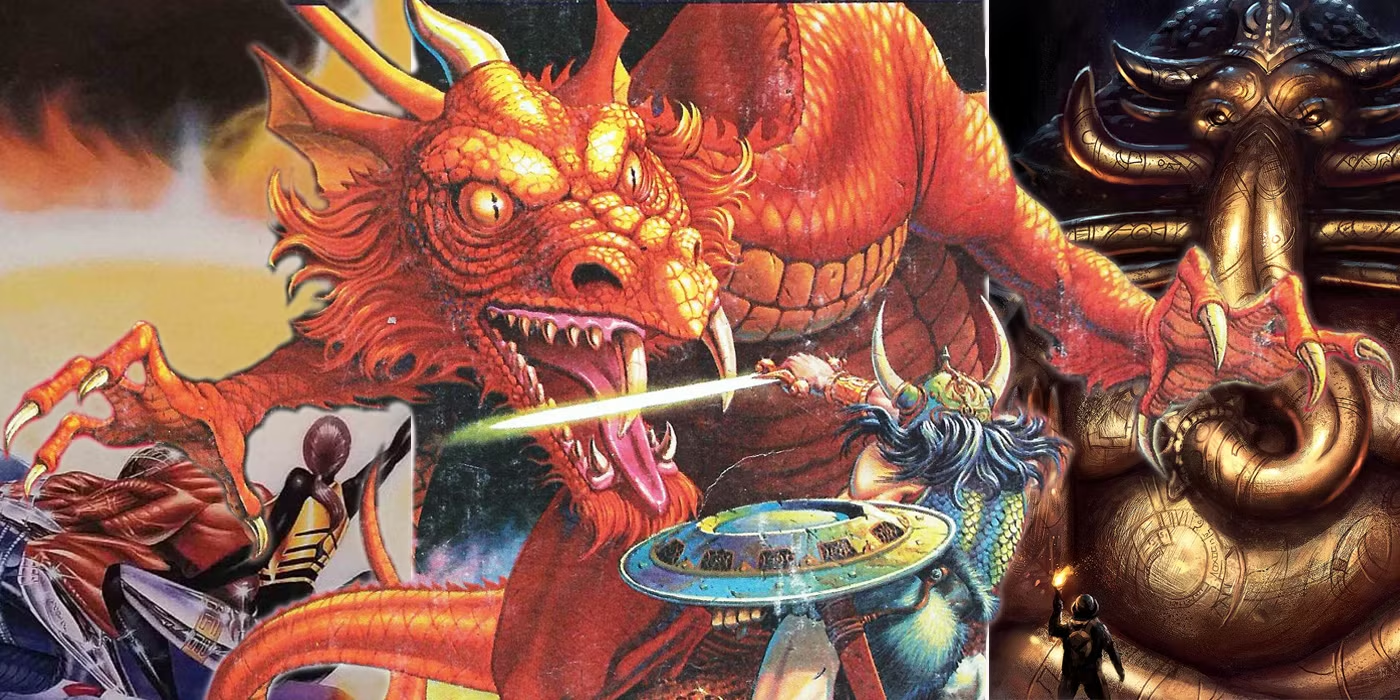
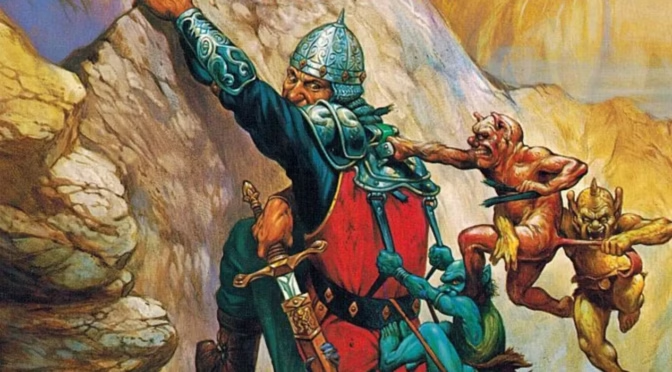
Top 10 Versions of Dungeons and Dragons

One question that shows up in my inbox again and again is simple on the surface but surprisingly loaded underneath. What is your favorite edition of Dungeons and Dragons?

I have done broader best RPG lists before, but that is not really what people are asking. They are not looking for my thoughts on the entire hobby. They want to know which banner I fly when it comes to D&D. Which version sits closest to my heart? Which books I reach for when someone says, do you want to play.

So I decided to answer properly.

Instead of naming a single winner, I pulled together a top 10 list that includes not just official editions, but also variants, clones, and offshoots that belong to the larger D&D family. Some are obvious. Some are unexpected. All of them, in one way or another, carry the torch of dungeon-crawling fantasy adventure.

It turned out to be a fun exercise. And with so much debate swirling around modern Dungeons and Dragons right now, it feels like a good time to zoom out a little. There is a vast landscape beyond the latest edition war. Plenty of roads to travel. Plenty of dragons to slay.

10. Forbidden Lands

I will start with what might be the most controversial entry on this list. Controversial only because it is the least mechanically related to D&D of anything here. Its core system comes from a completely different lineage. It does not descend from TSR or the d20 tree.

And yet, thematically, Forbidden Lands often feels more like classic D&D than some official editions. If we are willing to call 5th edition D&D, then I say by right, Forbidden Lands deserves a seat at the table.

What makes it unique is that it is tightly bound to its setting and intended campaign style. This is not a generic fantasy engine. It is a game about survival in a harsh and broken land, well defined, illustrated, and presented in beautiful detail. The players are not chosen heroes destined for greatness. They are desperate adventurers trying to carve out a place in a world that does not care if they live or die.

The mechanics are not perfect. There are a few rough edges, oddly familiar if you play a lot of D&D-style games. But what it does extremely well is align rules with tone. The system reinforces scarcity, risk, and tension. It avoids the incoherent sprawl that some classic D&D editions suffered from while still capturing that old school edge.

It is brutal. Life is cheap. Characters can and will struggle to survive. That feeling is deeply reminiscent of early D&D, when survival was not assumed and advancement had to be earned the hard way. Maybe it is not quite as unforgiving as the earliest editions, but it carries that same weight. Every journey into the wild feels risky. Every campfire feels temporary.

The boxed set presentation helps enormously. Forbidden Lands is largely self-contained. Yes, there are expansions, but the core box gives you everything you need. System, setting, campaign framework. It is all there, cohesive and focused. There is something refreshing about that. No endless stream of mandatory supplements. No sprawling library required. Just a complete experience in one package.

I have not played as much Forbidden Lands as some of the other games on this list, but the campaign I did experience was enough to convince me. It had that unmistakable D&D flavor. Exploration. Danger. Treasure. Hard choices. The difference was simply that the tone leaned darker and the system carried its weight more cleanly.

For that reason alone, it earns its place here. It may not share D&D’s mechanical ancestry, but in spirit it absolutely belongs to the same school of adventure.

9. Pathfinder 2nd Edition

I am not entirely sure I am a natural fan of the tactical RPG genre. I appreciate it. I respect it. But it is not my default preference. That said, when it comes to D&D style tactical systems, Pathfinder 2nd edition is undeniably solid.

I spent a fair amount of time running and playing it, and for good reason. It answers a very specific question. What happens if you take 3rd edition, modernize it completely, and then dive even deeper into tactical precision and character customization?

The answer is a beast.

Pathfinder 2e is enormous. Over six hundred pages of tightly engineered rules. Layers of customization. Class feats, ancestry feats, skill feats, archetypes, options within options. It likely contains more meaningful character choices in a single core rulebook than most of the other games on this list combined.

And yet, for all that weight, it is remarkably well organized. If you love deep mechanical play, Pathfinder 2e executes it in the most streamlined and optimized way possible. It is complex, but it is disciplined complexity. The math works. The action economy is elegant. The system is balanced with almost obsessive care.

What I admire most is something it shares with Pathfinder 1e. It takes a core concept and refines it relentlessly. Then it builds outward with themed expansions, adventure paths, and supplemental books that feel purposeful rather than random. It supports its own vision thoroughly.

At the same time, it is simply too heavy for me to run these days. I do not have the time I once did. There is no winging Pathfinder 2e. You cannot improvise your way through it casually and expect the system to carry you. To run it well, you need to put in the hours. Real preparation. Real system mastery. Without that effort, the experience suffers.

In my current stage of life, that level of demand is hard to justify.

As a player, however, I am far more open. If someone else is willing to do the work behind the screen, I am happy to show up and engage with the system. From the player side, Pathfinder 2e is a rewarding tactical experience. Fights are dynamic. Choices matter. Encounters can be genuinely challenging. And when paired with one of its strong adventure paths, it can deliver some truly memorable campaigns.

The Kingmaker adaptation for Pathfinder 2e is a great example. A massive kingdom-building saga, packed with depth and scale. As a player, I would gladly dive into something like that.

As a Game Master, though, I have to be honest. It is a hard no. Not because it fails, but because it demands more than I am willing to give at this point. Pathfinder 2e absolutely earns its place on this list. It is a masterfully engineered system. It is just one that requires a level of commitment I have long since outgrown.

8. Castles and Crusades

There are games on this list that I have spent years playing, systems that shaped entire eras of my D&D life. Castles and Crusades is not one of them. And yet it still earns a place here, because it fills a very specific role in the broader world of Dungeons and Dragons.

It covers a niche that I do not often need, but once in a while, it is exactly the right tool for the job.

Castles and Crusades emerged at a time when 3rd and 3.5 edition Dungeons and Dragons had grown increasingly complex. Character builds became intricate, rules interactions multiplied, and system mastery was often rewarded over good old-fashioned adventuring fun. Castles and Crusades stepped in as a lighter alternative, a rebuttal to the question, what does modern D&D look like. It felt like a modern continuation of 2nd edition AD&D, but with a cleaner and more unified core mechanic. In another timeline where TSR had remained in control and refined AD&D using a more streamlined approach, this might have been the result.

It was clearly dedicated to preserving the feel of classic AD&D. The classes, the tone, and the emphasis on medieval fantasy adventure all remained intact. The goal was not to reinvent Dungeons and Dragons, but to refine it. To keep the spirit while trimming away the layers of complexity that 3rd edition became known for.

For me the difficulty has always been the audience. The people I play with tend to fall into one of two camps. They are either committed old school players who want early TSR editions or faithful retro clones, or they prefer whatever the latest official version happens to be. At one time, that was 3rd edition, then Pathfinder, then 4th edition, and so on.

Castles and Crusades sits squarely in the middle. It preserves early D&D while presenting it in a modern framework. In theory, that should make it a perfect compromise. In practice, D&D players are rarely looking for compromise. They usually know exactly what they want.

As a result, my copy has often stayed on the shelf. A bit of a dust collector.

That said, from a design perspective, I have a great deal of respect for it. The system is elegant, focused, and confident in what it is trying to do. It is unapologetically both old school and modern at the same time, and it manages to pull that off remarkably well.

I’m not sure I love the Siege Engine, which is the core resolution system for C&C’s answer to skill checks. I always found the dice odds and results of that particular rules mechanic off, but as I tend to avoid the use of skills in my games whenever possible, it’s not that big of a deal. I think the game would have been better off either using the D20 skill system or the AD&D non-weapon proficiencies, but the middle ground kind of didn’t work as well as either one of those did.

That caveat aside, if you have a group that enjoys modern Dungeons and Dragons but is willing to simplify things a bit, and you are a Dungeon Master who prefers the feel of classic adventures without all the classic mechanical baggage, Castles and Crusades can be an excellent choice. It may not be the game I reach for most often, but I am glad it exists; it earns its rightful place on this list.

7. 5th Edition Dungeons and Dragons

I know some of my old school D&D friends will raise an eyebrow at this one. Especially after the 2024 update and all the noise that surrounded it. But here is the simple truth. I am a gamer. I care about what happens at the table far more than what happens on social media. I am here to roll dice, tell stories, and have a good time. The rest is just background chatter.

For me, 5th edition is the most polished and efficient power fantasy version of Dungeons and Dragons ever made. It knows exactly what it is doing. You are not a struggling adventurer scraping by with four hit points and a rusty sword. You are a force of nature. A fantasy superhero with spells, abilities, and enough resilience to stare down a fantasy monster without breaking a sweat.

And that is fun.

5th edition is about bold moves and dramatic victories. It is about kicking in the door and believing you might actually survive what is on the other side. The system is flexible, easy to learn, and offers a huge range of character options without drowning players in mechanical detail. It gives you variety without demanding spreadsheets.

That matters.

It also matters that this style of play speaks to a lot of people, especially younger players. My kids love it. They want to charge into battle against multiple dragons and come out standing. They want big moments and spectacular powers. 5th edition delivers that in a way that feels smooth and accessible.

As a writer, I love working in the 5th edition design space. It is easy to create adventures when you can assume the characters are competent and durable. You can focus on cool scenarios, memorable villains, and cinematic set pieces without constantly worrying whether the mechanics will collapse under pressure. Yes, it is difficult to create truly punishing challenges, and the game gets truly wacky at high levels. But if you approach 5e expecting it to be a brutal survival simulator, you are probably aiming at the wrong target.

Above all else, 5th edition is simply fun to play. If you are old school like me, you do have to let go of certain expectations. Once you stop trying to make it something it is not and just lean into what it does well, it becomes clear why it has brought so many people into the hobby.

The starter sets are a perfect example. They are some of the best introductory products Dungeons and Dragons has ever produced. I own them all, and despite having shelves full of adventures, my kids are perfectly happy replaying The Dragon of Icespire Peek again and again. We defeat the dragon, celebrate, and then roll up new characters to do it all over. It is like rewatching a favorite movie for the tenth time and still enjoying every scene.

Wizards of the Coast clearly understands how to speak to the current generation of players. What might look unusual or unnecessary to older fans feels completely natural to younger ones. They do not carry the same expectations or nostalgia. They just see a game full of possibilities.

If someone comes to me today and says they have never played a roleplaying game but want to learn D&D, 5th edition with one of the starter kits is still my go-to recommendation. It is welcoming, flexible, and immediately rewarding. And sometimes that is exactly what the hobby needs.

6. Pathfinder 1st edition

For me, Pathfinder 1st edition represents the entire 3rd edition era. When I put Pathfinder on this list, I am also tipping my hat to 3rd and 3.5 edition Dungeons and Dragons. Pathfinder 1st edition feels like the definitive final form of that lineage. The system was refined, expanded, and pushed right to its natural limit.

I played an absurd amount of 3rd edition era D&D. From the original launch of 3rd edition to the sprawling Adventure Paths of Pathfinder, no other game on this list has generated more memories or consumed more hours of my life. We practically lived at the gaming table. Twelve to fourteen-hour sessions were normal. Several times a week was normal. We were young, obsessed, and fully committed.

That era was a golden age for me, and part of that is simply timing. I was in my late teens when 3rd edition arrived. No wife. No kids. No career clawing at my schedule. Just friends, dice, and time. So much time. We learned the system inside and out. We did not just play it. We mastered it.

It also felt like a second great age of settings. Much like the early TSR days, the 3rd edition era exploded with new worlds. Scarred Lands. Eberron. Golarion. Midnight. Iron Kingdoms. Each one with its own flavor, its own tone, its own promise of adventure. The writing was ambitious and plentiful. You could jump from gothic horror to pulp intrigue to mythic war without ever leaving the broader d20 umbrella.

And the adventures. Some of the best campaign material ever written for the game came out during this time. Kingmaker stands tall in my memory as a near perfect expression of what long form campaign design could look like. Big ideas. Player agency. Epic payoff.

Mechanically, this was the age of prestige classes and intricate character builds. We loved it. We loved planning out ten levels in advance. We loved squeezing every advantage out of feats, skills, and class combinations. Looking back now, it feels excessive, but at the time it was exactly what we wanted. Video games were deep and complex. Miniature games rewarded optimization. We wanted systems with moving parts, and 3rd edition delivered.

That said, this is probably the one game on the list I would not return to today. Not because it failed. Quite the opposite. It demands time, focus, and energy. It rewards dedication. Back then I had those resources in abundance. Today, with family and career taking their rightful place, the thought of diving back into that level of mechanical depth feels exhausting.

That is not a flaw in Pathfinder. It is simply a shift in who I am now.

I regret nothing about those years. They were loud, ambitious, rules-heavy, and absolutely glorious. Pathfinder 1st edition stands as the monument to that chapter of my gaming life, and it earned every hour I gave it.

5. Dungeon Crawl Classics

Dungeon Crawl Classics is another brilliant offshoot of D&D that might be just a little too niche for its own good.

If Castles and Crusades is a careful bridge between eras, Dungeon Crawl Classics is what happens when you hand the keys to a group of wildly creative designers and simply say go. Goodman Games has assembled one of the most imaginative teams in the hobby. Their adventures and supplements do not feel restrained or filtered. They feel unleashed.

The result is a game bursting with ideas. Strange ideas. Loud ideas. Ideas that do not ask for permission and no sane person would ever approve them, but Goodman Games is …special.

For many D&D fans, whether old school traditionalists or modern build-focused players, it can be too much. Dungeon Crawl Classics demands an open mind. It asks you to step outside your expectations of what D&D is supposed to look like. You have to let go…a lot. Let the dice take over. Let the chaos breathe.

I ran a single Dungeon Crawl Classics campaign during the pandemic, when we were all locked in our homes and playing digitally. It was the perfect time to experiment. My group was ultimately lukewarm on the whole thing, and I understood why. DCC is strange. Its magic system alone feels like a deliberate rebellion against predictability. Spells can spiral into glorious disasters or explode into legendary triumphs. Control is not guaranteed or even expected.

In fact, that loss of control is part of the point. Where most RPGs try to smooth out volatility, DCC leans into it. It takes the core tropes of Dungeons and Dragons and turns every dial as far as it will go. The tone becomes gonzo. The situations become outrageous. At times, it feels like a fever dream version of classic fantasy adventure.

To really enjoy it, you almost have to take off your traditional D&D hat. If you cling too tightly to balance, careful planning, or long-term character optimization, the game will fight you. But if you embrace the madness, it becomes something special.

I personally love it. I think Dungeon Crawl Classics is an absolute blast to run and play. The shenanigans that unfold at the table often feel like a wild fantasy cartoon brought to life by dice. almost a kind of comedic parody of D&D. It is not sloppy design. Beneath the chaos is a carefully constructed engine built to generate those moments on purpose.

Still, it takes a very specific kind of group to truly enjoy it. It pushes both old school brutality and modern spectacle to their extremes at the same time. That combination is not for everyone.

I admire it deeply. I have tremendous respect for its creativity. But I completely understand why it might not click for most players. Dungeon Crawl Classics is less about comfort and more about curiosity. It rewards those who love bold design and fearless imagination as much as they love playing D&D itself.

4. 1st edition Advanced Dungeons and Dragons

1st edition AD&D is a true old school classic for me. I played it in the mid-eighties, when I was still very young, but even today I feel a surge of energy when I pull those old books off the shelf. The covers alone still have power.

That said, of all the games on this list, this is probably the one that has aged the worst.

Let me start with why I loved it, and in many ways still do.

It had style. It had mystique. Being a Dungeon Master felt like stepping into a secret order; being a player felt like you were stepping into a mystery. These were not just roles at the table. They were positions of either authority and deep knowledge, or explorers of a great mystery. The game expected Dungeon Masters to study it, internalize it, and guard it. Players, on the other hand, were meant to discover it through play, not through reading the books. This unspoken understanding was a social contract, and there was a clear purpose behind it.

As a player, the game was a mystery. We did not read the Dungeon Masters Guide. We did not flip through the Monster Manual. Doing so was forbidden. You learned by playing. You learned by surviving. You learned by making mistakes.

Knowledge was power, and that knowledge was earned; it was a trial by fire.

The first time we encountered a gelatinous cube, it was not a stat block. It was a horrifying surprise, but the next time, the players knew how to deal with it. Experience was earned by players and characters alike. The first time we got lost in the woods, found a magical lock, picked up an unidentified scroll, or crossed an ocean, there was no safety net. No clear mechanical explanation was handed to us ahead of time, we didn’t know the odds or even fully grasp the dangers. We discovered how the game and the world worked by interacting with it, by suffering at its cruelty and learning as we went.

The result was a game where the world felt real in a way that is hard to describe. Your character lived in it, but you as a player were also navigating something unknown. Characters died. That happened often. But the player gained experience. We remembered where the dangerous forest was. We remembered that troll and the hard lesson about fire. We made our own maps because none were provided. We built keeps for safety, opened taverns with our ill-gotten gains for fame and glory, and followed storylines that unfolded over years out of personal attachment to the events. Events in which characters perished to the plots of evil villains that lingered despite our best efforts to stop them. There were personal agendas, oaths of vengeance, we cursed the DM for cruelty and unfairness, but secretly we applauded the experience because it was so vivid.

There was a veil over the whole game, and we didn’t peek. The rules themselves were part of the exploration; the DMG was a mysterious book, and we could only imagine what was inside.

In modern D&D, that veil is usually gone. Players know the system inside and out. They know what monsters do. They can look up spells, effects, and optimal builds between sessions. The mystery is replaced with transparency. That is not necessarily bad, but it is different.

The hard truth is that maintaining that veil was never sustainable back then, either. Eventually, we all wanted to try being Dungeon Masters. We read the books. We saw behind the curtain. Once you understand the machinery, it never quite feels the same again.

Today, when I look at 1st edition AD&D with experienced and unveiled eyes, I see flawed mechanics, inconsistent rules, and some genuinely questionable design decisions. The structure is messy. The balance is uneven. The clarity we now expect simply is not there.

And yet, I can still feel what it was meant to be. I can still sense the potential. The idea that the game itself is something you uncover over time. That the rules are not just tools, but secrets.

Modern players ask more questions. They want clarity. They want consistency. They want to know how things work before committing to an action. They are less willing to let the system itself be part of the mystery. Without that mystery, 1st edition AD&D can feel fragile and awkward.

But when it worked, when that veil was intact, and the world felt unknown, AD&D had a kind of magic that was indescribably wonderful. I can understand the OSR for wanting to keep this version of the game alive and immortal. I’m 100% convinced that no other RPG in existence can offer the experience AD&D can, and if you haven’t experienced it yourself, I pity you.

If this were a list of the best RPG experiences of all time, AD&D would be at the top of the list by a margin so wide that there would be no point in adding any other games to the list.

3. 1st edition BECMI (Basic, Expert, Companion, Master, Immortal): AKA The Dungeons and Dragons Rules Cyclopedia

Yes, that is a mouthful.

The unified BECMI line is an interesting creature. The original purpose of Basic and Expert was simple. It was meant to be an entry path into Dungeons and Dragons, a starting point before players graduated to 1st edition AD&D.

But TSR being TSR, things did not unfold quite so cleanly. Business decisions and internal dynamics led to Basic and Expert continuing to expand. Companion added domain play. Master pushed power levels higher. Immortal went cosmic. By the time you had the full BECMI spread, you were looking at a system that rivaled Advanced Dungeons and Dragons in scope and complexity.

In a sense, it became an alternate evolution of AD&D. Not the same tone, not the same mystique, but just as ambitious.

Where AD&D felt mysterious and almost arcane, BECMI felt structured and purposeful. To me, its true strength was scale. This was a game built to sustain an epic campaign. Characters could progress from level 1 all the way to 36. No other version of D&D committed so fully to that kind of long-term arc, nor did most systems support game elements beyond simple adventuring.

It is the only edition that truly embraced the idea that a campaign might run indefinitely without slamming into a hard ceiling. I have never met anyone who actually reached Immortal play at level 36, but the mere existence of that ladder is inspiring. It suggests a game designed for years of development, not just months.

I ran a Mystara campaign that lasted nearly six years. Same world. Same characters, we reached level 21 if memory serves, we could have easily gone on for another decade. We began with Keep on the Borderlands, rusty swords and no backstories. Over time, those same characters ruled kingdoms, negotiated wars, shaped politics, and watched the consequences of their choices ripple outward. It became generational storytelling. Legends built at the table.

You can tell stories like that in other systems, certainly. But BECMI supports it directly. It has mechanics for domain management, armies, mass combat, and high-level play baked into the structure. From dungeon delving to empire building, it provides a framework.

Of all the old TSR-era systems, this is one that I believe still holds up remarkably well. It is robust, deep, and surprisingly cohesive when taken as a whole. The Rules Cyclopedia in particular stands out as one of the most practical and usable single-volume rulebooks TSR ever produced.

That said, like all TSR games, it expects house ruling. No version from that era arrived perfectly tuned. But the underlying design space is strong enough to support that tinkering, it was quite flexible. Not only as a design space, but because it had such a close relationship with AD&D, you could pull elements from the supplements supporting that game as well.

It is also important not to confuse BECMI with the earlier B and X sets. They are the same game, or at least share DNA, but BECMI grows far beyond a simple introductory game. This is not a basic experience. It is a complex and demanding system for players who want a long and detailed journey. In terms of commitment, it sits comfortably beside AD&D and 3rd edition.

Which is why I do not really run it anymore. Like those other deep systems, it asks for time and focus that I simply do not have.

But if someone came to me and said can you run BECMI for us, I would struggle to say no. It remains one of the strongest designs TSR ever produced, and it absolutely still works at the table; it’s worth the stretch.

2. Dolmenwood & Old School Essentials & B/X

I group these three games because they are directly connected. Old School Essentials is a beautifully organized and clarified presentation of B/X. Dolmenwood builds on Old School Essentials and wraps it in a rich, self-contained setting. They have interchangeable structures so adventures for any of them will work with any of the systems without alteration; they are, in a word the same game.

What I love about this architecture, especially as a Dungeon Master, is its simplicity and its immediate focus on adventure. I would even argue that these are not role-playing games in the modern sense. They are adventure games.

The difference, at least in my mind, is subtle but important. In most modern role-playing games, the character as an identity becomes central. Backstory, personal arcs, emotional journeys. In B/X and its descendants, the character is more of an avatar. An extension of the player exploring dangerous places. The focus is on what you do, not who you are.

My expectation with these systems is simple. I can say hey, do you want to play D&D, and ten minutes later we are rolling dice and kicking in doors. There is very little friction between the idea of playing and actually playing, which I can with confidence is ALWAYS a problem in almost all RPG’s. Character creation is quick. The rules are clear. The goal is obvious and explicit in the metagame (1 gold = 1 XP). Go into the dungeon. Survive if you can. Bring back the treasure.

Dolmenwood adds tremendous flavor to that formula. It provides a fully realized setting, strange and whimsical and dark in equal measure, with locations and hooks ready to use. It feels open and alive, but it does not demand hours of preparation. You can point to a map, choose a direction, and the adventure is already waiting.

I have never had an easier time getting a game to the table than with B/X or Old School Essentials or Dolmenwood. That immediacy is part of what made B/X so powerful in the eighties, and it is why its descendants still work so well today.

I often prefer pulling one of these off the shelf over 5th edition. But it is important to understand the tone. These games have teeth. They are not about cinematic heroics. They are about risk and survival. When you play a 5e starter set, character death is possible but unlikely. When you play B/X or Old School Essentials or Dolmenwood, death is not just possible. It is expected. The real story is often how your character meets their end.

And somehow that makes the victories sweeter.

Because the rules are light and direct, it is easy to get everyone aligned around the core premise. We are here to explore dangerous places, fight monsters, and haul treasure back to town. There is very little barrier between intention and action.

If I had to choose a line of D&D that gets from do you want to play to actually playing faster than anything else, this would be it. The kicker its, a stupid amount of relaxed fun, pure joy at the table without any of the weight.

1. 2nd edition Advanced Dungeons & Dragons

We have a winner!

When I think about the most complete and most authentic expression of Dungeons and Dragons, the version that captures the tone, the aesthetic, and the core gameplay in its purest form, I land on 2nd edition Advanced Dungeons and Dragons.

That is a bold claim, I know. But when I picture what D&D is supposed to feel like, this is the game that comes to mind. The art. The writing. The atmosphere. The balance between danger and possibility. Just the right blend of low and high fantasy. It embodies the identity of Dungeons and Dragons in a way no other edition quite does for me.

There is nothing in it that I would remove at the level of essence. Nothing I feel compelled to replace with something from another system. It feels whole.

At the same time, it is a deeply flawed game in many ways. In fact, of all the systems I have run over the years, this is the one I modified the most. That may sound contradictory, but when I talk about modification, I mean adjustment and tuning, not rewriting its soul. I balanced numbers. I clarified mechanics. I nudged pieces into alignment. I did not change what the game was trying to be.

One of the recurring issues with 2nd edition is the gap between description and execution. Especially in the expanded supplements, I would read the flavor text of a spell, a race, a class, or a weapon and think this is perfect. This is exactly what it should be. Then I would look at the mechanical implementation and feel the disconnect. The rules did not always deliver what the text promised.

That tension drove me to tinker, and 2nd edition is wonderfully suited for tinkering. It has a flexible design space and an enormous body of supplements. You can adjust it without breaking it. You can shape it to your table without losing its identity.

It is also the most adaptable edition in this lineup. Hand me almost any fantasy setting and, with the right books and a few mechanical tweaks, I can make it sing in 2nd edition. It sits comfortably within the grooves of traditional fantasy. It feels like the natural engine for the kind of worlds D&D was built to explore.

I also consider it the fairest of the classic systems. Earlier editions could be brutally lethal, especially for certain classes. Magic users and thieves often felt like they were one unlucky roll away from oblivion. In 2nd edition, you still faced real danger, but you had tools. You had options. You had a fighting chance. It struck a rare balance between survival horror and modern power fantasy. It was tense without being hopeless. Dangerous without being absurd.

I love this system. It is the only edition for which I own a truly massive library. Even now, I still collect for it. The material produced during that era feels rich and valuable. There is depth there that I continue to appreciate. I will admit the adventure writing for AD&D was hit and miss, but the settings were chef’s kiss. 2nd edition AD&D era settings were the best we ever got for any edition by a considerable margin.

If someone walks up to me and says hey, do you want to play D&D, and they do not specify an edition, I assume they mean 2nd edition Advanced Dungeons and Dragons. In my mind, that is the default form of the game.

In Theory: D&D 6th edition in 2027?

There is absolutely no debate that 5th edition Dungeons and Dragons, released in 2014, was a runaway hit. It did not just do well. It did not quietly succeed. It kicked in the tavern door, rolled a natural 20 on persuasion, and walked out with the entire hobby under its arm.

Now, yes, those of us with a few decades of dice scars may have a list of complaints. We have opinions. We have feelings. We have binders. But even the grumpiest old school gamer has to admit that 5e was a phenomenon. The numbers do not lie. The dragon was awake again.

There are many reasons for this success, but the big three are as clear as a freshly laminated character sheet.

First, 5e was a course correction. After the bold, shiny, heavily gamified experiment of 4th edition, Wizards of the Coast gently steered the ship back toward something that felt like classic D&D. Not a full retreat. Not a full reboot. More like returning home after a semester abroad with some new ideas and a slightly different haircut. It felt familiar again. That mattered.

What D&D should look like, what it should feel like, and in general what it should be mechanically has been debated for as long as the game has existed. There is, however, one universal thing that I think everyone can agree on, which is that it should be fun. And fun is the most subjective and incurably based on personal taste. You cannot create a game that everyone will love, but 5e came pretty damn close.

Second, Dungeons and Dragons escaped the basement and walked onto the stage. Thanks to groups like Critical Role and other streaming pioneers, playing D&D became entertainment. People were not just rolling dice. They were performing. They were voice acting. They were crying on camera. At one point, it was entirely possible that more people were watching D&D than actually playing it. Somewhere, Gary Gygax probably raised an eyebrow.

Third, Wizards of the Coast embraced the digital age instead of pretending it was a passing fad at the perfect time. The pandemic hit, and we were all trapped in our houses, and playing D&D online swung the door open. Unearthed Arcana gave players a peek behind the curtain. DnD Beyond made character creation less of a paper management mini-game. The DM Guild let aspiring designers throw their ideas into the wild (myself included), and the age of VTT’s blossomed. The game was not just something you bought in a bookstore anymore. It was something you interacted with online, argued about, homebrewed, and refreshed your browser for.

All of this helped, of course. But there was one more crucial factor.

The game was fun again. I know many people in the old school space hated it, but I think a lot of that hate comes from a general hate of change and is pretty misguided and mostly an assessment offered by a group of people that never even tried it.

Not exactly the same fun as the red box days, I get it. Not quite the ruthless, unforgiving dungeon crawls of our youth. But it hit a sweet spot with a wide audience. It welcomed new players without demanding they memorize a rulebook the size of a small nation’s tax code. At the same time, it did not completely exile the veterans to the wilderness.

I played it. I still play it from time to time. It is not perfect. It is not sacred. But it is, undeniably, a good time. And sometimes that is all a game really needs to be.

Gender Politics and Woke Agenda

All right. Deep breath. Let us wade into the dragon’s lair.

At some point, about two-thirds of the way through the 2014 edition’s ten-year reign, the world outside the hobby started changing at a rather brisk pace. Culture wars went from being something discussed on late-night talk shows to something that seemed to leak into every possible corner of entertainment. Television, movies, comics, novels, blockbuster franchises with laser swords and capes, nothing felt untouched.

Dungeons and Dragons did not exist in a vacuum. It never has. And eventually, Wizards of the Coast made it clear that they were going to plant a flag. The company leaned into contemporary social themes and made an effort to reflect modern values directly in the game’s language, art, and presentation. From their perspective, this was not reckless. It was responsible. It was being on the right side of history. It was aligning the brand with the audience they believed would carry it forward.

On paper, that sounds perfectly reasonable. No company wants to look outdated or hostile to its audience. The problem, as many entertainment giants have discovered over the past decade, is that audiences are rarely as unified as marketing departments hope they are.

Large franchises such as Star Wars and Marvel have had very public struggles navigating this terrain. For some fans, changes feel refreshing and overdue. For most, they feel intrusive, even if you support the ideology and purpose behind them. The result is often less a calm evolution and more a noisy food fight on the internet. And once the food starts flying, it tends to splatter everywhere, bumping against the bottom line.

Going woke with shows like Acolyte has cost Disney millions, but they are perfectly capable of creating insanely successful shows like Andor that stay away from political messaging and just let themselves be awesome. At some point, you have to pick. Do you want to make money or do you want to be political?

By the time D&D’s fiftieth anniversary update arrived in late 2024 and early 2025, rebranding the system as the 2024 edition of Dungeons and Dragons, tensions were already simmering in the wider culture; people were frankly kind of sick of the fight. The DEI and Tumblr warriors who never actually played D&D to begin with were gone, and the only people remaining were fans of the game, not so much the politics. The new core books sold quickly at launch. Wizards of the Coast proudly announced record breaking performance. Critics, however, have not been kind to these books. As is often the case, the marketing headlines were louder than the spreadsheets.

The reception itself felt different from 2014. The original 5th edition was greeted with near universal enthusiasm. The 2024 refresh, while mechanically very similar at its core, received a far more mixed response. Some players praised clarifications and refinements. Others felt uneasy about tonal shifts in the writing and presentation. The game had become very…preachy, as did the company running the franchise.

Then vs. now. How far the mighty have fallen. I understand that this is a bit out of context, a comparison designed to create outrage. My point is that the image on the left is indisputably Dungeons and Dragons, through and through. The one on the right is a parody and has nothing to do with Dungeons and Dragons at all. Period.

One of the loudest points of friction centered on the game’s language around ancestry, identity, and morality. Longstanding fantasy concepts were reexamined. Half-race people were reframed or removed. Traditional assumptions about inherently evil creatures were softened or rewritten. Orcs were no longer automatically villains. The language around alignment and culture became more cautious, more nuanced. Real-world politics and political positions were infused into the game on every page, in the words, in the design, in the art.

For some players, this was overdue housekeeping. For others, it felt like an overcorrection. They did not come to the table looking for a seminar on modern ethics, especially by the end of 2024, at a time that we had already endured so much infiltration of politics into our hobbies and entertainment. They wanted dragons, dungeons, and that escapist feeling at the table that D&D had provided for decades. They were looking for familiarity, the comfort food that is D&D. Instead, D&D like so many franchises, was weaponized to push a political agenda.

The art direction also shifted in tone. Where older editions leaned into grim and gritty sword and sorcery, the newer books embraced a brighter, more inclusive aesthetic. To supporters, this was welcomed creativity and inclusivity. To detractors, it felt sanitized or didactic. The debate was less about rules and more about vibe. The message of the book was not about Dungeons and Dragons and fantasy, but about the real-world culture war being waged in the pages of our games, splashing its way into yet another beloved hobby.

I’m not saying this is bad art; it very clearly is done by a very talented person who has a flair for color and style, but if these images did not appear in a D&D book, no one would mistake them for representing D&D worlds and settings. It’s art that belongs in a different game. In what setting do bards dress like rock stars and play an electric base?

And that is the thing. Mechanically, the 2024 edition is still 5th edition at heart. Advantage still exists. Armor class still matters. Fireball is still fireball. But tone is powerful. Presentation shapes perception. When fans are already fatigued from broader culture battles in other franchises, even subtle changes can feel amplified.

Meanwhile, corporate realities marched on. There were reports of layoffs within the broader Hasbro structure. Longtime contributors departed. Ambitious digital initiatives such as the planned virtual tabletop platform known as Project Sigil struggled to find a stable footing and collapsed, and there was a complete lack of any evidence of the game’s success, with plenty of proof to the contrary. For a brand publicly celebrating success, the surrounding news cycle felt oddly turbulent and out of tune with the messaging. This continues to this day.

Now rumors swirl, as they always do in this hobby. Whispers of a sixth edition drift through forums and video essays. Wizards of the Coast remains largely quiet, which of course only fuels speculation further. Silence, in the internet age, is rarely interpreted as calm confidence.

In the end, what we are witnessing may be less a moral apocalypse and more a growing pain. Dungeons and Dragons has survived moral panics, edition wars, satanic scares, and rulebook bloat thick enough to stun a troll. It is unlikely to be slain by a paragraph about orcs.

But it is fair to say this: the 2024 era feels different. Not necessarily doomed. Not necessarily triumphant. Just… contested.

Rumors have now begun, from claimed leaks coming out of Wizards of the Coasts to speculation, the question everyone is asking. Is 2024 ok? And if not, what is the next move?

My Theory

My theory is fairly simple, and possibly completely wrong, which of course makes it perfect for the internet.

The RPG industry is nimble. It always has been. It is powered by small publishers, independent designers, artists in spare bedrooms, and creators who can pivot faster than a rogue dodging an opportunity attack. If the cultural winds shift, they adjust. If players want grittier rules, lighter rules, stranger settings, someone will test it, publish it, and move on before the ink dries.

Wizards of the Coast does not move like that. It never has, and TSR did not either in its prime. When you are part of a large corporate machine, you carry weight. Layers of approval. Strategy decks. Risk assessments. Brand alignment meetings where phrases like cross vertical synergy are spoken without irony. By the time a plan is approved and executed, the rest of the hobby may already have experimented, adapted, and moved on.

Being big has advantages. Massive distribution. Deep pockets. Marketing reach that indie designers would trade a legendary artifact for. But size comes with inertia. In a fast-changing cultural climate, inertia can look like tone deafness even when the intent is good.

Add to that monster-sized echo chamber in which Wizards of the Coast lives. When your interviews are conducted by your own employees, when messaging is tightly controlled, and every word goes through sensitivity experts, when the loudest feedback comes from the most vocal online minority, like the utterly incoherent and completetly diluisional DnD Beyond forum community and its moderators, you risk mistaking noise for consensus. In the 2024 update, once a direction was chosen, it was embraced completely. The tone was deliberate. The messaging is unified. If this were a space opera, someone quietly said execute order sixty-six, and the creative trajectory was locked in.

Here is the nuance that gets lost in the shouting.

The fan base does want inclusivity. We want diversity. We want talented creators from every background imaginable making incredible games. Kelsey Dionne is a great example. A married lesbian designer whose work on Shadowdark won awards across the hobby. People did not buy Shadowdark because of her identity or the infusion of a political agenda in her book. They bought it because it is a sharp, confident, well-designed game that understands dungeon crawling at its core. She understood that the people who cry war over political issues and the audience who buy RPGs are not the same people. The awards and accolades came from D&D fans and were earned through craftsmanship, not activism. She was not given any credit from the so-called woke left because she refused to play their game. It was D&D fans who stood by her side and helped promote her work; she succeeded on merit, not bullshit.

I could go anywhere in the world, show any random person this image, and ask them where it’s from, and everyone will say “D&D”. This is Dungeons and Dragons art; everyone knows this. It’s a universal style, an understood cultural identity.

That is the distinction. You do not have to signal virtue. You have to be virtuous in your craft.

Most players are not asking for fantasy worlds that feel like corporate retreats. They want danger. Moral tension. Villains who are actually villainous. They want to feel heroic precisely because the world is not safe and tidy. They want that in the writing, in the mechanics and in the art of the games they play.

The mistake, in my view, is assuming that a diverse audience requires a softened fantasy. Being part of a minority group does not mean you want your dragon-slaying adventure to turn into a polite seminar with emotional affirmation circles fueled by sensitivity training. People of every identity enjoy sharp stories, dark themes, high stakes, and gritty art. To assume otherwise feels patronizing, even insulting.

What we are seeing feels like overcorrection. As if the brand is attempting to atone for decades of perceived sins by turning the dial all the way in the opposite direction. The irony is that when everything is curated to signal virtue, it can start to feel less diverse rather than more. Narrow in a different way.

There is indisputable proof that Wizards of the Coast is perfectly capable of capturing the theme, mood, settings and style of D&D in art in spectacular fashion, as proof in this amazing image from the 2024 5e book. Adding shitty art not representative of the name Dungeons and Dragons was done intentionally.

Dungeons and Dragons claims to be for everyone. But when the aesthetic and tone begin to feel targeted toward a very specific cultural slice, some longtime players inevitably feel sidelined. Representation is healthy. It was handled well in 2014. Strong female characters. Diverse heroes. Expanded visibility. It felt organic. It still felt like D&D.

The 2024 edition, by contrast, feels different to many players. Not because representation exists, but because the tone feels self-conscious. As if every page is glancing over its shoulder, worried about offending someone. That nervous energy seeps into the reading experience and to the table.

Most players, regardless of background, simply want great games. Bold settings. Mechanics that sing. Adventures that make them feel clever, powerful, terrified, and triumphant. They expect the game to avoid lazy stereotypes and actual bigotry. That is baseline. But they do not want every paragraph to feel like a position in a cultural debate.

But of course I’m talking about players, not social justice warriors, not the Tumblr echo chambers, not this violent vocal minority who doesn’t give a shit about Dungeons and Dragons, they just want to win an internet fight and see yet another franchise created by middle-aged white men burned to the ground.

We get it, Gygax was a racist and a misogynist, but he has not been part of D&D for nearly 40 years, and he is also dead and buried. Shut the fuck up and let it go!

Look again at Shadowdark. It trusts the audience. It leans into classic fantasy energy with confidence. It focuses on play. It feels like it is speaking from love of the hobby rather than from a corporate messaging strategy, and it does not misstep and offend reasonable people. It’s just a great game; it has let go of all the bad old legacy of D&D and embraced everything that is amazing about this hobby and this game.

I suspect this tension has not gone unnoticed inside Wizards of the Coast. Across entertainment, companies that leaned too heavily into overt cultural messaging have faced financial turbulence and consequences. Executives notice patterns. Quiet meetings happen. Words like recalibration and brand realignment start circulating.

The long silence since the 2024 edition launched, combined with persistent rumors of a sixth edition, suggests something is brewing. Maybe it is a simple iteration. Maybe it is something bigger.

Dungeons and Dragons has reinvented itself before. It will again. The real question is not whether change is coming. It is whether Wizards of the Coast recognizes that one may be needed and understands where they are failing.

What 6th Edition Should Look Like

What should 6th edition actually look like?

If the rumors are true and a new edition is on the horizon, my hope is simple. Not louder. Not shinier. Not wrapped in corporate buzzwords. Just better.

Right now the wider RPG scene feels alive. Designers are experimenting. Small teams are taking risks. Books feel focused and confident. They feel like they are trying to make great games, not press releases disguised as rulebooks. If 6th edition is coming, it should study that energy very carefully.

The biggest shift I want to see is a return to trust.

Trust the audience.

Trust that players can separate fantasy from reality. Trust that they can handle complex themes without a warning label every other page. Trust that diversity at the table does not require constant commentary from the publisher. If you hire talented, diverse creators, their voices will naturally shape the game. You do not need to underline it in red ink on every spread.

Focus on design. Focus on writing that crackles with adventure. Focus on fantasy that feels dangerous, mythic, and larger than life. Dungeons and Dragons is not a public policy document. It is not a corporate confession booth. It is a game about impossible heroes standing against impossible odds.

Yes, the hobby has a past. Many of us were there. We remember the rough edges. The jokes that aged poorly. The blind spots. Acknowledging that and doing better is healthy. But doing better does not require swinging so far in the other direction that the game loses its teeth. Growth is not the same thing as overcorrection.

Look at what Kelsey Dionne accomplished with Shadowdark. The inclusivity exists because she exists. It is part of the creative DNA of the project. It does not need a spotlight or a speech. It simply sits alongside tight mechanics and a clear love of dungeon crawling.

That is the model.

The best way to be inclusive is not to sand down every sharp corner. It is to welcome everyone to the table and then give them something awesome to play. Let the diversity of creators and players shape the culture organically. Corporations are in the business of making products. That is fine. Just make a great one. If you give players a compelling reason to buy your book, they will.

Above all, trust your audience.

We do not need moral instruction in every chapter. We do not need dragons reframed as misunderstood metaphors for modern anxieties. We need perilous ruins. We need villains worth hating. We need magic that feels powerful and a little dangerous. We need victories that feel earned.

We need dungeons.

And dragons.

Dolmenwood – Kickstarter Has Arrived!

As a general rule, I don’t touch Kickstarters with a ten-foot wizard’s staff. Too often, they feel less like scrappy dream-fueled projects and more like corporate “fund me” jars rattling for coins, a kind of alchemy I find, frankly, a bit of hogwash. If you’ve got the treasure hoard to make a game, then by the gods of dice and destiny, make it, release it, and I’ll happily toss my gold pieces into your coffers for a completed product. Misuse of the platform is as common as goblins in a mushroom glade, it irritates me to no end.

But every so often, a true conjurer of words and worlds appears, someone who uses Kickstarter exactly as it was meant to be: as a lantern-lit path for dreamers without publishers, great houses, or corporate dragons backing them. These are the brave creators weaving wonders with nothing but ink, imagination, and maybe a touch of faerie dust.

Dolmenwood is one such marvel, sprung from the mind of Gavin Norman of Necrotic Gnome. For a few years now, Gavin has been quietly brewing some of the most curious, creative, and downright enchanting projects in the roleplaying sphere. These are the kinds of things that would never survive the soulless glare of a big publisher’s boardroom, too niche, too strange, too delightfully weird. Exactly the sort of creations adventurers like me crave.

From the spellbinding Old School Essentials (a meticulous, love-drenched re-edit of Basic/Expert Dungeons & Dragons) to a treasure trove of smaller adventures, the cheeky and delightful Carcass Crawler zine, and now an entirely new game built around his own fairy-tale fever dream: Dolmenwood.

I have talked a lot on this blog about Old School Essentials. I ran a 3 year campaign using the system and it performed beautifully. It made me a fan of Gavin Norman. He makes a lot of good stuff.

I’ve been waiting for this one. Patiently, well, mostly, for nearly two years, ever since I pledged back in September 2023. And now, at long last, the package has arrived on my doorstep like a mysterious parcel left by a mossy-footed pooka. To say I’m buzzing would be an understatement. I tore into it with the giddy energy of a halfling spotting second breakfast.

One of the many charms of this whole journey is that Gavin has been an absolute wizard of communication, keeping us updated since day one with missives, sneak peeks, and development notes that felt like dispatches from the enchanted woods themselves. He gave us that personal touch, so even before my box of goodies arrived, I already felt like I’d been walking alongside the project every step of the way. I had been watching the trailer for two years, now I finally got to see the full production.

Today, we’re diving headlong into Dolmenwood. I’ll tell you what’s in the box, we’ll explore the game and its myth-soaked setting, and, most importantly, we’ll discuss who this game is for. So grab a cup of something hot and spiced, lean back in your favorite chair by the hearth, and settle in, because this is going to be a BIG article.

What is Dolmenwood About?

The very first question my friends asked, before I’d even cracked open the box, was: “Okay, but what exactly is Dolmenwood?” A fair place to start, I think, though a simple question this is not.

The best way to answer is to split Dolmenwood into two halves: first, how it works as a game system, and second, what it is as a fantasy world and story engine.

Dolmenwood as a Game

At its heart, Dolmenwood feels like a curious blend of two schools of design. On one side, it clearly draws heavily from Old School Essentials (OSE), Gavin Norman’s brilliant revival of 1980s Basic/Expert Dungeons & Dragons. On the other, it borrows the best lessons of modern narrative-first RPGs, which put storytelling, character invention, and immersion ahead of crunchy rules.

Now, that might sound like oil and water to some. After all, when many people hear “1st edition D&D,” they picture a rules labyrinth: THAC0 charts, descending AC, bizarre subsystems, and the heavy hand of the dice. Dolmenwood is not that. It doesn’t replicate old-school rules, it reimagines old-school concepts, polishing them into something that feels sleek and accessible to modern tables, but secretly, yes its old school rules. Confused?

To old dogs like me, this is just my adolescent stomping grounds, but I’m not blind to the fact that you have to really be glutton for punishment to still use systems that look like this today. There are better ways.

Ok so to be clear, there are no THAC0 charts, no wargame math, no headaches of deciphering unclear and unforgiving rules for which old school D&D is famous. For anyone coming from 5e, the rules will feel familiar and welcoming, even though for all intents and purposes, these are in fact old school rules. Imagine if a modern game designer, could travel back in time and advise Gygax on the fundamentals of rules writing and game design. Most of the decisions here are common sense for todays standards, but there is a clear focus on capturing the core concepts of these old school rules which (some of us old school guys) really do love. So its the good parts of these rules, without all the non-sense, which, when you get right down to it starts to look very much like a light, alternative, but modern version of D&D.

What Dolmenwood does carry forward from its old-school ancestry is the philosophy: this is not a game of superhero characters with endless feats and powers. It is low fantasy, low magic, high peril. A sword to the gut will probably kill you. You’re fragile mortals, not demigods, and that fragility is what makes your bravery meaningful. In Dolmenwood, you are heroes not because of your hit points, but because you willingly risk your tiny candle-flame lives in a world full of wolves, witches, and weirder things still.

Dolmenwood is not completely absolved of old school gaming shenanigan’s that deserve to stay dead and buried. For example, getting an XP bonus or penalty for having too low or too high prime ability score is just silly. There is some logic to it, but it dirties the waters in my opinion unnecessarily.

Of course as was the case in classic D&D, magic remains the great equalizer. Power often comes from what you find: a scroll, a wand, a ring, a talisman, the coveted equipment that often makes the difference between life with bags of holding full of treasure and horrifically tragic death at the end of a spear. Dolmenwood leans into that old-school rhythm where exploration and treasure-hunting matter to your prospects of survival and success. In fact, equipment is survival; resources are power, the story is about that glorious rise from a mere nobody to a powerful agent in the world.

Dolmenwood as a Story

Where Dolmenwood really unfurls its colors, though, is as a setting-first game. The rules exist, yes, but they feel more like a stagehand pulling ropes than the star of the show. Storytelling and atmosphere take center stage. In that sense, it leans closer to narrative-driven games like Vampire: The Masquerade or newer experiments like Daggerheart, where the drama lives in the back-and-forth between Game Master and players, rather then execution of rules.

This is why Dolmenwood’s books are so massive. The books are mainly tapestry of herbs, fungi, folklore, factions, fairies, pipeweed blends, oddball traditions, and richly described places. (Yes, there’s literally a two-page spread on different varieties of pipeleaf, and another on common fungi. You don’t need these details, but oh, how they make the world breathe.)

The game invites players not just to survive, but to inhabit. Characters don’t begin with a scripted epic or a railroad adventure paths. Instead, they’re handed a living sandbox, an open world alive with secrets, strange folk, and tangled politics.

At the start, you know almost nothing. You’re level 1 peasants with little more than a rusty sword, a pocketful of pipeweed and big dreams. The world is wide, mysterious, and dangerous, and you must carve your own path in it. The magic lies in how your choices, what goals you set, who you befriend, and which factions you side with slowly shape your story. The game doesn’t hand you a narrative; it hands you a place, filled with people with their own motivations and events brimming with fairy tales, and trusts you to grow a narrative out of it.

Dolmenwood is a stage ripe for theatre, something made clear from its evocative art and the writing style, even though theatre is not really traditionally an old school core ideology.

Over time, as you explore deeper, you begin to see the strings: the larger story of Dolmenwood itself. The factions, the plots, the creeping powers behind the veil. Small adventures tie into greater ones, and before you realize it, your once-humble would be adventurer is entangled in the grand weave of politics, prophecy, and faerie mischief.

And every inch of this playground is meticulously detailed. The campaign book runs a staggering 465 pages, stuffed with lore, locations, NPCs, and oddities. Every hollow, every hamlet, every mushroom ring feels like it has a story waiting to be uncovered, it feels that way because it is that way.

So yes, Dolmenwood is a game of rules. But more than that, it is a world, a moss-carpeted, fungus-studded, pipe-smoke-wreathed world, ripe for infinite exploration.

The Dolmenwood Setting

Let’s be clear: as a game system, Gavin Norman hasn’t reinvented the wheel. The “open world, make-your-own-adventure” style of play has been part of the D&D tradition for decades. But Dolmenwood tips its mossy cap to those old-school roots while polishing them for a modern audience, and I’m delighted to report that this approach is making a hearty comeback across the hobby.

Where Dolmenwood becomes something truly unique, where the real fairy-dust sparkles, is in its setting. This is no cookie-cutter fantasy world. In fact, I don’t think anything like it exists in today’s RPG landscape. It’s bold, strange, and deeply imaginative, so much so that it might even feel a little unsettling to players who are used to the safety blanket of Tolkien-inspired worlds.

Most fantasy settings lean heavily (sometimes lazily) on the Tolkien template: elves, dwarves, orcs, kingdoms, repeat. Dolmenwood gleefully shatters those expectations while still remaining recognizably “fantasy.” Its fairy-tale woods are bizarre, whimsical, and very dangerous. Nothing unfolds quite the way you expect, there are fewer recognizable fantasy troupes that players will connect with from other familiar settings. It’s geared towards real exploration, not the exploration of yet another alternative version The Forgotten Realms.

If I had to reach for an analogy, I’d say Dolmenwood is like a strange potion brewed from equal parts Harry Potter, Narnia, Legend and The Never Ending Story, with just enough Tolkien sprinkled in to keep it grounded. Fey folk, enchanted groves, and peculiar traditions abound, Gavin Norman delights in breaking expectations whenever possible.

The 1980’s classic Legend is a mostly forgotten film despite the fact that it was directed by Ridley Scott and stared a young Tom Cruise. It depicts a truly original fantasy world that departs from the Tolkien roots while still remaining oddly familiar as a fantasy world. It’s kind of the same effect Dolmenwood has when you read it.

Even at the character-creation stage, the game asks players to embrace the unusual. You can play a proud goat-headed Breggle, or a small, pipe-smoking Mossling, who feels like a halfling raised in a damp mushroom hollow. Sure, there are humans and elves, but they aren’t the focus. Dolmenwood itself is the wilderness, the edge of the map, the place where weirdness is the default.

The strangeness continues with classes. While you can still pick a Fighter or Cleric, you’ll also find uniquely Dolmenwood roles like the Enchanter, the wandering Friar, the cunning Hunter, and the noble Knight.

Magic, too, is peculiar and deeply rooted in folklore. While there are plenty of familiar things like the generic fireballs of high fantasy, spells draw on fairy glamour, rune-carved standing stones, ley lines, herbal concoctions, and fungi with names that sound like they were whispered by trickster spirits. It feels less like a spell list and more like a hedge witch’s grimoire.

But what elevates Dolmenwood above all else is the way the world itself is built. Nothing is random. Every ruined keep, every ancient shrine, every mossy mound is tied into the greater tapestry of Dolmenwood’s history. Stumble upon an abandoned tower in the woods, and you’ll eventually learn how it connects to the factions, politics, and hidden stories of the land. Nothing is throwaway. Nothing is meaningless. There is purpose and often you will not understand that purpose until later in your adventure, these locations become future lightbulbs for the players to connect in a larger story.

For players, this creates a delightful sense of discovery and self-importance, a logical puzzle where every new clue makes the world sharper and more comprehensible, known only to them. Knowledge that they can leverage in pursuit of their own success if they are clever.

For DMs, it’s a godsend: a pre-built web of places, people, and events that all interlock seamlessly. Players will feel clever as they connect the dots, while you’ll always have the tools to support their choices.

All of this is brought together in the Campaign Book, a masterpiece of editing and design. It combines event-driven encounters with location-based hex maps, giving you the freedom to run Dolmenwood as a true sandbox.

The one page layout approach of the campaign book is perfect for use at the table, you are a 2-3 minute read away from being able to run any area with plenty of flavor and direction, there is no need to read anything in advance even though you will not be able to help yourself.

What makes it brilliant is its clarity. You don’t need to read 100 pages ahead or memorize obscure lore. Every location is laid out in a simple, precise format: history, features, atmosphere, day/night differences, and the secrets that might be uncovered. No wasted words, no bloat, just clean, evocative notes that give the DM everything they need without scripting the events of an adventure.

Take The Craven Mounds, for example. In just a single page you’ll learn what the mounds look like, their unsettling history, the strange shrine hidden among them, the difference between visiting by day or by night, and which creatures prowl there. It’s enough to spark a full evening of play, while leaving room for you to weave it into the larger story. It’s connection to lay lines give it deeper meaning that might become important to the players later and then there is of course the real question, what are they for? The answer is not nothing and its this sort of intrigue that drives the Dolmenwood drama, a purpose in everything.

This structure repeats across the entire book: compact, flavorful descriptions that give you narrative cues and storytelling beats without ever tying your hands. The result is that your players can go anywhere, chase anything, and you’ll always be ready. It’s the kind of prep support most DMs dream about.

Dolmenwood is a sandbox done right: players get freedom, you get preparation, and the world itself does the heavy lifting.

What’s In The Box

While I don’t usually do kickstarters, if and when I decide to donate my hard-earned gold coins to a project, I don’t fuss about; I go all in for the full monty. I went for the limited edition loot box which includes pretty much everything except for a few of the “non-game” related items like T-shirts, buttons and stuff like that. It was a $200 dollar box and includes everything that is designed for the full Dolmenwood experience.

The Books

Let me say this right out of the gate: if you pick up these Dolmenwood books and are not utterly gobsmacked by their quality, then I’d like to meet the little green gremlins piloting your brain. The production values are jaw-dropping, perhaps the best I’ve ever seen in tabletop RPG publishing. The only comparable recent release is Daggerheart, and honestly, Dolmenwood still wins the duel, particularly when it comes to editing and layout.

These books are a dream to reference. The language is clean, concise, and direct, no wading through two paragraphs of purple prose just to extract one useful rule. Everything you need is right where you expect it to be.

Gavin Norman has always had a sharp editorial hand, OSE already proved that, but here, he’s outdone himself. This feels like divine work, a new gold standard for RPG book design. From this point forward, anything less will feel like sloppy wizardry. Work like this makes Wizard of the Coast publications look like incompetent goblins are running the company.

The Player’s Book

One of the trickiest challenges in RPG design is convincing players to actually read beyond the rules. When a game has a unique setting, as Dolmenwood certainly does, the danger is that players learn just enough mechanics to roll dice and stop there, never really tasting the flavor of the world.

The Players Book is a very handy reference for pretty much everything you need to know about Dolmenwood as a game, but its a bit light on giving players story based direction in my humble opinion.

I think Gavin understood this problem. The Player’s Book takes a deliberate approach: keep it short, sharp, and reference-friendly, while leaving the bulk of the lore and storytelling muscle to the Campaign Book. On one level, it works brilliantly. This is a book you don’t need to read cover-to-cover. Instead, it’s a handy companion that breaks the game into digestible chunks, how to make a character, how adventuring and combat work, how the physical universe ticks along. As a quick-start guide to “what is this game, mechanically?” it’s flawless. Often players books that are filled with lore between the pages, create an issue when you actually just want to look up some rules at the table, you won’t find problems like that in this players book.

But here’s the rub: Dolmenwood isn’t a system-first game. Yes, the rules matter, but the beating heart of the experience is the setting. It’s the moss, the pipeweed, the grimalkin, the fey bargains, the eerie ruins waiting in the mist. And I worry the Player’s Book doesn’t give enough of that to the people who arguably need it most, the players themselves. They need the inspiration for character creation and the grounding for their plans because this is after all, a open world game where players are expected to seek out the adventure on their own. How can they be expected to do that if they don’t know much about the place where that adventure is to take place?

Sure, there are delightful sprinkles of flavor scattered throughout. The races and classes ooze personality. The languages, gear, food, and drink entries all sneak in playful, flavorful cultural details. And there’s a particularly excellent chapter called “The Adventure” that does a stellar job explaining what role-playing actually looks like in Dolmenwood, complete with examples that make the difference between “rolling dice” and “telling a story” crystal clear.

Still, I can’t help but wish for just one more chapter, a lore dump, a short but rich introduction that gives players a real sense of what Dolmenwood feels like to live in. There is a kind of two page layout of major factions and settlements as a reference but its just not enough.

This is because while mechanics get us rolling, it’s the setting that inspires us to play. We don’t pick between Alien and Star Trek Adventures because of their initiative systems, we pick them because one is about horror in the void and the other is about utopian space diplomacy. It’s the story behind the game that drives the whole thing.

And Dolmenwood, for all its mossy brilliance, deserves that same up-front love and it should be in the first chapter of the players book. It’s absence I think in particular with players like mine, will be a bit of a problem.

As it stands, the Player’s Book is beautifully illustrated, brilliantly organized, and a joy to use, but I’d argue it’s just shy of being the perfect guide for players. A little more lore, and it would be flawless.

The Campaign Book

Ah, the Campaign Book. This towering tome isn’t just a rulebook, it’s a storybook atlas of wonder, equal parts practical GM guide and enchanting fireside read. From the very first page, I was grinning like a mischievous faun. Gavin’s writing is clever, breezy, and endlessly readable, just enough flourish to make it fun, but never so much that you lose track of the game-ready details. It’s splendid, cover to cover.

This is the meat and potatoes of Dolmenwood, written in a style that makes this entire book a page turner you will want to read cover to cover.

Now that I’ve got the finished version in my hands, with all its lavish illustrations, it feels like a treasure pulled straight out of a mossy chest. The art captures the words perfectly: whimsical, eerie, and evocative all at once. The character portraits especially are so vivid you can practically hear their voices, quirks, and mannerisms leaping off the page.

At first glance, one might assume Dolmenwood’s open-world, West Marches–style design means there’s no central story, just a big faerie sandbox. But that’s a trick of the briars. Hidden among the hexes and hamlets is an overarching narrative, an honest-to-goodness tale threading its way through people, places, and events. I won’t spoil it here (the delights of discovery belong to the reader!), but trust me: it’s there, and it’s wonderfully easy for a GM to weave into play.

The ink art is absolutely amazing, crafted to depict the bizarre world of Dolmenwood with a nod to classic D&D that is unmistakable.

The settlements section alone deserves applause. Each one feels like its own mini-campaign in a bottle, bursting with unique cultures, strange laws, and peculiar inhabitants. There’s no generic “town” or “city” here, every settlement is a little gem of fairy-tale worldbuilding, more bizarre and enchanting than the last. Its like reading Harry Potters version of England, except you have a wide array of cities from all over the world to explore, each wildly different from the next. They’re richly described in the Campaign Book and beautifully backed up in the accompanying Maps Book.

And then there’s the heart of it: the hex-crawl. A full third of this 460+ page grimoire is devoted to detailed hex locations, and they are a masterclass in design. Each entry can be digested in a couple of minutes, giving you just enough to run the area with confidence, but always laced with hints and connections that pull you deeper. It’s impossible to flip through without “cheating” as a DM, sneaking ahead to peek at how people, places, and events intertwine. Those connections are exactly what players will discover in play, and they’re intoxicating. You’ll want to run Dolmenwood the moment you put the book down.

Of course, the Campaign Book also comes stocked with the GM essentials: magic items, curious equipment, random tables, charts, and all the toys you need to answer the question, “What if my players…?” Whether your party sets out to plunder dungeons, open a tavern hawking strange ales, or establish a kingdom in the mist, you’ll have what you need within a page flip. That’s the real magic of this book, it makes running Dolmenwood feel effortless.

In short: I absolutely love this book. Honestly, if Dolmenwood had shipped with only the Campaign Book, it still would have been worth the price of admission.

The Supporting Tools

Dolmenwood comes with its share of frivolous extras (see below), but the real treasures for a GM are the supporting tools, clever, practical, and brimming with utility.

The Monster Book

This volume is a delight. The illustrations are gorgeous, the entries lean hard into roleplay cues, and the mechanics always come with a twist or two. Many of these creatures aren’t meant to be generic foes but unique denizens of Dolmenwood, weird, singular beings with their own origins woven into the setting’s lore.

An fantasy RPG is incomplete without a monster book, but frankly I have so many of these you have to do something really special to make it worth are time. In my humble opinion, Gavin nailed it, you cannot run Dolmenwood without this book and maintain it’s unique character.

That’s the real trick here: every monster’s backstory matters. Their histories and methods of creation often double as clues for how clever players might deal with them.

One of my favorite touches is the chart of monster rumors, half true, half deliberately false. They’re perfect for seeding tavern gossip, confusing players, or foreshadowing a lurking horror in the woods. It’s playful and practical, like the rest of the books.

The thing about most monster books for me personally is that I find that they are usually generic replications of pretty standard fantasy monsters that I have seen scraped together based on everything that has come before in D&D. This book is unique to the setting and you could not run Dolmenwood without it. Its a must have to do this setting justice and t ensure its well executed.

The Maps Book

Think of this as a stack of enchanted lenses. Each map presents Dolmenwood filtered through a different lens: political boundaries, faction domains, herb and fungus distribution, shrine locations, ley lines, and more (no spoilers!).

This is without a doubt a luxury, not really something you need, but having a lot of material that is easy to reference allows you to answer wacky questions that might come up unexpectedly and that is a nice touch to making the world feel lived in for the players. I like it.

For a DM, it’s an absolute luxury. Need to know which lord rules the next region? Or which strange herb grows in that hex? Flip a page and it’s there. The book also includes full-page settlement illustrations, styled to reflect local culture. They’re mostly for flavor, but oh, what flavor. Pull one out mid-session, and your players instantly feel the character of the place.

It’s not a necessity by any stretch, but its cool and I can definitely see myself using it.

The GM Screen

I’ll be honest: I’m not usually a GM screen fan. It can feel like a wall between me and the table. But if ever there was a screen that earns its keep, this is it.

I don’t use DM screens generally, but so far as they go, this is a pretty useful one.

Printed on thick, sturdy board, it’s packed with genuinely useful reference material: combat reminders, weapon traits, faction names, settlement lists, and those regional pronunciations you’re bound to butcher under pressure.

Again, not a necessity, but sure, why not.

The Adventures

The box also comes with four stand-alone adventures tailored to Dolmenwood:

  • Winter’s Daughter
  • Emelda’s Song
  • The Fungus That Came to Blackswell
  • The Ruined Abbey of St. Clewyd

Each one can be prepped in about fifteen minutes and run on the fly, short, sharp, and clearly laid out so you’re never bogged down in text when you should be running the table.

They’re tied into Dolmenwood’s broader story web, but they also work independently as bite-sized campaigns. And while I haven’t run them yet, I backed Dolmenwood largely because of Gavin Norman’s adventures. His style is unpredictable, evocative, and brimming with creativity, exactly the kind of storytelling that surprises even veteran GMs.

Winter’s Daughter is probobly THE adventure that made me a fan of Gavin Normans creativity and led to me buying Dolmenwood.

More importantly it doesn’t overcook your prep. This isn’t a story laid out point by point, or just a bunch of location place descriptions, its more of an adventure guide that gives you the basics and you fill in the rest. Though it gives you enough so that you don’t have to plan or think about it in advance, you’ll be able to run these on the fly.

That’s the mark of a good adventure writer: giving you something you couldn’t have conjured up yourself. These adventures hit that mark. Brilliant work, full stop.

The Frivolous Fun Stuff

Beyond the core treasures of Dolmenwood, the box also comes sprinkled with a handful of whimsical oddities, frivolous, yes, but delightful all the same. Think of them as the shiny baubles and enchanted trinkets you might find tucked into a mossy hollow after a long woodland ramble.

First up: funny dice. Yes, Dolmenwood blesses you with a set of charming polyhedrals, your trusty click-clack friends, ready to be rolled in fury or folly. Then there’s a jaunty little Dolmenwood patch, perfect for sewing onto a bag, cloak, or perhaps the satchel you take into the woods when mushroom-picking. Add in access to a digital soundtrack (more on that in a moment), and, most surprisingly, a full set of miniatures.

I tend not to use miniatures in my RPG sessions, mainly because I want combat to be just an extension of role-playing rather than a “mini combat game” we play periodically when a fight breaks out. But I love collecting and painting miniatures so these are going to get some paint regardless, because they are pretty unique.

Now, as a longtime lover of pewter and plastic adventurers, I must say the minis were the most delightful surprise, mostly because I had completely forgotten they were included! These are single-mold game pieces already perched on bases, sturdy and practical. No, they’re not dripping with hyper-detailed resin flair, but they’re absolutely paintable, and more importantly, they embody Dolmenwood’s curious cast of races and classes. Goatfolk, moss dwarfs, grimalkin, and other odd denizens you won’t find in your average fantasy bestiary, they’re here in charming form, ready to stalk across your tabletop. For anyone who likes to use minis in play, these are a genuine boon.

The soundtracks, meanwhile, are a touch of magic I didn’t realize I needed. I adore setting the mood at the table with music, and Dolmenwood’s offerings are wonderfully distinctive. There’s a proper “music” soundtrack, full of strange rhythms that feel like a cross between old-school video game tunes and eerie X-Files-esque mystery. Then there are the atmospheric tracks, which I think are the real gems. These are subtle soundscapes, whispers of wind, the patter of rain, the creak of branches, the low murmur of something uncanny just beyond sight. Many are region-specific, perfectly tailored to accompany particular areas of the setting.

Together, they capture the peculiar, otherworldly vibe of Dolmenwood in a way that words alone can’t. You can practically smell the damp moss and hear the flap of a nightbird’s wings.

So yes, these extras may be the garnish rather than the feast, but they’re flavorful little morsels all the same. Cool stuff, and wholly in keeping with Dolmenwood’s knack for enchanting the senses.

Conclusion – Who Is Dolmenwood For?

I’d love to say Dolmenwood is for anyone who loves fantasy and role-playing games, but that would be too broad, and not entirely fair. This is a unique world and a very particular system, and not everyone will vibe with it.

If you grew up with old-school Dungeons & Dragons, particularly the stranger, more experimental settings of 1st and 2nd edition, Dolmenwood will feel like a nostalgic return to form. It has the same bold departure from Tolkien tropes that made worlds like Dark Sun and Planescape so compelling, while still carrying that classic sense of story-driven adventure that made D&D a phenomenon in the first place.

For modern audiences raised on 3rd, 4th, or especially 5th edition, the appeal is more complicated. The setting, whimsical, fairy-tale, tinged with Narnia, Harry Potter and Neverending Story, may hook you immediately. But mechanically, this is not a game of heroic power curves, feat chains, or endless character builds. Dolmenwood is not about gaming the system, it’s about dynamic narrative play. Growth is slower, victories are hard-won, and characters are fragile. If you try to play it like 5e, leaning on dice and mechanics to bail you out, you will die. Often. This is a game that rewards planning, cunning, and creativity over brute force.

And yet, this might be exactly what modern players are looking for. Many D&D players openly admit they find the modern rendition of the game too easy, too bloated with safety nets, too focused on “powers” rather than theatre. Dolmenwood offers a refreshing change of pace: a system that strips things back, trusts the players, and invites you to rediscover role-playing as a collaborative story first and foremost.

That’s why Dolmenwood matters. It’s not just a curiosity, it’s part of a broader movement in the hobby. Games like Blades in the Dark, Shadowdark, and Daggerheart, along with the OSR revival, are all pushing role-playing back toward dynamic player-driven experiences. Dolmenwood stands proudly in that lineage, and in many ways raises the bar for what a modern fantasy RPG can look like despite its nostalgic nod to classic D&D play.

Now I would personally argue if you really want to experience a modern RPG as a design, Daggerheart is just pure magic. But as a built in story, combined with clever writing and an amazing set for theatre, Dolmenwood is also a fantastic choice.

So yes, I recommend it. Wholeheartedly. Not because it will replace D&D at every table, but because it reminds us that fantasy role-playing can be stranger, braver, and more imaginative than the well-worn Tolkien mold. Dolmenwood is extraordinary, a design triumph, a storytelling feast, and a bold step in the right direction for the hobby.

Gamersdungeon DM Guild Content

I don’t usually go around waving a banner that says I have self-published material for Dungeons and Dragons fifth edition on the DM Guild. It has always felt a little strange, even though it makes perfect sense. This is a gaming blog; I live and breathe this hobby, and every so often, I even create something new for it. So if I’ve been busy writing books, I should probably share them here.

So forgive me for a moment of self-indulgence. Imagine me as a slightly overexcited dungeon master showing off the treasure hoard I have put together. I’m rather proud of what I have crafted, and today I’m going to walk you through some of my creations I released on the DM Guild over the last year.

The Book of Backgrounds – Family Legacies

I published two books under this book series so far (Volume I & Volume II).

The book is compatible with 2014 and 2025 rules, though it was geared towards the latest version of 5th edition.

When the 2024 edition of Dungeons and Dragons arrived and backgrounds were reworked, I couldn’t shake the feeling that something important had been lost. The change wasn’t just a missed opportunity; it left backgrounds feeling hollow.

To me, and I think to many players and DM’s, a background should be more than a list of proficiencies or a couple of languages. It should be a springboard for role-playing, a hook for the dungeon master, and a way to breathe life into a character. Back in the 2014 edition, backgrounds had Personality Traits, Ideals, Bonds and Flaws. That little system added flavor and direction. It helped define how a character acted, what they believed in, and how they might respond under pressure. I loved it as both a player and a dungeon master.

But when the 2024 edition stripped that out without offering a real replacement, the result felt bland. Suddenly, backgrounds became purely mechanical. Useful, sure, but lacking heart. A soldier or acolyte was just a line of text with no soul behind it.

That is where Family Legacies came in. I wanted to put the narrative weight back into backgrounds and give them some teeth. Each legacy is built around a family history, a story that shapes the character you are playing. Maybe your ancestor was a notorious tyrant, a fabled duelist, or a beloved gladiator who spilled blood and won hearts in the arena. That history lingers, and you inherit the echoes of their legend.

The second volume practically wrote itself. I essentially released volumes I and II almost at the same time. Volume III has been tougher.

Each book features ten of these legacies. Writing them was a joy, but I felt they still needed something extra. That is why I designed special feats and tools for each legacy. These were not just mechanical add-ons, they were expressions of the story itself, giving each background a unique twist that tied directly to its lore.

The series has done well for something dreamed up by an amateur designer scribbling away in his free time. More importantly, it has been a blast to create. I fully plan to round out the set with a third and final volume later this year.

The Lost Citadel

It was my hope that creating adventures would also be a sort of series thing where I would write several over time, but writing adventures is a lot of work, and I don’t always have the free time to indulge.

Back in the eighties, just about every dungeon master secretly dreamed of publishing their own adventure. In a way, we all did it already whenever we scribbled maps on graph paper or cooked up villains with far too many hit points. But very few of us ever saw those creations appear in print.

Fast forward a few decades, and thanks to the magic of Dungeon Masters Guild and RPG DriveThru, that dream is no longer locked away in a dusty spellbook. Anyone can share their creations with the world, and if you craft something that really clicks, it can even be rewarding in more ways than one.

For me, that dream took shape in The Lost Citadel. I poured myself into this adventure, writing, rewriting, testing, tinkering, and dreaming. When it was finally finished, I felt like a kid again, except this time I actually had the published book in my hands.

The adventure itself is straightforward by design. I did not want to create something overly complex, but I also refused to churn out a bland dungeon crawl. In The Lost Citadel, players must contend with the mad wizard Vorlath Zevharak, who once sought to become a lich. His ritual failed, and instead of eternal mastery, he cursed himself into becoming a wraith.

I know the use of A.I. art is controversial, but creating adventures and content for D&D is neither a business nor a serious ambition. It’s a hobby I do for fun.

The citadel is crumbling, the players are trapped by one of Vorlath’s sinister snares, and the halls swarm with the undead. At one point, a horde of zombies crashes in with a frenzy that feels straight out of World War Z. And of course, it all builds toward the final confrontation with Vorlath himself, alongside his monstrous undead ogre companion.

I kept the setting intentionally loose so dungeon masters could drop it right into their own worlds without much fuss. That flexibility, I think, is part of why it resonated so well. The feedback was glowing, and to this day I have not had to patch a single plot hole. It just works.

I am ridiculously proud of this one. For me, The Lost Citadel is proof that a childhood dream can survive into adulthood and still feel just as epic when it finally comes true.

Boss Fights

It’s a small book, but I love the way it turned out. I have myself used it in a number of adventures; my players fear my creations!

If you have ever run a campaign, you know that creating monsters is practically part of the job description. No matter how many monster manuals Wizards of the Coast puts out, sooner or later, you find yourself needing a creature that just does not exist.

One of the long-standing challenges in 5th edition is the solo monster. The official stat blocks often struggle when one big creature has to face off against a whole party. The action economy tilts the scales so badly that your supposed epic boss ends up feeling more like a speed bump.

This is not a new problem either. Dungeons and Dragons has wrestled with it across editions, and it never quite goes away. That frustration is what sparked Boss Fights: Volume I. I wanted to give dungeon masters tools to run battles that truly felt like climactic showdowns, where the party has to dig deep and work together to win.

Now, this is a smaller book, but it packs a punch. Inside are three solo monsters designed to be dropped into your campaign at different levels of play. The Dread Dog Hydra is a three-headed beast inspired in part by a certain famous guard dog from Harry Potter. Anthera, the Queen of the Deep Colony, is a demonic insect monarch who rules with mandibles of terror. And The Umbra Claw is a shadowy hunter drawn from my love of the Predator movies.

These little evil critters have become a common nuisance in all my campaigns, to such a degree that one of my players actually used them as inspiration for a tattoo.

Each monster is presented in a style that will feel familiar to fans of the old 2nd edition monster manuals. You get descriptions of ecology, lairs, and tactics, not just a wall of numbers. Mechanically, I introduced systems like multi-initiative to keep bosses dangerous and unpredictable, as well as a minion mechanic inspired by fourth edition. Both mechanics are designed to balance out the action economy.

It may be a slim volume, but it is one I hope to expand on. My long-term plan is to build enough of these creatures to eventually release a dedicated boss monster manual. For now, Volume I stands as proof that boss fights can be just as thrilling on the tabletop as they are in your favorite video games.

The A.I. Art Controversy

There is one topic that always seems to stir up debate in the amateur publishing world, and that is the use of A.I. art.

I use A.I. art myself, and I understand why some people find it questionable. For most professional publishing, relying on A.I. is a tricky path. But I think there is an exception when it comes to hobbyist creators like me.

For me, these books are purely for fun. I have no ambitions to become a professional publisher, no dreams of “making it big.” I create because I love the process. I honestly would not mind giving these books away for free.

Like many fans, I also enjoy supporting other amateur creators. So I charge a little for my books, just enough to build a small cushion, and then I happily spend that money on other people’s content. This is basically how the Dungeon Masters Guild community works.

A.I. Art may be controversial but I don’t think technology is something to fear or get upset about. I mean, the results are cool, but it’s very obvious that it’s not original work. I don’t think A.I. art is ever going to replace the creative process.

A.I. art is just a tool to give my books a bit of visual flair. I have no interest in investing serious money into illustrations or trying to monetize these creations. It is all about enjoying the creative process, and I think that is fine.

If I ever treated publishing as a real business, I would definitely hire professional artists to illustrate my books. And I firmly believe that anyone approaching this as a serious commercial venture should avoid relying on A.I. art.

Shadowdark – Review…sort of…

I don’t usually review role-playing games here at Gamersdungeon.net, and for good reason. Reviewing an RPG after a single read-through or a session or two is like reviewing a restaurant after sniffing the menu. Sure, you could, but you’re not doing the chef, or in this case, the designer, any favors. It doesn’t help your readers either. RPGs are machines with a lot of moving parts, and you only hear the engine purr (or cough) after you’ve actually run the thing for a while.

But Shadowdark is a different beast. A strange, time-twisting beast. Because even though it’s a brand-new game, I’ve been playing it for… oh, about thirty years. Yes, thirty. Cue the Twilight Zone music.

How is that possible? Well, Shadowdark isn’t just a game, it’s the codex of house rules we old-school Basic/Expert D&D folks have been scribbling in the margins for decades. Shadowdark is, for the most part, “the best of” mixtape of all those tweaks, adjustments, and modern fixes that grognards like me have been lugging around in binders and notebooks since the Reagan administration. Reading it felt less like discovering something new and more like reading my own notes, only better formatted and with a professional layout instead of coffee stains with a few clever extras.

So yeah, I know this game. I know it like the back of my GM screen.

And yet, that doesn’t take away from what Kelsey Dionne (The Designer) has pulled off here. She’s taken the essence of classic D&D, bottled it, polished it, and somehow made it shine brighter than it ever did in the first place.

Spoiler alert: it’s a masterpiece. So instead of doing the usual review thing, I’m going to give you the tour of how Kelsey pulled off this wizardry.

Introduction to Shadowdark

If you’re an old-school D&D player, Shadowdark needs no introduction; it is a dungeon-crawling survival adventure in which players (not their characters) are challenged to take their avatars into dangerous places, explore them, and relieve them of their treasure. It’s the foundational concept of old school D&D dungeon survival gameplay, and Shadowdark doesn’t just lean into it; it makes it almost exclusively about that.

This core concept isn’t just a metaphorical thing, as it is the case in some modern fantasy RPG’s (think Forbidden Lands) that try to capture the dungeon survival genre. Like 1st edition B/X, it is a literal, mechanically supported goal built into the game. How much XP you get in this game is based on how much treasure your surviving avatars walk away with. This is key as treasure is intended to be the primary motivation behind the game…period….

This core pillar (treasure = XP) is not part of modern RPG fantasy play like 5th edition Dungeons and Dragons; rather, it has been replaced by the many shinaningans that go into character creation and session 0 planning. In modern games, “motivation”, aka, why are we here, why are we going on this adventure, how does “my character” feel about the story, events and plots, is the replacement for this rather simplistic motivation Shadowdark (and old school D&D) offers.

Shadowdark, as a concept, is a derivative of 1st edition Basic/Expert rules, even if many of its core mechanics are drawn from modern 5th edition D&D.

It’s a significant complication that comes with playing a modern take on role-playing in fantasy worlds. I’m not here to tell you what Shadowdark is better; it’s not a competition, but it is a hell of a lot simpler. So simple, in fact, it alleviates the need to have any discussion in advance at all. Like a board game, treasure = XP, is a simple, direct goal that ensures all the players and their characters understand the “why” behind the game’s primary motivation. All you have to do is create mechanical characters, and you’re ready to play. You don’t need any more information.

That, however, doesn’t mean that this old school approach doesn’t have character, story, plot, and narrative, but it puts those things outside of the scope of the work at hand.

Think of it this way. Your life, what you’re about, who you are, how you live, and what you wish to accomplish in your life aren’t necessarily linked to the 9 to 5 you put in every day. You do that for money, it’s what supports your other, more important ventures in life.

This is more or less how Shadowdark (and the old school gaming approach) sees it. You don’t go on personal quests in pursuit of some glorious ambition; being an adventure is “your work”. It’s dangerous work to be certain, but it’s where your wealth comes from, and so when you show up to work at the door of a dungeon, it’s time to buckle down and focus on the job at hand. Go in there, find the treasure, and get out. What you do with that treasure, what ambitions you will fulfill with it, well, that’s a kind of sidescape that is developed between player and DM later, perhaps even between sessions as a sort of backdrop to the game. That is, if you do it at all.

Maybe you open a tavern, maybe you start a guild, perhaps you build a Wizardry tower, or become a land owner constructing a keep and town. Perhaps you use it to destabilize the politics in the region etc.. etc.. All of it is possible, but none of it has a direct impact on what you actually do in Shadowdark as a game.

Now it’s important to recognize the difference between intent and application. As is always the case with RPG’s, you do with it as you please. You can just as easily run Shadowdark as a traditional story-driven game; there is nothing about the rules that prevents it, but as a design, what you find in the book in terms of advice and direction will push you towards the more classic old school gaming tradition. It’s a game, first and foremost, not a narrative storytelling “concept” as is the case with many RPGs that came after the 90’s.

While many will argue, the concept of storyteller and narrative first style gaming is largely credited to Vampire The Masquerade by White Wolf. Though story has always been a part of role-playing, prior to VTM, most people did not think of the game as theatre.

In the end, it is plain and simple: Shadowdark is a dungeon-crawling survival adventure game. It’s challenging and it’s fun.

Characters

Let’s talk avatars. One of the pillars of old-school dungeon crawling is simplicity, not just in the rules, but in the very idea of what your character is supposed to be. This isn’t about min-maxing or building the perfect “damage engine” with more moving parts than a Swiss watch. Shadowdark hands you a mostly-random pile of stats, a handful of hit points, and enough pocket change to buy a pointy stick and maybe a sack to carry your regrets in. Then it shoves you into the dungeon and cheerfully says, “Good luck!” It’s an idea that screams old school D&D, and it delivers it with precision and no apologies for being what it is.

The core game gives you four classes. Not forty-seven. Not a three-ring binder of subclasses. Four. The classic archetypes.

  • The Fighter. Your armored battering ram. They’ve got one job: take hits like a champ so everyone else doesn’t have to. Fighters are the heroic meat-shields we all need but never appreciate until they’re gone.
  • The Priest. Think of them as part-time warrior, full-time walking first-aid kit with divine customer service hours. They heal, they buff, they keep the rest of you standing long enough to make bad decisions.
  • The Thief. Not really meant for fighting so much as everything else. Locked doors, hidden traps, stolen wallets, the dungeon is their playground. In a dungeon, a thief is the difference between springing a deadly trap and dying horribly or walking out with bags of gold.
  • The Wizard. Wizards are the ultimate problem-solvers. The catch is they’re fragile. Like, “trip over a rock and die” fragile. But once you get past that whole being alive problem, they can bend reality, melt faces, or turn invisible just to mess with people. Basically, they’re children with nuclear launch codes.

On top of that, you pick an ancestry (what we crusty grognards used to call “race”). The usual Tolkien suspects are here: Dwarf, Elf, Halfling, Human, but Shadowdark spices it up with Goblins and Half-Orcs, which is a refreshing nod toward the “we know you want it, don’t lie” side of player choice. Each ancestry gives a small bonus, usually just enough to patch a weakness or flex a strength. These ancestries are also sufficient to act as a template for creating your own, which is generally kind of the point of games like Shadowdark. Every element in it is a blueprint for making your own stuff.

Importantly, unlike B/X, ancestry and class are separate. (Shocking, I know.) No more “Elf-as-a-class” nonsense. Also gone are the AD&D-style restrictions where, say, a Halfling couldn’t be a Wizard because… reasons. Here, it’s house-ruled freedom straight out of the box, I don’t know a person alive today who still plays with these sorts of restrictions. I’m sure they are out there; most of them hang out on the Dragonfoot forums, and I’m sure Kelsey has had to defend this decision more than once.

But that’s not all. You also get:

  • Backgrounds (modern flavor text so you can say you were a “Turnip Farmer” before all this).
  • Alignment (Lawful, Chaotic, or Neutral—nice and simple, like the good old days).
  • Talents. This is where things get spicy. Instead of cookie-cutter class abilities everyone optimizes to death, you get talents from a list, randomly stacked over time. No picking, no power-gaming. Just, “Congratulations, you rolled this weird perk, deal with it, make it work.” It’s very much in line with the “you get what you get” ethos of old-school gaming.

I’ve been running a house-ruled talent system myself for years, but I’ll admit it: Shadowdark’s version is smoother, fairer, and way more polished. Like, I brought a garage-built go-kart to the race, and Kelsey Dionne showed up with a Lamborghini. It’s the difference between someone who designs games professionally and amateurs like me.

This setup is perfect for a straight-to-it D&D game; it’s simple enough for character creation to be quick and easy, but interesting and diverse enough for each character to be unique. It’s kind of what old school B/X was trying to achieve, but I always recognized it didn’t quite nail it and ended up house ruling the crap out of it. Shadowdark effectively recognized the same thing and fixed it in an eerily familiar way, almost like Kelsey has access to my Google Drive.

Equipment and Magic

Here’s where Kelsey and I part ways a little. Shadowdark takes a very lean and mean approach to gear and spells: a short, functional list that covers the basics and nothing more. It’s clean, it’s efficient, and it absolutely works.

However, I’ve been running survival dungeon crawls long enough to know that equipment and spells are the only real currency players have. When you’re trudging through a dungeon, every ten-foot pole and flask of oil is the difference between “triumphant return” and “everyone dies in a pit trap.”

So while I respect Shadowdark’s minimalism, I can already hear my players asking: “Where’s the breastplate? What happened to Blink? Who stole my Bag of Holding?” To which the answer is: it’ll show up in supplements, or as is more often the case, I add in the stuff I think is missing. That’s how RPGs work, past and present. The core book is your foundation, and Shadowdark gives you a rock-solid one. The spice rack comes later or in the form of house rules and player-created content.

One of my favorite books of all time is the Arms and Equipment guide from 2nd edition AD&D. While largely it does not change the game in any significant way, I loved knowing stuff about all the wild medieval weapons, armor, and gear, both real and made up. This book remains a foundation for every type of fantasy campaign I ever run.

Now, magic. This is where Shadowdark got me grinning like a kid on Christmas morning. They use a mechanic I’ve been house-ruling for years: roll to cast.

See, in D&D, magic is basically an escalator that only goes up. Wizards get more spells, bigger spells, scarier spells, forever. No brakes, no consequences. Which is fun, sure, but eventually your wizard stops being “squishy scholar” and starts being “walking apocalypse with a staff.” It makes everyone else in the party feel like they are getting weaker and triggers classic conversations you will hear all the time among modern players like….for example, how to make martial classes more useful and comparatively powerful to a Wizard. This is the source of most power creep in D&D over the years; few think of ways to scale back mages rather than scale up martial classes.

Shadowdark fixes this with a brilliant twist: spell slots are gone. Instead, you roll to cast. If you succeed, great, the spell goes off, and you can cast it again later. If you fail, you don’t get to try that one again today. No tedious slot tracking, no Level 1 wizard crying in the corner because they already burned their single Magic Missile. It’s simple, it’s clever, and frankly, it makes me a little jealous. I’d been circling this idea for years, but Kelsey nailed it.

And then there’s the mishap table. Oh yes. Cast a spell, roll a natural 1, and magic slaps you upside the head for your arrogance. Fireball goes boom in your face. Illusions turn on you. Weird stuff happens. It’s delightful. Even better, clerics get their own version: instead of exploding mana, they get into an awkward theological argument with their god about “proper spell usage.” (“Really, Steve? You used divine power to impress barmaids again?!”) Chef’s kiss.

It’s elegant, it’s dangerous, and it makes magic feel like what it should be: a risky, volatile force that doesn’t always do what you want. And I love it.

Gameplay

When it comes to gameplay, Shadowdark isn’t here to reinvent the d20 wheel. If you’ve ever played Dungeons & Dragons, any edition, you’ll sit down at the table and immediately know what’s what. Roll a die, fight some monsters, loot the shiny stuff. It’s comfort food gaming, but with a few extra spices thrown in.

That said, Shadowdark doesn’t just photocopy D&D and call it a day. It sprinkles in house rules most old-school tables already use, and polishes them until they shine.

Take Advantage and Disadvantage from 5E. Elegant, simple, and a godsend compared to the days of juggling a dozen fiddly +2/-1 situational modifiers. I’ve been running with this mechanic since the moment Wizards of the Coast unleashed it, and Shadowdark agrees: it belongs everywhere.

The first article I ever wrote for this blog (From Mediocrity To Perfection: The Trials of D&D 2014) was an article about the 5th edition, namely the advantage and disadvantage mechanic. I still hold that it is the best mechanical contribution to the game of D&D that came out of the modern version. I use it for everything.

Then you’ve got critical hits and failures. Another fan favorite. Roll a natural 20 and something awesome happens. Roll a natural 1 and the universe laughs at you. Shadowdark makes sure both ends of the dice curve matter.

Need a quick ruling when you’re stuck? The 50/50 resolution rule has your back. Flip a mental coin (d2) whenever you can’t decide whether that dropped torch actually ignites the spilled oil or whether the surly innkeeper decides to punch the bard in the face. Simple, fun, done.

There are also Luck Tokens. Basically re-roll currency. Call them inspiration, hero points, light side/dark side chits, every system has its version. In Shadowdark, they work smoothly and give players a nice little “get out of jail free” moment when the dice go sour.

And when it comes to skills? Forget them. Gone. Instead, Shadowdark keeps things light with straight ability checks. Want to recall a trail, spot a goblin, or notice the barbarian is trying to cheat at dice? Roll your ability score and move on. It cuts down on bloat and keeps the game moving. Honestly, I’ve never been a fan of chunky skill systems either; they just overcomplicate what is, statistically, already a chaotic d20 toss. Kelsey clearly feels the same.

Initiative is simplified too, rolled once at the start of the session, not every combat. Nice and efficient, though personally I prefer Daggerheart’s “players choose” approach. Either way, Shadowdark doesn’t let bookkeeping drag the fun down.

Everything else, light sources, movement, hiding, surprise, resting, works exactly as you’d expect. Solid, reliable D&D bones. But the real fun is in Shadowdark’s quirks, the bits where it struts out on its own.

Carousing

Not new, but always a delight. Shadowdark bakes in carousing, spending your gold on wine, women, song, and general debauchery, in exchange for XP. It’s perfect for those characters (players) who don’t have lofty ambitions like “found a kingdom” or “uncover ancient truths.” Nope. They just want to party like rockstars, and Shadowdark says, “Sure, here’s some XP for your troubles.” A beautiful money sink and a role-playing excuse rolled into one.

The Real-Time Torch

And now, the poster child of Shadowdark: the real-time candle. Light an actual candle at the table, and when it burns out, so does your character’s torch. It’s atmospheric, I’ll give it that. You will get tension as you watch the flame sputter lower. But honestly, it’s more of a gimmick than a core mechanic. My players are usually prepared enough that the candle rarely does more than stress out the snack table.

Don’t get me wrong, I like the idea of time pressure mechanics. I just think the execution works better in other systems, like Daggerheart’s use of timers and fear/hope points to tilt the spotlight between players and GM. That feels more interactive. The candle is a cool set dressing. But set dressing, all the same.

The DM Guide

So far, I’ve only skimmed the surface, roughly the first hundred pages of Shadowdark’s 300+ page tome. The rest of the book is the DM’s playground. Advice, tables, monsters, treasure, it’s essentially a lovingly crafted toolbox for running the kind of dangerous, seat-of-your-pants adventures old-school D&D is famous for.

I firmly believe that the best Dungeon Masters Guide ever written was done by Gary Gygax for 1st edition AD&D, but it’s not an easy read, it’s not convenient and it’s a horrific editing job compared to modern standards.

Now, I could spend three separate articles dissecting this section alone (believe me, I have opinions), but let’s keep it simple: if you’re new to being a Dungeon Master, you could not ask for a better teacher than Kelsey Dionne. Her guidance is sharp, practical, and rooted in that “fun first, but scary second” vibe that makes a great game.

Two parts stood out to me in particular:

Monsters That Want You Dead

Shadowdark monsters don’t exist to pad your XP bar. They exist to kill you. Brutally. Gleefully. They’re designed to remind players that being an adventurer isn’t glamorous; it’s like taking out life insurance in a world where goblins are the actuaries.

This isn’t a game where you kick down doors and expect a “balanced encounter” to be waiting. Shadowdark firmly plants its flag in the old-school camp: if you fight fair, you die. The odds are stacked against you. Survival depends on planning, creativity, and maybe just a smidge of cowardice. Frankly, I adore it.

Treasure Like a Slot Machine

Then there’s the way Shadowdark handles magic items, which is pure genius. Instead of handing out the usual +1 sword you’ve seen a thousand times, items are generated in a Diablo-style mix-and-match fashion. Random rolls create unique gear combinations, so you never know if that sword you just looted is going to be “pretty good” or “campaign-definingly insane.”

This approach does two things: it keeps DMs from drowning in prep, and it keeps players leaning forward at the table like gamblers feeding coins into a slot machine. Every treasure haul is a gamble. Sometimes you win big, sometimes you don’t, but either way, you’ll dive back into the dungeon for another pull on that loot chart.

The most addictive part of Diablo was (is) the dynamic loot system. It drives you to delve deeper and play longer, and coming back to town to identify everything to see what you got was pure joy. Having that as a core element to a table top RPG is brilliant.

And honestly, that’s perfect for a game like this. Because if monsters are going to chew you up, you should at least have the hope of finding a shiny toy worth dying for.

Conclusion

There’s a lot more I could say about Shadowdark, but here’s the thing: RPGs aren’t meant to be absorbed purely through reviews. They’re meant to be cracked open, rolled with, and tested in the wild. You’ve got to actually sit at the table, sling some dice, and see if it sings for you.

That said, let me be crystal clear: Shadowdark is one of those rare books that belongs on your shelf even if you never plan to run a grand, sweeping campaign with it. It’s the perfect “anytime RPG.”

Here’s a scenario I know you’ve lived: you’re hanging out with friends or family, and someone says, “Wouldn’t it be cool to play D&D?” Everyone nods enthusiastically… and then reality sets in. Fifth Edition? Character creation alone is a three-hour marathon of spreadsheets and spell lists. The evening’s already gone before you’ve even rolled initiative.

Shadowdark laughs at that problem. With this book, you can go from “should we play D&D?” to “roll for initiative” in about twenty minutes. It’s quick, it’s deadly, and it captures the heart of old-school dungeon crawling without burying you in prep.

And that’s the magic of it: Shadowdark isn’t just for grognards or OSR diehards. It’s for everyone. New players. Casual tables. Busy adults who miss the game but don’t have the time for a full-blown campaign commitment.

So yeah, spoiler alert confirmed. It’s a masterpiece. And more importantly, it’s an RPG you can get to the table very easily. It respects your time and doesn’t assume you have hours to spend on prepping your entertainment. It’s the RPG equivalent of saying “let’s go to the movies… right now”

I love this game; it nails the intended design goal with perfection.