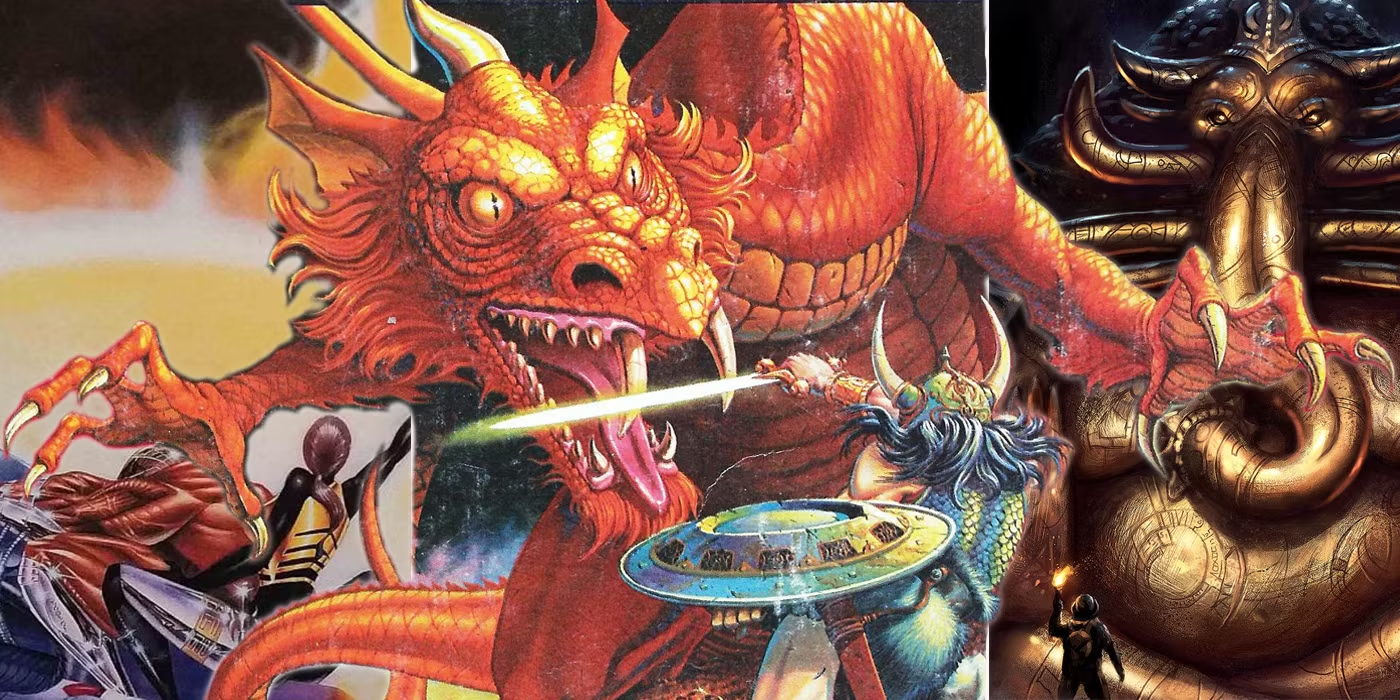
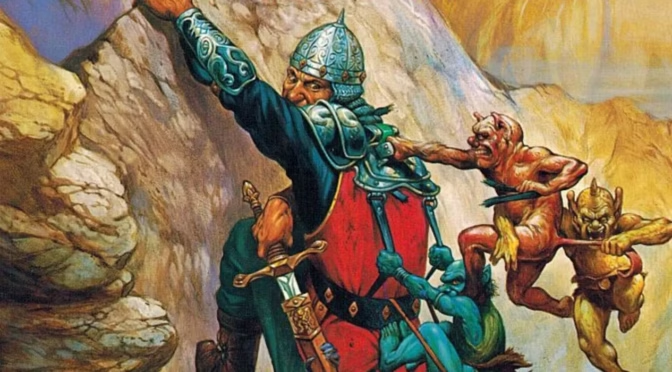
Over the past few months, I’ve been dropping not-so-subtle hints about my affection for Advanced Dungeons & Dragons 2nd Edition across this blog. But my Top 10 Versions of Dungeons & Dragons article back in February didn’t just hint, it basically proposed marriage; it was my number 1 pick.
While I don’t think this is a big reveal, I have in the past kind of avoided simply stating it outright because that tends to draw… attention.
As expected, a few loyal readers have (politely) raised an eyebrow and asked me to explain myself. Now, I don’t usually feel the need to justify my tastes, this isn’t a courtroom, and I’m not on trial for “liking THAC0 unironically.” But the questions seem to come from genuine curiosity rather than thinly veiled judgment… mostly.
So the question is simple: what is it about 2nd edition AD&D that clicks for me? Why, out of all the editions of Dungeons & Dragons, would I pick one that, aside from the occasionally misunderstood Dungeons & Dragons 4th Edition, is often labeled as one of the least popular?
Now, I’m not entirely convinced that’s true. In fact, I’d argue 2nd edition is one of the more popular versions of the game. Do I have hard data to support that claim? Absolutely not. But in the grand tradition of internet discourse, I’m comfortable asserting it confidently anyway, and besides, no one else seems to have the numbers to contradict that claim either.
I suspect this “unpopular” reputation comes from the timing. 2nd edition was around when TSR, the company behind D&D, was heading straight toward financial ruin. Naturally, people connect the dots and assume the game must have been the problem, and in fact, it’s often blamed for TSR’s demise.

But if you actually dig into the history of TSR’s downfall, you’ll find something surprising: it had very little to do with the game itself and everything to do with spectacularly questionable management decisions. We’re talking the kind of business strategy that makes you double-check if it was actually real or a parody. Entire books have been written on this subject as an illustration of what not to do as a corporation.
But I’m wandering off into history-lesson territory, and that’s not why we’re here.
I came to answer a question.
And answer it I shall.
The Origins Of Ethos In Dungeons and Dragons
I touched on the “ethos” of Dungeons & Dragons in my last article, specifically in relation to D&D’s latest incarnation, D&D 5.5, but I feel the need to circle back and give it the attention it truly deserves in the context of 2nd edition AD&D. Because if early editions invented the ethos of D&D, then Advanced Dungeons & Dragons 2nd Edition took that rough idea, wrote it into stone as commandments, and formed the official religion. Everything we consider to be THE ethos of D&D largely comes from 2nd edition AD&D, even in modern versions of the game.
A big part of that comes down to one thing: 2nd edition AD&D is absurdly verbose, and I mean that as the highest compliment.
Pick up just about any 2nd edition book, and you’ll quickly realize something important, especially compared to other versions of the game: this game was created by writers, not designers, people who gave far more importance to the narrative weight of the game rather than its mechanics.

And it shows, mechanically, 2nd edition sometimes leaves a lot to be desired, which might hint at why many D&D players frown at its presence or mention, and I get that. There are balance issues, odd design choices, and plenty of “did anyone actually playtest this?” moments scattered across spells, monsters, and adventures alike. It’s the kind of system where you occasionally squint at a rule and just decide, as a group, to emotionally move past it because there is just no way to justify its existence.
I do believe when the 2nd edition was being designed, it was forced to work under certain constraints, namely backwards compatibility with the 1st edition, so I do believe part of the design problem stems from that, but for the most part, as a design, 2nd edition AD&D is just kind of meh… but with moments of brilliance that in my opinion make it THE best version of the game. We will get to that in a minute.
But the writing is phenomenal, of that there is no question. D&D is a game about stories, and writing trumps rules in my humble opinion. It’s the creative center of D&D, it’s where lore and mechanics converge to create the ethos, and it’s why, in my humble opinion, 2nd edition AD&D becomes such a critical part of franchise history.
Between the pages, you can feel the beating heart of D&D lore coming alive in a way it never did before or since. Not hinted at. Not loosely suggested. Fully realized and fully committed to Sword and Sorcery in all of its glory.
Spells don’t just tell you what they do, they invite you to imagine what they could do. Monsters aren’t just stat blocks; they’re given histories, ecologies, and so much more than you could ever ask for. You don’t just learn what an orc is, you learn how it lives, what it fears, and probably what it argues about over dinner.
And the sheer volume of it all is astonishing. The “Complete” series, the endless player and DM option books, the sprawling settings, the amazing monster books, 2nd edition didn’t believe in giving you just enough. It believed in giving you everything, plus a few extra pages just in case you were getting comfortable.

These books were wildly creative. Deeply flavorful. Occasionally unhinged in the best possible way. There’s a richness to the writing that makes D&D feel distinct, lived-in, creating a deeply ingrained ethos in your soul. For me personally, 2nd edition AD&D defined what D&D is forever.
I, however, was not the only person who garnered such affection from the writing behind 2nd edition AD&D. This game inspired an entire generation of designers who created some of the most memorable D&D video games ever made, not to mention the volumes of books written with 2e as a backdrop. From the Baldur’s Gate series to the Neverwinter Nights games, from Planescape Torment to the Gold Box Era games. From the Forgotten Realms saga’s to the Dragonlance epics. Ask anyone what their favorite D&D PC or video D&D game adaptation is or their favorite D&D book, and I will show you how 2nd edition AD&D writing was the primary influence.
What 2nd edition really did was bring the core ideas and growing ethos of the game into sharp focus. Things that felt a bit blurry in earlier editions suddenly became established constructs of the game. The identity of D&D, its tone, its style, its voice, was no longer implied. It was spelled out for you, in loving, excessive detail.
Later editions leaned heavily into the idea that “D&D can be whatever you want it to be.” And to be fair, that’s a perfectly valid philosophy. The game has always relied on DMs and players to shape it into something personal, even in the 1e days, perhaps specifically in the 1e D&D days.
But 2nd edition took a different approach. It didn’t just hand you a toolbox, it handed you a fully furnished house and said, “You can redecorate if you want… but you really don’t have to.” More than that, it anticipated player desires and offered solutions to some of the deepest and often most convoluted questions. It was, in a word, excessively thorough.
In my view, that’s where 2nd edition truly defines the ethos of Dungeons & Dragons. It answers the question: What is D&D? in no uncertain terms. Where modern D&D would say “Here is what D&D could be, it’s up to you though, don’t take my word for it, I just want to make you happy, I don’t want to tell you what to do, in fact, never mind, do what you want, any D&D at your table is real D&D, we don’t actually have an opinion.” I don’t want to say that the alternative approach is wrong, it’s not, but if you want to play D&D within its core ethos, explicitly defined and gloriously written, 2nd edition AD&D is the only version of the game that comes even close to doing that. By comparison, everything else is intentionally vague at best.

2nd edition D&D was not just a set of rules, but a culture. A tone. A shared understanding. A very real “thing” that you can recognize instantly, and even people who weren’t fans of the edition would ultimately be influenced by its existence.
When you hear a 2nd edition AD&D player describe D&D, it will always be with confidence, arrogance even, but this stems from the simple fact that they didn’t invent it, it’s not some version in their head or homebrew, they read it, straight from the horse’s mouth in exceedingly, almost painful detail.
Mode Switching and Execution Complexity
Two of my biggest gripes with Dungeons & Dragons, both before and after Advanced Dungeons & Dragons 2nd Edition, are what I call mode switching and execution complexity. And yes, I realize those sound like terms stolen from a software engineering meeting, but stay with me.
Let’s define them before we wander too far into the dungeon.
Mode switching is that very obvious shift in playstyle when the game goes from “we are telling a story” to “everyone grab a miniature and roll initiative.” Combat happens a lot in D&D, but to me, a fight is still part of the story. It’s the climax, the tension release, the cinematic payoff. It shouldn’t feel like you’ve paused the movie to boot up an entirely different video game.
But that’s often exactly what happens in all versions of D&D after 2nd edition.
A fight breaks out, and suddenly the roleplay screeches to a halt. Outcome the miniatures, the grids, the measuring tools, and we transition, sometimes dramatically, into what is essentially a tactical combat mini-game with its own rules, pacing, and logic. It’s like switching from a novel to a board game mid-sentence.

Closely tied to this is the execution complexity is the moment combat begins, time compresses into 6–10 second chunks, movement becomes squares, and actions start to feel like selecting abilities from a hotbar. Attacks, spells, effects, they’re no longer described; they’re executed. Press the button, resolve outcome, next turn. The rules stuffed into these systems are complex and intertwined with exceptions and sub-sections. Even in a well-designed game its a coma-inducing experience with the pace of continental drift, hardly the stuff of cinematic combat.
Now, I get why this exists. There’s a certain appeal to tight, tactical combat systems. But for me? That level of depth and mechanical layering pulls me out of the story rather than deeper into it. It’s the antithesis of role-playing. I expect to do that when playing Warhammer 40k, but not D&D.
And this is where 2nd edition AD&D quietly does something brilliant mechanically. I can’t say if it was intentional or not; we don’t know that much about the design thinking behind 2nd editin AD&D, other than being a derivative of 1st edition AD&D, but it nails it just the same.
It sidesteps all of this, not by removing tactics, but by embedding them inside the narrative.
Combat in 2nd edition is fast, brutal, and dangerous, but it never stops being part of the story. It doesn’t switch modes. It just intensifies the cinematics; it asks for more adjectives, not less.
First, a combat round is about one minute long. That alone changes everything about the dynamics of battles in the game. Suddenly, there’s room for description, for dialogue, for actual acting. Your character isn’t just swinging a sword or executing power X, they’re circling, shouting, reacting, and making choices that feel like part of a living scene.
Second, and this is the real magic, all combat actions are declared before they are resolved, and before initiative is rolled. This is a crucial dynamic shift, it’s the key design decision that transforms 2nd edition AD&D combat from a tactical mini game to a strategic narrative game. It switches the game from a sport to an actual battle.
- The DM describes what the monsters and NPCs are doing.
- The players describe what their characters intend to do.
- THEN the initiative is rolled, and actions are resolved in that order with narrative adaptations made on the fly.
That sequence fundamentally changes how combat feels. Instead of reacting to a mechanical order of turns, players are asked a much more interesting question:
“Here’s what’s happening, what do you do over the next minute?”
It’s proactive, not reactive. Narrative first, mechanics second.

Even initiative itself, while technically a simple d10 roll, is influenced by real in-world factors, weapon speed, number of attacks, whether you’re using ranged weapons, what armor you’re wearing, and so on. It’s not just a number generator; it’s a loose simulation of physical reality, stuffed in one place, yet defined by the decisions players made in how they equipped themselves and their style/approach to combat. All of the realism and factors are bundled up into a single mechanism that gets out of the way of the narrative play right after it’s executed, but has a tremendous impact on how combat ultimately resolves.
There’s enough granularity to keep things tactically interesting, but not so much that it strangles the flow of the story. The system isn’t obsessed with rigid operational execution; it’s trying to interpret what’s happening in a believable way in a story about a battle, rather than being a mini-battle game.
Compare that to earlier editions, like Advanced Dungeons & Dragons 1st Edition, which aimed for something similar but got buried under mechanical weight and was overall focused on Dungeon survival as a core feature of the game. Or later editions, 3rd, Dungeons & Dragons 4th Edition, and 5th, which lean heavily into structured, tactical execution. Those systems work well if what you want is a combat-focused miniatures game, but they undeniably shift the experience into a different gear.

And just to be clear, I’m not saying that’s bad. Plenty of people love that style, and I don’t fault them for it, but to me, it’s actually always kind of a fresh hell. It trips up the narrative in incalculable ways and resolves stories in an almost silly mockery of reality, dirtying the waters of storytelling. I just don’t like tactical combat in my RPG’s, any RPG’s, least of all my beloved Dungeons and Dragons.
What I love about 2nd edition is how seamlessly it connects combat to the rest of the game. The act of saying “this is what I do” is the same whether you’re negotiating with a king or fighting for your life. The way it plays out, how the story shakes out, is pretty much the same. Some dice rolls to determine success and failure, and an attached collaborative narrative to those results.
That consistency matters to me a great deal. It’s really why I play RPG’s in the first place. I want it to be a movie in my head, not a game that I try to win at the table.
It also gives real meaning to choices that might otherwise feel purely mechanical. Weapon selection isn’t just about damage; it’s about speed and timing. Armor isn’t just protection; it affects how you move and act. Spells aren’t just “strong” or “weak”, they’re fast, slow, risky, or reliable.
It adds an extra dimension without adding unnecessary friction.
The result is a system that feels tactical within a narrative framework, rather than replacing the narrative with tactics. Combat becomes a vivid, flowing scene instead of a start-and-stop simulation.
And perhaps most importantly, it’s actually simple to run, it gives players and DM’s room to be creative, dynamic, to adapt as they go, and combat is described, rather than executed. The one main difference between 1st and 2nd edition AD&D is the rules weight associated with bringing these dynamics to the table.
There’s a rhythm to it. A cadence. Describe, declare, resolve. Repeat.
It just… works, and no wonder, as this is the core rhythm of role-playing in general. This is how most RPG’s work today, that tactical depth and mode switching is largely a product of modern D&D, not really of modern RPG’s. Modern RPG’s function actually function as 2nd edition AD&D, which oddly makes 2nd edition AD&D the most modern version, from a design perspective, ever made.
Storywriting and DM Inspiration
I’ve already sung the praises of the writing in Advanced Dungeons & Dragons 2nd Edition, but there’s an important side effect worth calling out: what it actually does to the people sitting at the table, especially the DM.
Because inspiration isn’t just a “nice to have” in Dungeons & Dragons, it’s the fuel the entire game runs on.
For DMs in particular, inspiration is everything. Your first duty isn’t to the rules, or balance, or whether that goblin encounter is “appropriately tuned.” Your first duty is to the story and to the world the player characters inhabit. You’re building something that needs to feel alive, believable, and flexible enough that players can meaningfully interact with it (and, inevitably, derail it).
And here’s the thing, when you’re given rich, detailed, and thoughtfully written material to work with, that job becomes less of a burden and more of a joy.
2nd edition AD&D is, quite frankly, a goldmine for inspiration.
You can crack open the Player’s Handbook, the Dungeon Master’s Guide, the Options books, or, perhaps most dangerously, the Monster Manual, and within minutes you’re spiraling into ideas. Not “oh, that’s neat” ideas, but full-on campaign arc ideas.
I’m not exaggerating when I say you can open the Monster Manual to a random page and accidentally invent a three-month campaign before you’ve finished your coffee.
The level of detail is sometimes overwhelming, sure, but it’s purposeful. There’s intent behind the words, a sense that someone really sat down and thought, “How do I make this creature feel like it actually exists and make it a worthy addition to a narrative game?” And that effort shows. We haven’t seen such dedication in D&D books in a long time. Modern D&D books, have fallen out of this habit.
It feeds the creative monster in your brain. Constantly.
With 2nd edition, I never feel like I’m running out of ideas; I feel like I’m trying to keep up with them.
And honestly, I can’t say that about most other editions of D&D.
You could make a case for 3rd edition; it had its moments, no question, but when I look at later editions, like Dungeons & Dragons 4th Edition and 5th, I personally find them… lacking in this department. Not bad, necessarily, just flat.. vague. The writing feels cleaner, more structured, more “accessible”… and somehow far less inspiring. It’s like the difference between reading a rulebook and reading a story.
Everything works. Everything is clear.
But nothing grabs you by the imagination and refuses to let go.
Now, to be fair, Advanced Dungeons & Dragons 1st Edition had flashes of brilliance. I have often spoken about the mystic nature of that game. Especially buried deep within its Dungeon Master’s Guide. There are sections in that book that are still among the most inspiring things ever written for a DM.
But they’re exceptions, not the rule, and AD&D 1st edition, I think, is a very difficult game to run unless you ignore most of the rules.
Overall, 1st edition often feels more concerned with telling you how to run a game, how to manage players, enforce rules, and maintain control. Useful, yes. Inspiring? Less so. It can feel a bit like being handed a manual for operating heavy machinery when all you wanted was to tell a story.
2nd edition strikes a different balance. I think at the time it was written, there was a general understanding that role-playing was more than Dungeon Crawls and rules management.
It gives you structure, but not shackles. Guidance, but not micromanagement. And layered on top of that is this constant stream of evocative, flavorful writing that makes you want to create.
It doesn’t just support storytelling. It encourages it.
And that’s not something you can easily design into a system… but somehow, 2nd edition AD&D pulled it off.
The Perfect Game For Me
If I were to describe my ideal version of Dungeons & Dragons in abstract terms, it would come down to four core ideas: Sword and Sorcery, narrative combat, fantasy realism, and a wide but grounded range of character customization, though each comes with some caveats. That probably sounds straightforward, but, as with most things in D&D, the devil is in the details.
Sword and Sorcery
When it comes to general preferences as to the type of fantasy I want, Sword and Sorcery is the clear winner. I want more Baldur’s Gate grittiness than Final Fantasy power fantasy. I want a sword to be a dangerous weapon, a monster to be a legitimate threat, and I want the life of an adventurer to be hard.
I want rarity to matter, spells to be special, and magic weapons to have character. I want the world and the rules to support each other, rather than support the wacky ideas of an anything-goes fantasy. I want being a Dwarf to mean something, not just a “shorter human”.
Sword and Sorcery is based on classic fantasy, and while I can appreciate modern high and power fantasy from a distance, I find it excruciatingly boring. Most of all however, I don’t want to run or play in a game that favors the players; I want the zero to hero story, I want the game to have stakes and not through a veil of pretend stakes where everything is engineered to give you the illusion of danger, but is balanced for your level, but real, objectively, and observable stakes.

In a game of Sword and Sorcery, when a fight breaks out, I want the players to feel their characters are in imminent danger and the decisions they make over the next few minutes to be life or death.
Narrative Combat
I’ve already talked about this at length, but it really is the cornerstone for me, so it’s worth revisiting in this context. Combat needs to feel gritty, dangerous, and just a little bit terrifying. Not in an over-the-top, grimdark noir sense, but in a way that makes players stop and think before they draw steel. In my ideal game, combat is not the default activity; it’s a consequence with potentially terrible risk. It’s something that happens when plans fail, negotiations break down, or risks are taken too far, and at best, a part of a well-laid plan. It should never feel routine; players should always fear that this time, their character might die.
That danger feeds directly into the narrative and tension of the sort of fantasy I want to create at the table. When combat is lethal, every decision carries weight. That wizard with a single Sleep spell suddenly isn’t underpowered; he’s the reason the party survives the encounter. Victory stops being an expectation and becomes something earned, something the players feel at the table. That sense of “we barely made it” is, to me, one of the purest expressions of what D&D is supposed to be narratively.
At the same time, I don’t want combat to bog the game down. This is where things get a bit paradoxical. I want it to be fast and simple to execute, but still rich with meaningful choices. Not so simple that it becomes a repetitive dice exercise, but not so complex that players have to pause the scene to decode their character sheet. The decisions should come naturally from the situation, from the character, from the story, not from scanning a list of abilities for the “correct” option. This is all about syncing the activities in the game as a matter of practical execution with the narrative of the story.
Class and equipment play a huge role in this. A fighter shouldn’t just deal more damage; they should feel different in how they approach a fight. The same goes for equipment; what you carry should reflect how you fight, not just how much damage you can output. A lightly armored duelist and a heavily armored warrior shouldn’t just have different numbers; they should create different moments at the table.
More importantly, I don’t care about balance. An Amazon with no armor and a spear should be weaker than a knight in full plate mail. I don’t believe in the equalization of power. Your character choices should not be driven by trying to be good at combat, but by the narrative you want to bring to the table. I don’t care if the game is fair; I don’t need it to be.
Spellcasters, in particular, should stand apart. Their identity shouldn’t come from raw power alone, but from preparation, timing, and intent. The spells they choose shape how they interact with the world, and that should be visible in play. Two wizards with different spell selections should feel like entirely different characters, not just variations of the same template. I don’t need 30 Wizard sub-classes to create distinct “wizard types”, a magic-user is a magic-user, just like a fighter is a fighter. What makes them distinct is how they use those powers.
When all of this comes together, with lethal stakes, fast resolution, and meaningful choices, combat naturally becomes narrative. Players stop thinking in terms of mechanics and start thinking in terms of actions, risks, and consequences. The fight becomes a story in motion rather than a separate game layered on top of it, more importantly, what comes before the fight has an elevated level of importance.
Fantasy Realism
The second pillar is what I think of as fantasy realism, though it’s less about realism in the traditional sense and more about internal logic. The world doesn’t have to mirror reality, but it does need to make sense on its own terms. What happens mechanically should reflect the perceptions of the characters and make sense to the players.
This is where the idea of associated versus dissociated mechanics comes into play. A mechanic is associated when it makes sense within the world, when it represents something the character is actually doing. The character and player can lean on the reality of the world and know that the mechanics work to reflect it. A dissociated mechanic, on the other hand, exists purely for gameplay purposes, disconnected from the logic of the setting and player character realities.
A simple example would be something like tripping an opponent. In a grounded fantasy world, that’s just something anyone can attempt. It’s part of physical interaction. But if it becomes a limited-use “ability” tied to an abstract resource, it stops feeling like an action and starts feeling like a button you press. The moment that happens, the player’s focus shifts away from the situation and toward the mechanics.
That shift might seem small, but it has a ripple effect. Once players begin thinking in terms of “what can I activate” instead of “what would I do,” the connection to the world weakens. The game starts to feel less like a lived-in reality and more like a system to be navigated.

This isn’t about rejecting mechanics or demanding strict realism. Fantasy, by definition, isn’t realistic. Magic exists, monsters roam the world, and none of it needs to align with real-world physics. What matters is consistency. The world needs to have its own logic, and the mechanics should support that logic rather than constantly breaking it.
When that consistency is maintained, players naturally engage with the game in a narrative way. They act within the framework of the world because the world makes sense to them. When it isn’t, they fall back on the rules as written, and the experience becomes more mechanical than immersive.
For me, maintaining that sense of fantasy realism is critical. It’s what keeps the game grounded, even when everything happening in it is entirely fantastical.
Character Customization
The final piece of the puzzle is character customization, and while most editions of D&D handle this reasonably well, I still have a couple of preferences that shape what I consider ideal.
First, I want customization to stay grounded in a gritty, low-fantasy tone. I’m not looking for an endless stream of increasingly exotic options that need to be retrofitted into settings. I prefer something closer to the original feel of settings like the Forgotten Realms, where the world has a clear identity and the available character options fit naturally within it.
When I say I want a wide range of choices, I don’t mean anything goes. I mean a variety of options that feel like they belong to the same world, drawing inspiration from classic fantasy rather than constantly expanding into something more abstract or exaggerated. There’s a tone to it, a kind of grounded fantasy aesthetic that I find much more compelling.
The second aspect is that I want character options to emphasize narrative identity over mechanical power. A small bonus or a unique ability is fine, but the real value should come from how those choices shape the character as a person, not how effective they are in combat.
This ties back to the idea of starting from zero. No matter how interesting the concept is, I want characters to begin as relatively ordinary individuals and grow into something greater through play. The journey matters more than the starting point. If a character feels fully formed and mechanically complete at level one, something is lost.
What I’m looking for is that moment where a player understands who their character is, not because of a build they optimized, but because of the choices they’ve made and the experiences they’ve had in the game.
Bringing It Together
When I look at these four ideas together, they describe more than just a set of preferences. They describe a particular feel, a way the game unfolds at the table.
For me, Advanced Dungeons & Dragons 2nd Edition captures that feel better than any other edition. Not because it’s perfect, but because it aligns with these principles at a fundamental level. It doesn’t need to be bent or reshaped to fit this style of play. It already lives there.
And that, more than anything else, is why it remains my personal gold standard.
Problem Mechanics
Now, before anyone accuses me of wearing rose-tinted glasses the size of dinner plates, let me be very clear: I am fully aware that Advanced Dungeons & Dragons 2nd Edition comes with its fair share of… let’s call them quirks. Some of them are dated, some of them are clunky, and a few of them make modern game designers visibly uncomfortable.
I get it. I really do, I’m not making a sales pitch for THAC0 here.
Whenever 2nd edition comes up in conversation, the same usual suspects tend to be dragged into the spotlight like they’re on trial for crimes against game design. So let’s address them properly.
Class and Race Limitations
The Player’s Handbook outlines various restrictions, race/class combinations, ability score requirements, and so on. These are often presented as a major sticking point, but for me, the solution is almost laughably simple: I ignore them, always have, and I’m yet to sit at a table in all my years of gaming where things like this were enforced. In fact, in the 80’s it was unanimously agreed that this sort of thing was generally stupid; it was the OSR that brought them back. Actual old school gamers didn’t really do this, or at the very least, it was understood that it wasn’t important in most cases. It was used when it was relevant to the game and ignored when it wasn’t.
Unless I’m running a very specific setting where those limitations serve a narrative purpose, they don’t really add anything meaningful. They’re not essential to the mechanics, and they certainly aren’t critical to the storytelling. More than anything, they feel like artifacts of a different design philosophy, one that hasn’t aged particularly well nor was particularly well thought out to begin with.
If someone wants to play a paladin with a strength of 8, go for it. You’ll just be… a very underwhelming paladin. And honestly, that sounds like a character concept with legs.
To me, these “restrictions” read less like hard rules and more like suggestions from another era, perfectly safe to ignore without the system collapsing into chaos.
Rolling for Ability Scores
This one tends to divide people, but I’ve always been a fan of rolling ability scores. There’s something inherently fun about not knowing exactly what you’re going to get. It adds a bit of unpredictability to character creation, a sense that you’re discovering the character rather than engineering them.
And importantly, starting with less-than-perfect stats isn’t a problem in 2nd edition, it’s a feature. Characters grow over time, both mechanically and narratively. Beginning with average or even mediocre abilities gives the game texture. It creates room for development.
Not every hero needs to be born exceptional. Some of them can earn it the hard way. In my experience, the most forgettable characters are always optimized characters.
THAC0 and Descending Armor Class
Ah yes, the infamous THAC0. The mechanic that launched a thousand internet arguments.
Here’s my honest take: I’ve never actually used it in any variant of D&D.
The very first DM in the very first game I ever played with flipped the math, turned everything into ascending values, and we just… kept doing that. Problem solved. No confusion, no headaches, no existential crisis over subtraction.
If your THAC0 is 18, congratulations, you have a +2 to hit. If your armor class is 7, that’s AC 14. Done.

This is one of those debates that has always puzzled me. People act like THAC0 is some insurmountable barrier to entry or defend it like it’s a meaningfully different construct, when in reality it’s just a different way of expressing the same numbers. If you don’t like it, change it. The system doesn’t break. The dice don’t revolt. Everyone survives.
It’s a non-issue masquerading as a major flaw, literally the most inconsequential mechanic in all of D&D, yet it has prevailed as the most common debate. It’s absolutely bizarre to me.
Thief Skills and Non-Weapon Proficiencies
This is where I start to get a bit more opinionated.
I really struggle with how skills have evolved in later editions of Dungeons & Dragons. Earlier systems, even into 3rd edition, kept things somewhat grounded. But by the time you get to Dungeons & Dragons 4th Edition and 5th, skills often feel less like character traits and more like mechanical levers you pull to bypass situations.
And that’s where it breaks for me.
At its core, a “skill” is supposed to represent something your character is good at. It’s part of who they are. But in practice, it often becomes a gamble, “I invested in this, now let’s see if the dice agree that I’m actually competent today.”
That disconnect is hard to ignore, and it’s also what has led to the dice odds slowly over time favoring the player more and more, arriving in a way back to where the whole concept started. A representation of what you can do, rather than what you can sometimes do if you’re lucky with the dice.
Take knowledge, for example. If your character has spent years studying the arcane, why are we rolling dice to see if they remember something about magic? Either they know it, or they don’t. That’s a judgment call based on their background, training, and abilities, not a coin flip.
The same goes for physical capability. If you’re strong enough to lift something, you lift it. If you’re not, you don’t. Rolling dice doesn’t suddenly make you stronger, it just adds randomness where it doesn’t really belong.
Now, there are exceptions. High-stress situations, sneaking past a guard, spotting a hidden trap, those make sense as rolls. Pressure introduces uncertainty. That’s where dice shine but it is also a great place to put a class with specialized abilities for that purpose, aka, The Thief!
And this is why I’ve always preferred the way 2nd edition handles it.
Thief skills, in particular, are a great example. They’re specialized, class-based abilities that reinforce identity. If you’re playing a thief, you own that space. You’re the one finding traps, picking locks, and moving silently. That’s your role, it’s a specialization, and no one should be as good at it as you, and this makes sense within the logic of a fantasy world.
And roles matter.
When someone chooses to play a fighter, they expect to be the best warrior in the group. A wizard should feel like the master of magic. A thief should be the undisputed expert in stealth and subterfuge. When skill systems flatten those distinctions, something important is lost.
Non-weapon proficiencies, on the other hand, strike a nice balance. They represent additional talents and areas of knowledge, things that define your character beyond combat, without turning every interaction into a dice roll. They’re more like declarations of capability than lottery tickets.
And that’s really the core of it for me.
Your character’s abilities should be something you can rely on. They’re part of your identity, not a gamble. The dice come into play when circumstances are uncertain, when stress, danger, or chaos make success less predictable.
An archer doesn’t miss during practice. But in the middle of a life-or-death battle? That’s a different story.
Stress changes things. That’s where randomness belongs.
Outside of that, I want the game to trust the character, and by extension, the player, to simply be good at what they chose to be good at.
Conclusion
To be frank, I could probably keep talking about Advanced Dungeons & Dragons 2nd Edition all day. There is so much about this version of the game that resonates with me that I could easily write an entire series of articles. In fact, the biggest challenge with this piece has not been finding things to say, but figuring out where to stop.
At the end of the day though, I think the simplest explanation for why I love this game is also the most honest one.
I love how it feels.
I love the rhythm of it, the atmosphere of it, and the way the mechanics and writing align with my personal vision of what Dungeons & Dragons should be. The game feels dangerous without being oppressive, imaginative without becoming absurd, and narrative without abandoning mechanics entirely. It occupies this strange middle ground that no other edition has quite managed to capture for me.
Now, the point of this article is not to convince you that 2nd edition AD&D is the definitive version of D&D. I think far too much energy online is spent trying to persuade strangers that their preferences are somehow objectively wrong. Preference is preference. We all come to this hobby looking for different things, and that is perfectly fine.
What I wanted to do here was explain why this particular edition speaks to me the way it does.

If this article has sparked your curiosity, though, I would offer a couple of pieces of advice before diving into 2nd edition AD&D.
First, focus on the writing and the experience at the table rather than the myths that have grown around the game over the years. A lot of people judge 2nd edition purely by reading isolated mechanics on paper or the perceptions of keyboard warriors with a cause, and I honestly think that gives a very misleading impression of how the game actually plays. This is a fantasy writer’s version of D&D, designed for fans of reading fantasy books. That is the game’s secret.
The experience of playing it is very different from the way the rules read in isolation. There is a narrative rhythm to the game that only really reveals itself after some time with it. The flow of play, the pacing of scenes, the structure of combat, the emphasis on storytelling and atmosphere, all of it comes together into something that feels genuinely distinct from every other version of D&D, even from Advanced Dungeons & Dragons 1st Edition, despite how much DNA they share.
Second, and perhaps more importantly, explore the settings and expanded material. Read the Complete books. Read the setting guides. Read the monster entries in full instead of just scanning stat blocks. The more you explore, the more you begin to understand what I mean when I talk about the game’s connection to sword and sorcery fantasy and narrative storytelling.
These books are unapologetically verbose. They want you to sit down and immerse yourself in the world. They want you to imagine things. Sometimes they feel less like rulebooks and more like someone desperately trying to infect you with enthusiasm.
I will also say something about modern D&D that might come across as a bit controversial, though I genuinely mean it fairly, and it’s directed at Wizards of the Coast more than the fans.
Modern editions of D&D have actually done a pretty good job of achieving their design goals. Personally, I find them too high-powered and too tactically focused for my tastes, but that does not mean they failed. Quite the opposite. If your goal is to create a more mechanically balanced, tactical, character-driven fantasy combat game, then modern D&D absolutely succeeds at that.
It would be unfair to criticize the designers for accomplishing exactly what they intended to accomplish. Besides, for me, lowering the power levels, adapting the game to be less tactical and more story-focused, these are things within my power to adjust. Modern systems are flexible enough to achieve this. There are even 3rd party source books that help achieve just that.
Where I think modern D&D struggles, however, is the writing.
And here I will admit my bias and disappointment openly.
Personally, I find the writing in the latest material, particularly 5.5 core books, to be painfully sanitized and overly simplistic. It often feels less interested in sparking imagination and more concerned with flattening every edge and sanding away every rough corner. There is very little mystery to it, very little atmosphere, and almost none of the rich, excessive enthusiasm that defined older editions, especially compared to 2nd edition AD&D. It has no style or reckognizable theme of its own; it is, in a word, bland and generic, in the worst and unappealing way. From a writing perspective, it’s a complete catastrophe.
Older D&D books felt like they were written by eccentric fantasy nerds who desperately wanted to pull you into their worlds.
The latest core books coming out of Wizards of the Coast feel like they were reviewed by a corporate committee whose primary concern was making sure nobody anywhere might misunderstand a sentence.
That sounds harsh, I know, but it is genuinely how I feel when comparing the two.
That said, I have not completely given up hope. I’m glutten for punishment, and foolishly, I am actually quite excited about the upcoming Forgotten Realms books. I would love nothing more than to be pleasantly surprised. In many ways, this feels like my first and final real attempt to reconnect with modern D&D on its own terms.
Because at the end of the day, I do not want to dislike modern D&D.
I want to fall in love with it again. I want to be part of it, I want to look forward to new books and be excited about using them, and I want to be inspired by them.
I can always fall back on my beloved 2nd edition AD&D, but I’m always hoping for a better future.