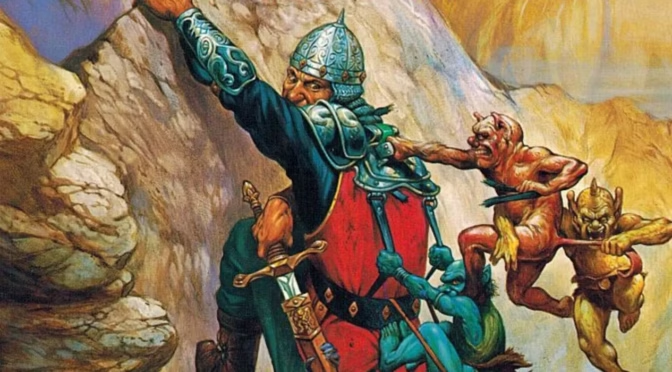
Hidden Gems: Warcrow Adventures

Miniature gaming, role-playing games, and board games are becoming more and more difficult to neatly categorize these days as we see more and more cross-over hybrids. Warcrow Adventures, the latest take on the adventure game genre from Corvus Belli has been my gaming group’s latest obsession, and for good reason as this hybrid adventure game has a lot to offer.

Warcrow Adventures is based on the new miniature war game of the same name (Warcrow), using the same setting background and actual miniatures for the miniature game. An app-assisted story-driven dungeon crawler, players take on the roles of adventures using the classic Dungeons and Dragons formula in which they follow along a branching storyline, make decisions, fight monsters, find treasure, and level up!

Corvus Belli, has an outstanding reputation for producing fantastic miniatures and Warcrow is no exception. Dynamic poses, highly detailed, and a good chunky size all contribute to the wonderful quality of these mini’s.

This game borrows from quite a few different gaming genres, but the attraction is the D&D DNA-inspired treadmill. It boasts a lot of very streamlined mechanics that are deceptively simple yet impactful. Every choice you make in the game, every task you complete, and every interaction you have unveils part of a unique story while creating hurdles for you to jump through in a pretty challenging risk vs. reward structure.

I will be doing a full review of Warcrow Adventures once my group completes the adventure, but beware that this is very much a legacy-style adventure game that will take many sessions to complete.

App-assisted games are becoming more and more common and the production values of these apps are improving with each new generation. Warcrow Adventures app delivers fantastic voice-overs, a simpler interface, and a very organized structure that makes it easy to use at the table.

Already now however I can tell you that if you are a fan of adventure games, if you love Dungeons and Dragons, this is an outstanding platform for bringing that classic dungeon crawl feeling to the table.

The hybrid nature of the game, being part miniature game also offers the opportunity for everyone to do some hobby painting. Know that these are not “board game pieces”, these are actual, fully detailed miniatures, and well worth your time to paint. In fact, every miniature in Warcrow Adventures is getting a full profile and will be used in the Warcrow miniatures war game so if you are already collecting and playing Warcrow the miniature game, the adventure game has the side benefit of giving you new units for that game as well.

The Warcrow miniature game on which Warcrow Adventures is based has also indoctrinated itself into my gaming club largely based on the already well-established reputation of our beloved Infinity (the other Corvus Belli miniature game we play). We just can’t help it, one look at these amazing miniatures and you know you just need to own some!

My group immediately got to work painting these mini’s and not only has it built up the excitement to play Warcrow Adventures, but it’s got us all buzzing about Warcrow the miniature game as well the setting itself. If there was ever a setting that deserved to be an RPG, this is it!

In either case, whether you do or don’t get into the miniature game, Warcrow Adventures as a stand-alone product is already proving to be a great time, Corvus Belli has done a fantastic job building an atmosphere with its amazing setting and building a story I think any role-player would enjoy sinking their teeth into.

I’m no master miniature painter, but great minis inspire great paint jobs and I have to say, I’m pretty proud of this one!

Look for a full review shortly, but for now, if you are on the fence about Warcrow Adventures, I can tell you here and now, it’s a fantastic package!

Miniature Game Theory: Picking The Right Game For You

It happened by accident—at least, that’s what I tell myself—but the truth is, I own a lot of miniature games. I’ve painted and played so many that it’s a little scary! I don’t even want to think about how much time and money I’ve sunk into this hobby, especially not around my wife! In today’s article, I’ll take all that hard-earned experience and try to put it to good use by offering some advice on finding the perfect miniature game for you, with a few recommendations sprinkled in.

Let’s dive right in!

The Three Categories Of Miniature Gaming

Most miniature games can be sorted into three broad categories—though many games blur the lines between them. These categories are: hobby-focused games (sometimes called lore-heavy games), mechanics-focused games (often competitive in nature), and narratively focused games (driven by storytelling and immersion).

Now, every game publisher will tell you their game does everything, and technically, they’re not wrong—but the reality is, most games lean heavily into one category more than the others, often to an extreme. Knowing what kind of game you’re getting into and understanding how the community that plays that game sees it is a big part of the key to picking the right game for yourself.

Categorization is key because all miniature games are marketed in a visually exciting way because they ARE visually exciting. If you pick a game like Star Wars: Shatterpoint, you likely have certain expectations and imagery about what the experience might be like (player expectations), but Shatterpoint is a highly mechanized game designed for competitive play, about playing King of the Hill on generic objectives. It’s closer to being a board game than being a miniature game, falling heavily into the Mechanic-Focused category.

Let’s break down these categories for clarity.

Hobby-focused games

Hobby-focused games are all about the experience—stunning miniatures, immersive lore, and endless collection opportunities. Here, the gameplay often takes a backseat to the joy of building, painting, and diving deep into the game’s rich world.

These games are usually supported by expansive novels, army books, special terrain, and a constant stream of new releases. They demand a serious investment—not just in time, but in cold hard cash. Hobby-focused games are easily the most expensive, often costing two to four times more than other types.

A prime example? Warhammer 40k by Games Workshop. To even get started, you’ll need at least a 1,000-point army (2,000 points being standard), translating to anywhere from 50 to 100 models. Before you can even think about playing, you’re looking at hundreds—if not thousands—of dollars spent on miniatures, terrain, rulebooks, and accessories.

While most miniature games can be classified as a hobby to some degree as you will often be assembling and painting miniatures, there is a distinct difference between miniature games being a hobby and a game being hobby-focused. Warhammer: Underworld for example aims to get you playing the game right away with easy-to-assemble miniatures that have colored plastic with a game that is played on a hex board with all the accessories (cards, tokens etc..) included in the box. You can play a full game like Underworld a few hours after you open the box, it is not a hobby-focused game even though you will get the opportunity to paint some miniatures and experience the miniature gaming hobby element inherent in all miniature games.

When all is said and done, you’ll likely spend over $500 and 100+ hours before experiencing the full game of Warhammer 40k as it is intended to be played. No ad will tell you this, and hardcore fans might argue otherwise, but trust me—after 35+ years in the hobby, I’ve yet to meet anyone who’s done it for less.

Warhammer 40k is a hobby-focused game, you will spend just shy of 100 dollars to get into the starter set and after assembling and painting these miniatures you will discover that what you have purchased is not even close to the full game. You are still hundreds of dollars and hours away from experiencing Warhammer 40k from this point. In fact, the starter set doesn’t even teach you the real game, it gives you a sort of “sub-game” of the real thing. Warhammer 40k assumes a lot about what you will spend in terms of dollars and hours preparing to play a full game.

The trick is that this is exactly what Hobby-Focused games are designed to be and it’s what fans of such games want. If it was easy and fast, it would not have the same appeal. To hobby-focused gamers, this long road is seen as an opportunity, not a drawback.

But here’s the thing—fans of hobby games love this level of commitment. The journey of collecting and painting is the whole point. You’re never done, and that’s exactly the appeal. To fans of these hobby-focused games, the journey is the juice.

Mechanics-Focused Games

If hobby games are about immersion, mechanics-focused games are about playing—and playing now. These games prioritize tight, balanced rules over deep lore or hobby elements, often designed for competitive tournament play.

Many of these games require little to no hobby work at all. most come with pre-painted miniatures, easy-to-assemble miniatures and/or low model counts, making them much more accessible for casual or competitive players.

Examples? Star Wars: X-Wing and Star Wars: Armada, with streamlined mechanics and pre-painted minis that let you jump straight into the action. Even hybrid games like Star Wars: Shatterpoint leans into this category, focusing on accessible, tactical gameplay with minimal prep.

Most mechanic-focused games are going to try very hard to make the hobby parts of miniature gaming as painless as possible, even going so far as offering pre-constructed, pre-painted miniatures. The goal of a mechanic-focused game is not only to get you playing right away but more specifically to get you competing right away. Star Wars: X-Wing is a prime example of a game that took this to the furthest extreme. You need roughly 3-6 models, everything is pre-painted and assembled, and essentially you are ready to sign up for tournaments after the unboxing.

Side Note: Star Wars X-Wing has been discontinued by the publisher, but don’t fret, miniature games never truly die and X-Wing is no exception. Communities keep these games alive and there were so many products produced for X-Wing that there are more miniatures available for purchase today than there ever was when the game was still being published.

Mechanics-focused games often feel closer to board games than traditional miniature games, with precise, clearly defined rules that leave no room for “eyeballing it.” These games are generally much cheaper to get to the table while getting the intended full gaming experience.

Narratively Focused Games

Narratively focused games sit on the opposite end of the spectrum from mechanics-driven ones. These games aim to capture a feeling—bringing iconic franchises, historical moments, or unique settings to life in a cinematic way.

Balance and precision take a back seat to storytelling and thematic immersion. Instead of symmetrical matchups, expect scenario-driven play that tries to replicate key moments—whether they’re historical battles or epic fantasy showdowns.

Bolt Action is a fantastic example of a narratively driven game that hybrids a bit into the hobby-focused element. The point of Bolt Action is to create (or use) scenarios that depict historical battles, but the game is not about simulation or exacting rules, it’s about creating the atmosphere of a great action-war movie. It’s about the sensation at the table, the atmosphere of the setting, and quick execution. The extra effort to put together a nicely painted army and building nice terrain is to quench that creative appetite, though I would still argue it leans far more into the narratively driven games rather than the hobby-focused games.

Two great examples of Narrative-focused games are The Middle-Earth Strategy Battle Game and Bolt Action. MESBG tries to replicate the lord of the Rings movies, while Bolt Action tries to replicate a movie version of historical World War II battles. In both cases, the games exaggerate the cinematic fantasy to bring the feel and style of their chosen setting to the table.

Understanding Your Interest In Miniature Games

Now that we’ve established a way to categorize games, the next step is figuring out how to use this information to guide your decision and ultimately select the right game for you.

You might already have a gut feeling based on the categories we’ve outlined, leaning more towards one over the others. Preferences are often instinctive and valid, but it’s important to remember that while most games lean toward a particular focus, they usually incorporate elements from all three categories. Even games with a clear identity—like Warhammer 40k being hobby-focused—venture into narrative and mechanics to some extent.

Choosing the right game is about balancing your interests with realistic expectations. To help narrow down your options, consider these three key factors:

Time & Money?

It’s easy to be drawn to what excites you most, but miniature games require a significant investment of both time and money.

Games generally fall into three price categories:

  • Cheap: Around $60-$100, comparable to the cost of a typical board game.
  • Standard: Ranging from $150-$250 for a full experience.
  • Expensive (a.k.a. “Go F* Yourself”)**: $500+ for the complete experience.
The BattleTech Alpha Strike box set is an outstanding value for a game, coming in on the “cheap” category, this box set costs about 90 dollars US and quite literally comes with more than what you need to play a full game. You can buy this box set, never buy any more stuff for Battletech, and play the game forever. This kind of value is rare in the miniature market, but if you love giant robot battles, you can’t do better than this.

Price is not the only consideration however, Battletech can take upwards of 6+ hours to play a single game, so you have to ask yourself that question too. Will you ever have time to play a 6+ hour game?

It’s worth noting that you can spend more or less on any game. For example, you could grab an intro set for Warhammer 40k at $50, but that won’t give you the full experience Games Workshop intends. On the flip side, a core set for Battletech at $90 can offer a well-rounded experience, though diving deeper could cost thousands.

Time commitment follows a similar pattern. You might grab an X-Wing starter set and be playing within minutes, while something like Warhammer Old World could demand 60+ hours of assembly and painting before your first match.

Infinity is a fantastic example of a game that respects your wallet and your time but still offers a very robust gaming experience with extreme collection and expansion opportunities. They do this through masterful design, ensuring that the game is every bit as exciting and fun on a smaller scale with simplified rules as it is with large scale and nearly bottomless rules expansion. A small game from a basic starter kit can cost less than 50 bucks to get into and offer a game session as short as 45 minutes, to larger scale and elaborate battles with deep rules that can cost hundreds of dollars to collect and create play times exceeding 5+ hours.

Some gamers (this one included) love games that have varying scales like this, it makes collection (acquisition) easier and you get to play as you collect, build, and expand. In my eyes, Infinity is one of the best miniature games out there, especially when it comes to respecting your time and money!

Many games market “quick start” options, but the reality is that each game has a clear overhead. Take the time to research what’s truly required to enjoy the full experience and compare it with your available resources.

Miniature Games are a group activity

No matter what game you choose, remember that miniature games are fundamentally social. While they can be enjoyed as a solo hobby (through collecting and painting), the core experience revolves around playing with others. Most games require at least two players, but the best experiences often come from being part of an active community.

Don’t have any friends to play miniature games with but you still want to get into it? Don’t worry, Warcrow Adventures has your back! Ok, I’m going to say this up front, games like Warcrow Adventures (just like any game) are always more fun when you have friends to share them with. But if you want to get into miniature games and you are living in isolation or simply don’t have anyone around to play with, Warcrow Adventures offers a fantastic game that can be played completely solo. It offers fantastic miniatures for you to paint and enjoy the hobby part of miniature gaming with expansion opportunity and because the game’s miniatures are directly connected to Warcrow the miniatures game, you could potentially in the future expand your collection to that game as well.

That said, I still think the best option is to find some friends to play games with, community is just a huge part of this hobby and often it almost doesn’t matter what miniature game you play, as long as you have people to play it with.

Before diving in, make sure your chosen game has a local presence. There’s nothing worse than investing time and money into a game you never get to play because no one else in your area is into it. Online communities can help bridge gaps, but nothing beats in-person matches and events. After all, if you’re going to invest time and money into building an army for a game, playing some digitized version of it is going to be very anticlimactic, don’t expect that sort of thing to fill any voids.

Competative or Casual

Some games are designed with competition in mind, while others lean into a more relaxed, narrative-driven approach. While this often aligns with a game’s core category, community culture can shift things in unexpected ways.

Take Warhammer 40k, for example—designed as a hobby-focused game, yet many local communities treat it as a highly competitive experience. Conversely, Star Wars: X-Wing, built for competition, has embraced the mantra “Fly Casual,” encouraging players to focus on enjoying the thematic experience rather than strict competitive play despite its clear design goals.

These community-driven shifts can be confusing for new players, so it’s crucial to research how a game is actually played in your area rather than relying solely on its marketing or official design.

The concept of the current state of the game as seen through the eyes of the community should be an important consideration when selecting your game. Marketing is one thing, game state is an altogether different thing. Take Warmachine for example. A few years back I would have recommended this game without hesitation, it was once, a fantastic game. Today I wouldn’t wish it on my worst enemy. Privateer Press has done a very poor job taking care of this game and it’s in terrible shape right now, unlikely to survive going forward. It’s a real mess!

It’s also worth noting that any game has a “current state” defined by the opinions of the community which defines the mood of the community. This is an important pulse to have your finger on, because the rules and governance of a game by it’s publisher can have a tremendous amount of impact on the game and the gaming community. It’s important to know that being negative gets more clicks, so look for positive feedback on any game you’re considering, but beware that every game has a “this game sucks” anti-fan club on social media.

The Miniature Games – Overviews!

I have already offered a bit of insight on a few games in the article, but I will do a few more here just to give you some ideas and inspiration for your own research, that said, here comes the golden advice.

DO YOUR OWN RESEARCH!
This is so critical to the process, before you whip out that credit card you should know everything there is to know about a game. Don’t go into miniature games likely, even the most basic game is going to demand a lot more from you than a typical board game, so miniature games should never be an impulse buy!

Star Wars Legion

It’s truly a rare gamer that I run into that doesn’t love Star Wars on some level and it’s natural for gamers to gravitate towards familiar franchises. As such, Star Wars Legion always comes up in conversations about miniature games because it is, in a nutshell, Star Wars on a grand scale.

In Star Wars Legion you are going to have mass battles on large battlefields with Jedi’s, AT-AT walkers and the countless troops each with their own personality from the Star Wars universe. Visually, it’s every kid’s dream to play Star Wars on this scale.

That said you have to be weary here. This hybrid game, has a heavy hobby element requirement, it’s quite expensive to get a full game on the table and the game state right now is a bit confusing.

It’s a great game, but be sure to check on the status of this game thoroughly and do some calculations. Once it’s all said and done you will spend a solid 300-400 dollars to get a complete army with many hours of hobby time to pull it all together. It requires a commitment!

Marvel Crisis Protocal

Like Star Wars Legion, the Marvel Universe has been popularized in recent years by the never-ending influx of Marvel movies, so gravitating towards a miniature game with all of your favorite superheroes is perfectly natural.

What you have to know about Marvel Crisis Protocol is that it’s a very structured mechanic-focused game with a very stern competitive style and objective-oriented game. This is not a narrative-focused game at all, it plays more like a board game than a miniature game. The scenarios in the game are just “adjective” driven excuses for what amounts to a game about holding objectives (positions) on the board.

It’s a fun and fantastic game, but be sure you match your expectations with the actual gameplay.

Wings of Glory

Speaking of managing expectations, let’s talk about Wings of Glory. As an avid historical war gamer, I love a good heavy war simulation, so one look at Wings of Glory and it is easy to get excited.

The important thing to know about Wings of Glory is that it’s not a simulation at all, in fact, this is the UNO of miniature games, one that can be taught to children. It does not take itself seriously, there is no hobby element (everything is pre-painted) and it’s not designed for narrative-focused play.

This is a very simple dog-fighting game, with board game-like mechanics. It’s light, fast and super fun, but this is not the historical simulator you might hope it would be.

Ok that’s it for today guys, I hope you found the article useful, good luck out there!

Highlights and Let Downs of 2024

When I put 2024 down on digital paper, I feel like I live in the future. It’s hard to believe it’s 2024 and even harder to believe the year is almost over.

I would make the argument that it’s been a great year for gaming but frankly, my gaming life has been full of ups and downs this year, and tons of really surprising results. While there has been some great gaming this year, had you shown me this highlight reel at the start of the year, I would not have believed it.

There is a lot of games to talk about so sit back and enjoy, it’s going to be a serious wall of text today!

Hegemony: Lead Your Class To Victory

It’s a tough learning curve, but unquestionably one of the most unique games I have played in a long time.

This was among my favorite discoveries in 2024, even though it was technically released in 2023. It’s a robust and very crunchy Euro with a lot of psychology built into it and a fair amount of cut-throat competition. It’s not something I would recommend for everyone, but for groups like mine who love to argue and play “take that” games, it’s right up our alley. The interesting part about this game is how all of these asymmetrical mechanics come together. Testing this game must have been a real hell because there is so much interaction, and so many game states possible, it’s kind of crazy.

This one came out for the first time at our big board gaming weekend in the summer, and it was a smash hit with everyone, we talked about it endlessly afterward and everyone agreed it needed to be played repeatedly! That was the first and last time we played this game.

This is not a reflection on the quality of the game but more of a reflection of its length and its harsh learning curve. It took us a solid 7 hours for our first game. Like Through The Ages which I will talk about a little later, it’s just a long, complex game and it’s a bit of a pain in the ass to teach. It also has one of those rule sets where every single micro rule and the order it’s executed in, is a gaming-breakingly important thing, meaning, play one tiny rule wrong and the entire face of the game changes. So playing the EXACT rules to the letter in this hyper-crunchy game is critical to a fair gaming experience, but because of its complexity, it’s easy to get them wrong. This creates this unusual quandary where you need to put together a dedicated, crack-squad willing to invest in learning the game on their own so that everyone at the table is efficient and knows how everything works. Without that, you end up with a 3-hour game that takes 7 hours to play.

It’s a great game but man, it’s tough to build up the will to play it.

Part engine builder, part thought experiment, Hegemony is an exceptionally unique game design that I think if you and your gaming group are hardcore, veteran board gamers that love that Euro crunch, this is a must-own. Easily a candidate for the best game I played all year. That said, it’s not very approachable and I think most tables will find that it’s a bit too much.

Warhammer 40k got a 10th edition

Way back in the 6th edition days, I was a huge Warhammer 40k player. We played a lot, I had two armies (Tyranids and Necrons) and I did the entire hobby thing from A to Z. I honestly never in a million years would have guessed that in 2024 we would be going back to it, I thought I was done with 40k forever. It’s return to our gaming groups consciousness is one of the wildest events of the year.

The game fell out of favor in my group over a decade ago, replaced by modern miniature games that focused on stronger gameplay and in many cases like Star Wars X-Wing and Star Wars Armada, cut the entire hobby part out of the game with pre-constructed and pre-painted miniatures. This became the norm in my group and even when we did buy into more hobby-centric games, we usually played those with unpainted miniatures like Songs of Ice and Fire for example or they were isolated to small parts of our group as the case was with Bolt Action for example. In either case, the choice of miniature game was always heavily influenced by gameplay quality over “hobby focus”.

Warhammer 40k and the entire hobby part of the miniature gaming hobby made a big comeback when the 10th edition dropped last year. In 2024, shockingly, there was a lot of both, gaming and hobby in the 40k universe in my group. I rebuilt my Tyranid army and several members of our group who had never experienced 40k bought into the game for the first time. It became a thing.

I’m pretty proud of my Tyranids, this towering giant took over 20 hours to complete. When people say Warhammer 40k is a hobby, this is no joke and it’s good to keep in mind that it’s a pretty expensive hobby at that.

What I can say about Warhammer 40k is that it’s still a pretty shitty game from a mechanics perspective. Especially compared to modern-designed miniature games that focus on strong gameplay. I think anyone who plays 40k knows that the mechanics of the game are there to facilitate the hobby part of the game and playing it is just something fun you do when you and your friends get together to show off your miniatures. As a game, it leaves a lot to desire.

Warhammer 40k is almost a role-playing sort of experience. You work on your army, read the manuals and codexes, do your list building, and absorb other content like the animated series and the novels. It’s sort of a story-driven, hobby where the game is just a thing you “participate” in to complete the circle. If you’re looking for a good competitive miniature game, pretty much anything else is better, but so far as the hobby goes, GW makes the miniatures; no question about it.

It’s a lot of fun but in more ways than one, 40k is more of a robust activity than a game and I think as long as you can accept that and not get frustrated by the crazy imbalances and mechanical weirdness, it really is a fun activity.

I will say however that 10th edition is probably the best version of the game mechanically in all the years I have played 40k. Still not good by any stretch of the imagination but a vast improvement over previous editions and GamesWorkshop has gone to great lengths to try to keep the game as balanced as they can. A+ for effort even if the final grade, is a C- and I’m being very generous here.

If you’re thinking about Warhammer 40k, I think it’s important to know that you do not get into 40k for the game. You get into it for the fantasy storytelling, the art, the books, the animated series and most importantly the hobby of building and painting miniatures. That is what 40k is first and foremost and it does a fantastic job of it. The game is an afterthought. It’s fun too, don’t get me wrong, but it’s not what I would call “mechanically good” fun, more like we get to play with the toys we made kind of fun.

Empire Of The Sun

Empire of the Sun is a grid-based, card-driven historical war game that covers the entire Pacific War. A more complete game has never existed.

I play Empire of the Sun as a matter of habit every year, not to suggest I don’t enjoy it, I do, in fact, it’s an addiction that must be fed but this year, it exploded. I played a ton of games, probably more this year alone than the previous 4-5 years combined thanks to a fantastic online community.

I do not generally recommend Empire Of The Sun to most people. This is a highly complex historical war game with an extreme level of simulation and deep strategic interactions. It is not for the faint of heart and all I can say is that as a gamer you should know if a historical chit-game is for you or not. This is a very specific, very niche style of game that is or is not in your wheelhouse.

That said, I can’t think of a game on my yearly playlist that I look forward to more than Empire of the Sun. Each year when it comes out, I know I’m about to experience a masterpiece, and this game never disappointments. I typically play it with online opponents as it can be very difficult to play this one in a single sitting with a live opponent. In fact, even online, a typical game of Empire of the Sun can take the better part of a month to finish even if you do live sessions of 3-4 hours at a time on a weekly basis. It is a 12+ hour game for most partners and can take considerably more than that if you suffer from analysis paralysis, which is something this game infects you with if you don’t already suffer from the condition.

Mark Herman is one of my favorite game designers because he makes games that he loves to play and it shows in his designs. A true master of his craft, but like all masters, it takes some soul searching to understand the how and why of his designs. There is a personal connection you build with his games that will have you digging far beyond just the mechanics and design of the game, you will find yourself watching Pacific War documentaries, reading history books and imagining what the world must have been for people in the Pacific War. This is not just a game, it’s an exercise for the brain and it’s good for you!

If that doesn’t appeal to you, avoid this one, it’s for the historical buffs and no one else.

Through The Ages: A New Story of Civilization

Through The Ages has been near the top of my all-time favorite games for a long time, but I’m very careful and picky about who I pull it out with. Pick the wrong people and you are looking at a 6-12 hour game that will suck the soul right out of your body.

This long-time favorite and staple of my collection usually collects a lot of dust because it’s just a very long and robust game, that can be dreadfully slow when playing with new or inexperienced gamers.

Fortunately this year I managed to get it to the table a couple of times with some veterans and not only was it a pleasant experience, but with some great competition it was lightning fast which proves two things. First, it doesn’t have to be a long game, this game can be played in under 3 hours with experienced players who know what they’re doing and two, it’s still one of the most competitive games on my shelf, with brutally tight end games.

I will warn you that this game normally takes 3-4 people the better part of 6 to 8 hours to play and can take upwards of 12+ hours to complete. Yeah, I’m not joking here, so be prepared for some long games when learning this one. People who suffer from analysis paralysis will be in hell and drag this game out endlessly, if that sounds like you, this is one to avoid. You need to be thinking ahead and making key decisions so that you’re your turn is nice and fast, executed with precision, that is the only way to get this game’s excessive length down.

I will say that so far as Civilization builders go, meaning games that give you that Sid Meier Civ feel, this is one of the best around.

For those out there looking for a similar gaming experience but want a larger group and shorter game, Nations is a pretty decent substitute and fits the same niche playstyle. It’s a great game in its own right, but some argue it’s a very “ugly” looking game.

This is a classic civilization builder, its tight competitive nature, unique dynamic card-driven gameplay, and diverse interactions make this one of the best of its kind. There is a reason this game has been at the top of BBG lists for decades! But yeah, you need to find the right people to play with, this is not a “let’s just play with anyone” kind of game, not unless you’re ready to spend an entire day playing it.


Sekigahara: The Unification of Japan

Stratego was one of the earliest gaming experiences I had as a kid and this game definitely reminds me of those days.

I was very late to the party with this 2011 release, but Sekigahara is a well-established war game in the community, sitting pretty in the number 6 spot among war games on BBG and 207 overall. That is pretty impressive for a dry block-based historical war game based on medieval Japanese warfare. I bought into this one and managed to get it to the table a few times this year and color me impressed.

There is a solid and obvious reason for this popularity. This is an extraordinary game combining tactical and strategic dudes on a map war game that is card-driven. The core feature of the game is the hidden unit concept built into blocks that make up game units similar to classic games like Stratego which gives this game a great “feel” at the table. I think the bulk of the games fun factor has to be this idea of setting up your units and board positions, with a strategic plan based on the minimal information you have about enemy positions and strengths.

It’s a very clean, yet tense competitive war game that is easy to understand but difficult to master. I’m not at all surprised about its status among war gamers but I do think that even at 207 on the overall list which is quite high for a historical war game, this one is grossly underrated. This is one of the most unique titles I have seen in quite a while, I can’t believe I’m only just now discovering it. This is one of those games you can introduce to anyone, there is nothing complicated about it at all. It’s a kind of chess-like atmosphere with a fun theme.

Very highly recommended for pretty much anyone interested in competitive two-player war games.

Underwater Cities

Very streamlined game with a fantastic theme, dynamic mechanics, and that easy to learn – impossible to master core that elevates it above the competition.

I’m a big fan of Terraforming Mars, I play it a lot and there are a few games that I can point to and say “If you like Terraforming Mars, you should try…..”. Well, Underwater Cities is that game.

It’s not exactly a duplication or replication of the mechanics, but it scratches a similar itch with its dynamic engine-building – card-driven gameplay. Also, like Terraforming Mars, you can’t just play this game once and feel satisfied, you will find yourself obsessing about how to play it more efficiently, how to make each card play more effectively and above all else trying to find that “killer” strategy in a game that is far too dynamic to ever definitely resolve.

This is not a puzzle that can be solved as is the case with so many Euro-style games, the sand is constantly shifting under your feet and you have to adapt and overcome using a unique approach in each game, with a surprising amount of game states. It’s what I love about Terraforming Mars and it’s what I love about Underwater Cities.

Fantastic game that looks amazing on the table, it’s easy to teach but impossible to master. It’s what Euro gamers crave, a fresh take on a familiar engine building formula. If you haven’t tried it yet, this 2018 release should be at the top of your list.

Everdell

This cute game about animals living in the forest has some teeth. Lots of potential!

I only played it once for the first time this year and still, it made a very strong impression on me. This rather simple resource management, worker placement and card management game is exceedingly thinky. There are clear strategies driven by a wide range of dynamics in the game that create a great sense of competitiveness while being very straightforward from a mechanics perspective. Very tight scoring and a bit of a race between engine building and scoring. The entire game runs like a well-oiled machine, clearly the result of thorough playtesting. I see a lot of potential for replayability here, but at this stage, given that I have only played it once, that is hard to say.

What I can say is that despite a single play, this is on my “stuff to keep an eye on” as I see a lot of potential in this one. The accolades and popularity of this game are warranted.

Eclipse: The Second Dawn For The Galaxy

It’s a hit-or-miss experience, for such an expensive game I would not recommend it over far better games like Twilight Imperium. It’s not a bad game, it’s just not good enough for the price tag

This is a game I keep going back and forth on and I think a big part of the reason for it is that the gaming experience itself can be hit or miss from session to session. Sometimes it plays like a tight, 4x strategy game with battles, technology and lots of sneaky and tricky moves (exactly what you hope for). All the stuff you hope to get out of a 4x civ builder. Other times it’s just this horrifically boring and predictable Euro where essentially nothing interesting happens and someone wins by default in about the most anticlimatic way a board game can end.

I hold to it to account for its supposed claim that it’s “a better” or “lighter” Twilight Imperium, it’s not, it’s not even in the same league. In the infamous words of Will Smith, “Keep my Twilight Imperium’s name out of your mouth!”, a Twilight Imperium anything, this game is not.

That said I do love the aesthetic and the game is well-designed even if the experience can land flat. I would argue it’s way too expensive to recommend just to see for yourself if you can live with this unpredictable result, in fact, I would go further and say, don’t buy this game if you’re looking for a 4x experience because it does a poor job of it. This is more for Euro gamers who want a space theme and even there, be ready for some disappointing end games.

Imperial Struggle

Easily one of the best games in my collection, I just wish it hit the table more often!

I managed to squeeze in only three games of Imperial Struggle this year to my sad disappointment and frankly, I just wish someone made a digital version of this game already like they did for Twilight Struggle because I so desperately want to make this a nightly thing for me. I love this game but it’s kind of a pain to get to the table. This might end up being the game that I decided to digitalize myself just for my own purposes, but I’m just not sure my programming skills are up to the challenge. This game has a lot of moving parts.

It’s a fairly robust game in terms of complexity and strategic thinking and while the well is super deep, it’s sometimes a bit anti-climatic as the game can and often feels like it ends prematurely. Now I know that this is because of skill level differences, this is one of those games like Dune (Rex) where quite literally what you do in round 1 might end the game right then and there. Normally with some experience that is never going to happen but, yeah, this game has some very subtle nuances that can create exciting, long and tight games, or just these horrific early crushing defeats.

It ranks as one of my favorite games of all time, I think it is a worthy contender for the lifestyle game list but I just feel like I don’t play it often enough to be certain of that.

If you like Twilight Struggle, it doesn’t necessarily mean you are going to love this game even if these two games have a lot in common and are from the same creator. Twilight Struggle is more of a card game while Imperial Struggle is more of an action economy game. They are both from the influence area control genre, but not quite the same experience.

That said I still hold that Imperial Struggle is the better game… there I said it.

Great Western Trail

This is my modern-day Monopoly, I’m happy to play it anytime and with anyone. It’s just a fun, laid-back time, win or lose it’s always entertaining.

Great Western Trail continues to hit my “must play it” list periodically and I think I ended up playing it 5 or 6 times in person and a whole bunch more on BoardGameArena (online). In fact, I have 113 lifetime plays so far in this game and honestly, I’m not even remotely done with it yet. I crave it with regularity.

Why? Well, I think the biggest boon of this game is that it’s just a very clever mechanic and it’s kind of unique compared to most Euros. The unique engine building and heavier interaction between players, make this a Euro you don’t feel like you’re playing solo. It just works and it’s fun. Sometimes a good game is difficult to explain but I put this game in the same sort of ranking world as I would put Monopoly. To me, this is a family game. Sure it’s a bit more complex and has a few moving parts, but it has those types of rules that you just kind of remember after a few plays and they stick with you.

I have not gotten a chance yet to try some of the new versions of the game, there are two in total now, Argentina and New Zealand. They look interesting and are on my 2025 list of stuff to play.

Raiders Of The North Sea

Very fast worker placement game, great for a quickie, yet it has that robust, satisfying worker placement Euro feel. Great art too, I love looking at this game.

My daughter likes this one a lot, not to say I don’t but because of her we ended up playing it many-many times this year and it sort of became a thing.

As a whole, this game is a pretty straightforward worker placement game and one of the simpler ones from the Shem Philips line of games which includes stuff like Paladins of the West Kingdom, Viscounts of the West Kingdom, Architects of the West Kingdom and a bunch more. Good games all, I have tried most of them at this point but I still find Raiders of the North Sea, the first of the series I ever tried to be the most approachable and fun.

It’s a kind of combination of resource management, worker placement, and quasi-race. The race part is mostly because it is a pretty fast game that ends a lot quicker than you think. My daughter and I go like 30-45 minutes tops, so whatever your strategy is, there isn’t time to refocus or adapt, you have to ride it out and see what happens.

Most games are quite tight, generally, you’re going win this one by a hair unless you drop the ball so it’s always fun. Every move counts.

Great game, like Great Western Trail, it is a simple family game, very streamlined, and easy to understand the strategies behind it.

Star Wars Unlimited

One of the best CCG’s to come out in a very long time. Not quite a replacement for Star Wars Destiny in my opinion, but I’m kind of biased, I loved that dice mechanic. Still, so far as CCG’s go, this one is so tight, so clever, I’m not at all surprised at its success so far.

There is no question that Star Wars Unlimited stole the show this year. It’s been one of the biggest rises and most played games of the year in my group. I have so far collected all three expansions for the game and I don’t see any slowdown in my group. We love this one.

I would say it’s probably the first collectible card game since Lord of the Rings the Living Card game that I have felt comfortable just buying into it Blind. Star Wars Destiny turned out to be a big disappointment, more on that in a minute. Legend of the Five Rings was discontinued and Game Of Thrones the card game just never took off in my group. This is the first in a long time I think has some hope for becoming a Magic: The Gathering-type game where it becomes a filler for all occasions and a lifestyle choice in our group.

Very well balanced so far, with clever dueling mechanics and they are very wisely making each expansion a kind of mechanically isolated thing so that there is a kind of deck reset every time one comes out. This is great for our group as we all love deck building and it’s nice to have to sort of “re-think” strategy each time a new expansion comes out. It revitalizes the game each time a new expansion comes out and get’s us excited about getting together to play.

Love it so far, really hoping this one sticks the landing long term.

Now I want to say a thing or two about Star Wars Destiny, Star Wars Unlimited ugly stepbrother. I recently made a Top 10 Collectable Card game list where Star Wars Destiny landed in the number 5 spot, but its position on this list is mainly because the game is discontinued and because it was a CCG and it should not have been. Star Wars Destiny should have been using the Living Card Game format FFG is kind of famous for and had they done that, I think it would be Destiny not Unlimited we are talking about today. I personally think that Destiny is a much better game, but it was so poorly managed that it sort of self-destructed. It was a real bummer. Thank god that Unlimited came along and filled this gap.

Other Worthy Mentions

The above is a very inconclusive list, I played a lot more than what is here, but this article is about highlights and I think that covers the bulk of the standouts for me. There were several other games I will quickly mention here for posterity that received table time this year.

Terraforming Mars is always on my agenda each year, we played it several times this year and it continues to be the masterpiece from 2016 that just keeps on giving. It’s as good as it always has been and the expansions for this one do improve the game in so many ways, really refreshing the entire experience. I put this one on my lifestyle games list, it’s a staple of my gaming life these days and it’s one of my default recommendations to all board game fans.

War Room got played as it always does on my birthday (and hopefully always will). Love this one, but it’s 12+ hour monster that I find once a year is plenty. I never recommend it, it’s a niche game, but from my perspective, it’s one of the best games ever made. So a bit of a quandary. Let’s just say you have to be a “type” to appreciate a game like this. I suggest checking out my full review on this one.

Lord of the Rings the living card game naturally hit the table repeatedly as it always does for me each year, another lifestyle game I play regularly, mostly solo. I put this one into kind of a niche category as well because I find it’s sort of an all-or-nothing game. Either you collect everything and go full-on crazy, or skip it entirely. The same way I feel about most collectible card games. For a Lord of the Rings fan however, this is one of the best games ever made. I wrote a revised article in 2023 that surprisingly has become one of the most visited articles on the blog.

Lord of the Rings The Living Card game is 10 years old, but if the hits on this site are any indication it’s currently more popular than it has ever been in the past. This may be the result of 2nd edition being released in 2023.

Things on the agenda for 2025

2025 is looking very exciting already, there is a lineup on my shelf of games that are going to get played come hell or high water, and a few I still need to pick up (or am waiting to show up).

Dolmen Wood

I kick-started this old-school adventure RPG based on 1st edition B/X (Old School Essentials) rules. I’m a big fan of the designer Gavin Norman, he does a lot of great writing and design that speaks to me in a rather unique way.

Dolmen Wood is essentially a self-contained RPG and campaign, based largely on fairy tale lore and old myths. As a kick-starter I already have the game in PDF form in my possession and the books will arrive later this year.

If you love Dungeons and Dragons from the 80, this is a nostalgic trip down memory lane, except that it’s designed to be extremely approachable, and episodic all wrapped up in a fleshed-out open world. It’s easily among the best RPG content I have ever read and I’m eagerly anticipating its arrival.

Arcs

Arcs is a 2024 release designed by Cole Wehrle who is quickly becoming one of the big stand-outs in the board gaming world. He is responsible for instant classics like Root, John Company, Oath and Pax Pamir.

He has a unique eye for Asymmetrical game design which is definitely in my wheelhouse, but more than that, I think he knows how to bring a theme to life.

This one combines trick-taking and the 4x genre, which I will admit is a strange combo, but it’s another thing that I love about Wehrle designs. They are always a bit off, but always in a good way. I’m hoping it is going to live up to the hype but given the reputation of this designer, I go into it with confidence.

The Middle-Earth Strategy Battle Game

The Battle of Osgiliath is a really cool set that comes with lots of mini’s and terrain. While there are some more modern miniatures here for certain hero characters, most of the sculpts are really old and kind of crappy. They are not the GW quality you are probably used to if you are a modern miniature game fan.

I talked about this one briefly in a recent Hidden Gems article, but my hope is that this year, MESBG becomes something that I can expand on and sink my teeth into.

The claim to fame for MESBG is that it’s one the best rule sets GW has ever put out. I don’t know if that is really true or not, and honestly I don’t really care that much. It does seem to be the most common mantra among miniature-gaming fans which is great and all but as a Lord of the Rings fan, I just want to paint and play with some Middle Earth mini’s.

My issue with this game is that I came into it too late and right now as I paint up some of the miniatures of this game based on the Osgiliath box set, while I’m excited to get it to the table, I’m not really that impressed with the quality of the mini’s. This is an age thing, some of these sculpts are the better part of 10+ years old, but this is why now is a great time to get excited about this game.

In 2025 we can expect GW to be putting out new sculpts for this game and the obvious hope is that they go back and “refresh” the lines most key armies. I’m hoping we get new sculpts for the entire Fellowship and other key heroes/villains and I really hope we see new Orcs, Goblins, Rohan and Gondor troops. A lot of these old sculpts are really crappy by today’s standard and while I’m really excited, I don’t want to paint shitty miniatures. So here is hoping GW throttles up and gives us some new mini’s!

Hidden Gems: The Middle-Earth Strategy Battle Game

In the world of miniature games, there is but one king of the throne and that is Warhammer 40k, but what if I told you that even among the fiercest 40k fans, almost unanimously, most people will agree that The Middle-Earth Strategy Battle Game is widely considered to be the best game GamesWorkshop makes.

Originally released in 2001, this miniature game based on the Lord of the Rings and Hobbit movies has been the oddly-kept secret at GamesWorkshop for over two decades, and while its following pales in comparison to some of GW’s larger franchises, the cult status of this game supported by dedicated fans has kept it afloat for years. Over two editions the game has thrived and recently GW has announced and started pushing the game with an updated 3rd edition.

Unlike many of GW’s games, however, The Middle-Earth Strategy Battle Game was made right the first time, and over the editions, very little has actually changed. The game has been streamlined sure, but the rules have remained largely the same for going on a decade now and the new editions is mostly just a repackaging of the same game. Minor tweaks so small if you already have the 2nd edition rules there is hardly any reason to upgrade.

Now the exciting part isn’t the new edition, GW is famous for its grandiose books, that is certain, but it’s the miniatures you want!

The books as you would expect from GW are absolutely over the top. Illustrated from front to back, carefully edited and printed using the most excessive methods available. The books are pure joy to read.

On the heels of this new edition, there is a new starter box set coming out as well as a general refurbishing of the entire line which is likely going to go on for a couple of years at least. The quality of the miniatures is outstanding from the images already released and we know from the various announcements that there is going to be a regular stream of new stuff to buy. Get your credit cards paid off people, this shit ain’t gonna be cheap!

The quality of miniatures coming out of GW is unmatched in the miniature market, they not only make the best miniatures, by they do so by a margin so wide, there is nothing that comes even close by comparison. They quite literally have no competition in this area and no one even tries to compete with them anymore. Painting GW miniatures is pure joy, they make you feel like a pro.

Now there are some very important things to note about this game before you consider diving into it, because this game is…. different.

There are three things that really make Middle Earth Strategy Battle Game unique, and it’s really important for fans of miniature games, especially those accustomed to the standard objective-based, list-building style games looking for a good balanced gaming experience to know them.

First is the fact that this game, while it offers a sort of list-building match-play mode, it’s very clear from the design that this is a game designed largely to support narrative play. The concept of narrative play drives your approach to collecting miniatures.

This isn’t a game where you “pick a faction” and then buy units to support your preference or “list”. What you do is pick a scenario or a group of scenarios, typically either scenes directly from the movies, or presumed battles that took place in the middle-earth history (off-camera) and then collect the miniatures you need to create that scenario. The goal is to effectively play the scenarios and collect the mini’s you need for that.

As such a typical player in this game might not say “I have a Mordor army”, they are more likely to list the scenarios their army is built for.

The second thing to note is that this is a “cinematic miniature game”, which is to say the goal of the game is to tell a story of a battle, by playing it out, but more than that, the mechanics are designed to reflect the action you see in the movies. Characters for example are extremely powerful and have unique abilities that let them take on entire hordes of enemies. The detail of the mechanics are designed to cover actions like hopping over a chasm and fighting on a ladder, there are rules for siege engines and running sieges, and special rules for magic even though there are only a small handful of characters that can perform such a thing. There are special timing rules for dueling and more importantly, the action is focused on individual models, so there are no weird grouping rules for movement or attack actions.

In the end the game plays out more like a tactical battle out of a role-playing game like Dungeons and Dragons with a wide range of special actions and unique effects. All of these rules are carefully crafted to bring that cinematic feel of the movies to the table top and the game really nails that concept but this really comes at the sacrifice of balance and you really feel that if you try to convert your army to work with match play and list building. This concept of match play was tact on to the game after the fans insisted it be added, but the game originally had no such thing.

Which brings me to the third thing. This game is crunchy as fuck! As the goal is for the game to be this cinematic, scenario-focused game, there are a lot of special rules and unique elements designed into this game to bring the right feel. This comes with some rules weight, the game can get quite fiddly and while there are scenarios of all shapes and sizes, there is no sort of standard play length or game. A scenario might be small with just 5-10 miniatures that lasts for 20 minutes or it can be a massive siege that can take several days to finish.

Suffice it to say, the scope here can be quite grand and yet the rules drill down to bring this scope to your table using a lot of minutia.

Is the game any good? Well, this is where answering the question gets kind of tricky. I would say, first and foremost, that you must be a die-hard Lord of the Rings fan, this might seem obvious but unlike a lot of miniature games, much of the game is not going to make much sense or even feel balanced unless you understand the context of the movies and its many characters. The story is really crammed into the mechanics.

The second thing is that you have to make your peace with the scenario style of play and collection. I see a lot of disappointment coming from the quasi-competitive scene. Match play and open play are fine concepts here, but the entire balance of the game is super iffy and there are clear winners and losers in the list-building department. This hasn’t been and likely isn’t ever going to be addressed because as already mentioned, its crystal clear that the primary way this game is meant to be played is scenario-based.

The current available product line for this game is huge and there are tons of scenarios that depict every scene and much more from the movies. There is so much to potentially collect, so many different experiences to have here that you could easily spend in excess of 10,000 dollars and thousands of hours and come up short of experiencing everything. It’s a bottomless pit and this is a good thing!

Finally, I would argue that this is the single most expensive game to collect in existence, even more expensive than 40k because there is no such thing as a 2,000 point army and done. It’s kind of a never-ending thing as you expand to include more and more scenarios your army can do and you are often collecting multiple factions. This includes tremendous efforts to paint as you are often working with a lot of models.

All that said, personally I tend to agree with the consensus, this game is without question the best thing GW makes. It’s addictive, something you can really obsess about and because it’s scenario based, the concept of balance and fairness really aren’t a thing in this game. Scenarios are built to depict the scenes and cinematics of the movies and this is where the games loyalty lays. It’s not for everyone but if re-creating the battles of the movies sounds good to you, no game does it better.

Gamers Dungeon 10 Year Anniversary

As of September of 2024, GamersDungeon.net turns 10 years old and I felt like, that in itself deserves an article at the very least. After all, running a blog for a decade while making me feel old, also makes me feel mature and professional. I know I’m absolutely not, in fact, I’m a fumbling idiot for the most part but still, hitting the 10 year mark feels great.

I thought the way I would celebrate is by going through the posting history to talk about some of my favorite articles as well as those I hate. Sort of a flashback, a look at GamersDungeon.net over the last decade.

The first article I ever wrote for this blog was about D&D, in a way this blog was founded on talking about D&D and I have done so quite continually throughout the blogs life. This article was triggered by the big event at the time, the release of 5th edition Dungeons and Dragons and as I was excited by having a new edition in my hot little hand, I was very generous with my words.

Since this article I have written quite a few articles about 5th edition Dungeons and Dragons, either being mentioned as part of a larger theory article or directly addressing the edition itself. Over the years I have gone back and forth about my feelings about 5th edition but sitting here now with the 2024 edition released, I can say these definitive words about 5th edition Dungeons and Dragons.

It’s ok. I still prefer the classic playstyles of 1st edition D&D, the Dungeon Crawl, The Dungeon Survival, that deadly game where players aren’t heroes because they have powers, they are heroes because of the risks they take for the greater good against all odds.

Still, I do enjoy 5th edition D&D. It’s an easy game to the table and looking at this article, though I was a bit generous, I still believe 10 years later that the general assessment remains true. 5th edition is as close as the franchise has gotten over the years to returning to the original, classic formula of 1st edition. It’s a bit high powered and has plenty of exceptions, but all and all, it’s a fine game.

My first Top 10 of all time list was published in 2015 and I have to say, looking at it today, I still think most of these games are great, but it does feel a bit strange to see some of these titles today. There are some exceptions like Star Wars X-Wing and Twilight Imperium, both of which I consider top notch games still today.

Star Wars X-Wing in the number one spot feels great, I still love this game, I still have my collection and believe it or not it still comes out on occasion. It’s a fast moving fun dice chucker and while it’s no longer on my list today, I proudly stand by this one.

Twilight Imperium is still on my top 20 list today (no. 7 spot) and this game has remained on the list the entire decade. I love Twilight Imperium and true love lasts forever!

The rest of the list gets a bit shaky. Fury of Dracula in the no. 4 spot is the eye sore here, I’m not sure what I was thinking but I probably haven’t played this game since 2015. Formula D also feels a bit odd. I do like it but its a very niche game, quite random and way too long for what is effectively a kind of push your luck dice chucker. Dominion is the really painful one, I culled that one from my collection many moons ago and just the thought of playing it gives me the shivers.

This however is exactly why I update my best of list each year, these lists don’t age well.

In September of 2015 I created my rating system that I would use from this point forward when receiving games and I have to say, even today, I still think its one of the best and most fair way to review games.

I think it’s actually the most brilliant thing I have ever done on this site to be honest, I love this system and I actually wish it was more standardized. I really dislike the arbitrary way in which boardgames are reviewed. It’s like, I give it a 7 out of 10… how? why? My rating system really quantifies things and gives categories of judgement weight based on the intended design so that way a game intended to be a short, fun dice chucker doesn’t get judged the same way a big, complex strategy game would. These are different games that require a different review approach and I really think my rating system captures that.

I’m very proud of it.

The What Makes It tick was an article series that I never really fully explored. I did some decent work here but what I discovered is that these sort of articles aged really poorly, especially when applied to a constantly evolving game like miniature games.

I didn’t write very many as a result, but I do think they were pretty good for the 5 minutes they were actually valid.

I have done a lot of reviews over the years and most of them I stand by, but there are a few that I cringe when I read them, the most famous of these blunders was my review of 7 Wonders Duel.

Man I feel like a fool for this one. I crapped all over this game and I was wrong about all of it. 7 Wonders Duel is a fantastic game, I still play it today nearly 10 years later quite regularly with my daughter, its actually one of my favorite games that I play with her and I’m pretty sure its one of her favorite board games of all time.

If there is a review I would love to re-write its this one.

Every year my friends and I disappear for 4 days to a place called Hassela, where we lock ourselves in a house in the country and do absolutely nothing but play boardgames all day, eat good food, drink good drink and be merry. It’s the gaming highlight of every year and we have been doing it now for nearly a decade. In fact, we will be celebrating our 10th year anniversary for this event.

Writing these articles is pure joy and it’s also probably the most diverse list of games you will ever see bunched up together in a single article. Great for when you want to find something new to try.

In April 2018 I met a guy online that created the Lord of the Rings LCG companion, a website dedicated to Lord of the Rings. He was looking for a webspace to put the companion, I was a super fan of the game and basically I decided to host the sub-site and have been doing so ever since.

This site has been and continues to be updated and maintained, I have gladly paid to keep it up and running and will do so as long as the creator who by the way, I have almost no contact with, keeps it current. It’s been a fantastic resource provided to the community, I use it myself all the time and I love the idea that I keep it alive, there is something felathrapic about it.

Theory articles have become a kind of staple of my site over the last few years, but it all started back in 2018. In fact, I do far more of these types of articles these days than I do boardgame reviews.

Part of the reason is that I’m not really all that interested in keeping up with the latest and greatest when it comes to boardgames. I choose my games rather abstractly based on current interest, I really don’t pay that much attention to new releases.

RPG’s however are a staple of my gaming life and I find myself playing, thinking about and writing about them all the time.

It also helps that these are the most commonly read articles. A single theory article can get more hits in a day, than most articles will get in a decade. They are very popular and generate a lot of traffic and while I’m not making money on this blog, I do like to see it getting traffic, it feels good.

I’m a huge battletech fan and writing this three part Battletech guide was one of the most fun articles I have ever written and it was one I was very heavily invested in.

I think all together there was over 100 hours worth of research and work that went into this three part series and personally I think its the single most relevant information you will ever find on the subject of Battletech anywhere on the internet and I’m quite proud of that.

This article series is a deep dive into Battletech that explains every resource, how it all fits together and all the options, variations and nuances of the game. It’s pure gold in my opinion, a effort well worth it for me.

While the 7 Wonder Duel review is something I’m not very proud of, my original review of Great Western Trails triggered me to do a “re-review” article, the only of its kind on this blog to correct some of those errors in judgement.

To some extent it was a kind of response to certain readers, who complained about some of these reviews and rightfully so as a few of these reviews were pretty terrible. I was glad I wrote this article but I had to swallow my pride when doing so.

Blood Rage is the first and only game in 10 years to receive a perfect 5 out of 5 score using my rating system and frankly, I still believe today that it’s the only game that deserves it.

I think this actually speaks to the objectivity of the rating system itself as well of the quality of Blood Rage as a board game because, believe it or not, this one doesn’t even crack my top 20 list.

There is no question in my mind in every category from components, gameplay, theme and replayability this game nails the landing with perfection. It is, genuinely in my opinion the only game I have ever played to which I could not find a single thing to complain about. It really is, the perfect game.

Now personally I think its a fun game and I always enjoy playing it, but it doesn’t really fit my style of game. For me, a game doesn’t need to be perfectly designed and published, to make the list. In fact, I usually prefer my games with some nuanced flaws, it gives them character.

I really do try my absolute best to be as objective on this blog as I can, especially when it comes to reviews, but in the case of Napoleon’s Imperium it was simply impossible.

This heartwarming story about a game developer publishing his first game, based on a life time spent designing it, with a fascinating and inspiring long road to that publications was enough to shake the foundations of objectivity. I however had the pleasure to meet and befriend the designer Andrew Roland and that really sealed the deal for me, throwing any sense of objectivity out the window.

All I can say is that I love this story, it is without question in my mind, one of the most fascinating and inspiring tales I have come across as a writer and I loved writing this article and this review.

For what it’s worth, after writing the article which did include some criticism, Andrew contacted me and not only thanked me for writing the review, but told me that this was the most accurate and most insightful review of the game he had ever read.

I’m not surprise at that comment as I spent the better part of 40 hours agonizing over every word of this article.

I was very proud of that and I was happy to help Andrew promote his game because I have never met anyone more deserving of success.

Empire of the Sun by famed historical war game designer Mark Herman was a very coincidental and rather rash purchase on my part, but would end up completely changing the way I think about and what sorts of games I love. It was one of my first foray’s into serious historical war gaming and I have not been the same since.

This absolute masterpiece was one of the most difficult games to learn and dissect, without question one of the toughest reviews I have ever written. I have never worked harder to get words onto a page than the ones put together for Empire of The Sun.

I really hope I did the game justice, as it is one of my favorite games of all time, a lifestyle game I plan to play until the day I die.

Probably one of the strangest articles and projects I ever took on was trying to create my own arcade system. I only wrote two articles for this one, something I hope to remedy one day when I actually finish the project, but I can tell you that I do in fact have a working prototype at home.

In fact my daughter and I play our homemade arcade every week like clockwork, we absolutely love and I really hope to finish this article and this project over the next couple of years because I had a ton of fun building and playing with it. It’s a unique experience that I would encourage any nostalgic gamer to pursue, if I can do it, anyone can do it.. I’m a fumbling idiot!

When I wrote this article, I can tell you that the 5th edition D&D community was not kind. For a gaming community that claims to be all about tolerance and inclusivity, their true colors really shined through when I dared to write an article suggesting that there are other RPG’s out there that might replace 5th edition D&D as “THE” role-playing game.

In fact, I will call it out here and now just for the record. The 5th edition D&D community is predominantly populated by gatekeepers completely intolerant to anything other than their version of D&D. They are hostile, rude and bigoted, their defense is of course that everyone else is the bad guy and they are just innocent snowflakes. I don’t want to throw the entire community under the bus here, because of course this is a generalizations, I have met plenty of nice people but as a community a bigger group of assholes has never existed, the whole lot of them can fuck off.

A Song of Ice and Fire the miniature game played a huge role in my gaming life during the pandemic era thanks mainly to Table Top Simulator which allowed us to play this miniature game online. I think I must have played 100 matches over the course of two years and I got to know this game really well. Well enough to trigger a rebirth of the What Makes It Tick articles.

As was the case before, these articles did not age well as the game is constantly being adjusted, adapted and updated. Suffice to say, while I enjoyed writing them, they are all very much obsolete at this point.

It never occured to me to write a top 10 list of gaming experience, but when I did I found it a rather refreshing way to look at a top 10 list. As I was not bound by the quality of the game, but rather the play experience at a given moment, it allowed me to write an article free of trying to justify what is and isn’t good about a game in a sort of review style. Instead I was just writing about how things went and that was really fun.

I definitely will do more of these in the future.

Q&A – Time to answer some questions

I don’t interact with my readers very much, I don’t have a comment section and usually while I read every email anyone sends to me, I rarely respond. There is a reason for this. My blog is my space, it’s a white board for my thoughts, ideas and opinion and these things are not up for debate. Generally I don’t care what people think, what other people think is not what this blog is about, its a very narcissistic thing, it’s my opinion that matters here and it’s a one way, take it or leave, train.

That said, I figure after 10 years, perhaps this one time I will break the silence and answer some direct questions. I will not reveal any personal information here and I will paraphrase the questions for brevity.

Q1: Why don’t you have a comment section? What are you afraid of?

Already answered to a degree in the intro but to be plain and blunt about it, I don’t really give a fuck what you think and I’m not going to provide you with a space for it on my blog. I know there are a lot of snowflakes out there that think there opinion must be heard and to those I say, write your own fucking blog!

To answer the second part, I’m not afraid of anything, I just don’t care to hear or debate people’s opinions about my opinions. I see no value in it, some people agree with me, some people don’t. We can make that assumption without me having to moderate assholes who take advantage of an anonymous space to vent their bullshit.

Q2: Editorials and repost request

I get a metric ton of requests from people wanting me to re-link or publish articles on their behalf on this blog, which I can understand, I have a fairly sizeable audience for a small gaming blog.

Here is the thing. I’m not a professional, I’m not even a writer, I’m just a gamer with a blog that use it as an outlet to express my opinions and ideas. It’s really that simple, one voice in a larger chorus.

I have never felt comfortable exposing this space to other publications and authors, to me, it doesn’t make sense. Every word on this blog I have written, errors, run-on sentences, terrible opinions and stupid articles mixed in with some good content (I hope) is mine. The point is for it to be mine so I have no interest in sharing the space with anyone. I know there is money in it, but I have plenty of money, I don’t need to make more on my hobby.

Q3: Your wrong and I demand you correct it

There are certain communities out there like miniature gaming communities, original D&D communities and 5th edition communities who actually believe that I have some sort of obligation to them when I write. They insist that if I don’t word things the way they think I should that they have the write to not only tell me about it, but in some cases even do actionable stuff like send me fake cease and desist letters (yeah that actually happened).

I get it, people are passionate but I can’t stress enough how few fucks I give about people’s opinions about my opinions. I’m not saying I’m always right, but what I think is what I think, if you disagree, your barking up the wrong tree telling me about it, I really don’t care and I’m not going to alter my articles. I know that frustrates people, I can’t tell you guys enough how much it means to people that I listen and respond, which is exactly why I never do.

Q4: Review My Game

I get a lot of requests to review people’s games, even from large publishers who are willing to send me free copies if I do so. I’m not going to claim I have never done this, I have made exceptions but I generally avoid this sort of thing.

Writing articles and reviews for this blog is not my job, it’s my hobby, I do it for fun when I fancy to do so. I do not keep schedules, perform “task assignments” or anything else of the sort. In fact, I rarely ever do “new release” type stuff. I write and talk about things I’m doing in that moment and that can be just about anything.

So probably the answer is no, I’m not saying “stop sending me requests”, I’m just saying that in most cases I’m probably not going to respond.

Dedicated To All Things Gaming