Let’s get one thing straight before we wade into the swamp.
I don’t have a dog in this fight.
I play what I like, I ignore what I don’t, and I move on with my life. It’s a surprisingly effective strategy that I highly recommend to anyone currently drafting their 14th Reddit manifesto about “the death of the RPG hobby.” As far as I’m concerned, the best version of D&D already came out decades ago, 2nd Edition AD&D, and it’s been entertaining fans like me for decades, not asking for a rebrand, a rules refresh, or a marketing campaign with buzzwords like “evolution.” It just exists in its glorious awesomeness.

So, whatever Wizards of the Coast decides to do with the modern game? Interesting, sure. Important? Not really. Their wins and losses don’t keep me up at night. I’m more of a curious observer than a concerned shareholder.
But I am interested in the trajectory of Dungeons & Dragons and RPG hobby as a whole. The way it changes, the way it stumbles, the way it occasionally trips over its own shoelaces while insisting it meant to do that. It’s fascinating. And more importantly, it makes for good writing opportunities. And if this blog is going to talk about anything relevant in tabletop gaming, it has to talk about D&D.
So here’s the situation.
Dungeons & Dragons 5th Edition wasn’t just successful; it was a phenomenon. It dragged the game out of niche obscurity and shoved it into the mainstream spotlight. Podcasts, streams, celebrity games, you couldn’t throw a d20 without hitting a new player. It has done nothing short of kick-starting a golden age of Dungeons and Dragons.
Then came its so-called successor: Dungeons & Dragons 2024 edition 5e Revised or 5.5, or whatever name it’s going by this week. A game that arrived wrapped in bold claims, corporate confidence, and just enough ambiguity to make you wonder if you were buying a new edition or a software patch.

And despite being labeled “the best-selling D&D ever” by Wizards of the Coast, a claim with little evidence that deserves its own investigation, it landed with all the impact of a damp fireball. No explosion. No spark. Just a quiet fizzle. The fanbase’s reaction has been cruel at best, outright hateful at its worst.
So the question is simple: What happened? Why did it happen?
And maybe most importantly, how do you follow up a golden goose by serving scrambled eggs?
Let’s get into it.
We have been here before
History doesn’t repeat, but in D&D, it definitely rerolls.
The whole 5.5 situation is not new. Not surprising. Not even particularly creative. We’ve watched this exact episode before, just with worse branding and fewer YouTube reactions.
Let’s rewind to the late 2000s.
Back then, Dungeons & Dragons 3.5 Edition was riding high, arguably the biggest thing D&D had been in years. But like all editions, it eventually drifted into the Long Tail: that slow, inevitable phase where releases keep coming, but excitement quietly packs its bags and leaves. The shelves are full, the rules are bloated, and even the diehards stop buying new books.
So Wizards of the Coast did what they always do when the engine starts sputtering: They scrapped it and started over.
They assembled a top-tier design team, seriously, no sarcasm here, these were heavy hitters in RPG design, and told them to fix D&D. Modernize it. Streamline it. Give it structure. Give it teeth. Make it, you know… a proper game.
And out came Dungeons & Dragons 4th Edition. A game so divisive it made alignment debates look like polite dinner conversation.
It was a bit of a disaster, and Wizards of the Coast’s official D&D franchise would get knocked off its throne for the first time since it rose to it. But here’s the uncomfortable truth, brace yourself: 4th Edition wasn’t a bad game.
There, I said it. Take a moment. Breathe.

If you examined it objectively, stripped of the logo, it was a tight, tactical, well-balanced game, frankly ahead of its time. A heroic tactical fantasy RPG that really defined a new sub-genre in RPG’s that would catch on and in the future (as in now) trigger inventions like 13th Age and Draw Steel, for example. Compared to the glorious chaos of Advanced Dungeons & Dragons 1st Edition (which reads like it was assembled during a wizard duel) or even 2nd Edition, my beloved, bloated masterpiece, it was smooth. Clean. Playable without needing a legal degree. It should have been a success, but it wasn’t.
So why did it crash? Why did a good game get rejected by the very audience it was built for?
Because the designers solved the wrong problem. And here’s where 5.5 walks straight into the same rake.
Both 4th Edition and this new “definitely-not-a-new-edition-we-swear” version suffer from the same fatal flaw: Once again, the designer forgot the D&D Ethos.
Not balance. Not mechanics. Not accessibility. Ethos.
That invisible, irrational, deeply ingrained identity that makes D&D feel like D&D and not just “generic fantasy system #27 with better UI.”

4e didn’t feel like D&D, that was the primary and unanimous complaint from fans.
And 5.5…Well… it feels like D&D after a corporate wellness seminar.
Same mistake. Same cause. And if history is any indication, same result, just with better marketing copy.
What is the D&D Ethos?
I think not everyone understands what the D&D Ethos is, in fact, it’s often confused with lore, but the two are not really the same thing.
This is where things get messy.
The idea of “Ethos” isn’t neat, it isn’t quantifiable, and it definitely isn’t something you can drop into a design document and explain. It’s slippery. It’s instinctual. It’s institutional. You know it when you see it, and more importantly, you really know when it’s missing.
The easiest way to explain it is through example.
Take ability scores: they are primary attributes of a character that range from 3–18. Why? Why, after 50 years, are we still clinging to this relic like it’s a sacred text? Why six abilities? Why generate a number that, in most cases, doesn’t even matter mechanically because the game only cares about the modifier?
From a pure design standpoint, it’s nonsense. You could streamline it tomorrow, clean it up, make it more intuitive, more modern, more elegant.
But we don’t. The secret is the reason we don’t is because you really can’t. It’s part of the D&D ethos.
That 3–18 range comes from rolling 3d6, a method for generating ability scores from the past that most D&D tables don’t even use anymore. We’ve got arrays, point buy, all sorts of cleaner systems, but the bones are still there in modern D&D. Not because they’re optimal, but because they’re D&D. It’s legacy code baked into the DNA of the game. It doesn’t need to make sense, it needs to feel right.
That’s Ethos.

And once you start looking, you see it everywhere. Spell slots and Vancian casting. Hit Points that somehow let you survive being stabbed repeatedly until you suddenly fall over at zero. Armor Class as an abstract number instead of, you know, actual armor doing anything logical. A shortsword doing 1d6 damage because… it always has. Wizards being squishy and allergic to armor. Fighters being walking meat grinders. None of this is sacred because it’s good design, it’s sacred because it’s D&D design, it’s part of the D&D ethos.
Could you improve these systems? Absolutely. If you were building a modern fantasy RPG from scratch, you probably would. But that’s the problem, D&D isn’t a modern game, not really. It’s a game held together by decades of expectation, tradition, culture, and a fanbase that knows exactly how it’s supposed to feel. You can update it, sure, but every change is a negotiation with history, and fan base expectations, and these two things are immovable forces of nature.
Sure, fair-weather fans and new arrivals might come in and demand modernization, but the core D&D community, the vast overwhelming majority fan base, is not vocal. Their world is at the table, it’s a place of practicality that is executed away from online spaces like Twitter and DnD beyond. The noise always comes from vocal minority groups who don’t understand or care for D&D’s legacy, but when it comes down to it, the cash cow that is Dungeons and Dragons answers to the core fan base, and as 4e discovered and as 5.5 is discovering now, these people vote with their wallets. You’re not going to get feedback on your new evolved edition of the game, you’re not going to hear about it until you see the needle drop on your spreadsheets.

This is because, just like me, every D&D fan already has the edition of the game they love, so if whatever is new doesn’t register with them, they (we) just go back to playing the game we already love. No reason to make a fuss about it.
This is exactly where Dungeons & Dragons 4th Edition stumbled. The design was tight, the math worked, the systems were clean, but it drifted too far from that underlying D&D Ethos. It stopped feeling like D&D. What players got instead was a well-designed, highly functional fantasy system that just happened to be wearing a D&D nametag. And fans didn’t want “well-designed.” They wanted recognizable. They wanted D&D.
Because that’s the real trap. Designers can push the Ethos. It’s not frozen in amber. But it evolves slowly, cautiously, over time. From a business standpoint, every deviation is a gamble, and you never quite know which sacred cow is actually load-bearing. Push too far, too fast, and suddenly you’re not evolving the game, you’re replacing it, abandoning the very thing that made you famous to begin with, and perhaps most importantly, this disconnects you from the fan base.
4th Edition crossed that line and faceplanted.
And 5.5? It walked right up to the same line, took a confident step forward… and then acted surprised when the ground gave way underneath it.
But what specifically about the 5.5 design has departed so far from the core D&D Ethos that has fans abandoning the game like it’s the latest coronavirus? Understanding that, is the real magic trick here.
Where 5th edition succeeded and 5.5 failed
One thing you have to understand is that this is almost never about one catastrophic mistake. D&D doesn’t collapse because of a single bad decision, it erodes. Slowly. Quietly. Painfully. Breaking away from the Ethos isn’t a dramatic explosion; it’s death by a thousand very deliberate, very “well-intentioned” cuts.
It’s the little things that get under people’s skin. The tweaks. The “quality of life improvements.” The subtle reworks that, on paper, look harmless, but in practice feel like someone rearranging your house while insisting it’s for your benefit. That irritation builds. It spreads. It turns into a kind of collective Barbarian rage that starts at one table, then another, and before long it’s everywhere. Not all at once, but steadily, like a slow infection.
And this is why when Wizards of the Coast says 5.5 is the best-selling D&D of all time, I’m not even inclined to argue. That’s probably true. Of course it is. Dungeons & Dragons 5th Edition was massively popular, and those players were always going to buy the “next version,” whatever label it shipped under. New books are exciting. Updates are exciting. I bought in too. Most of us did.
But sales happen at launch. Opinions take time.
That Barbarian rage? That comes later.
So let’s talk about the cuts.
The Art
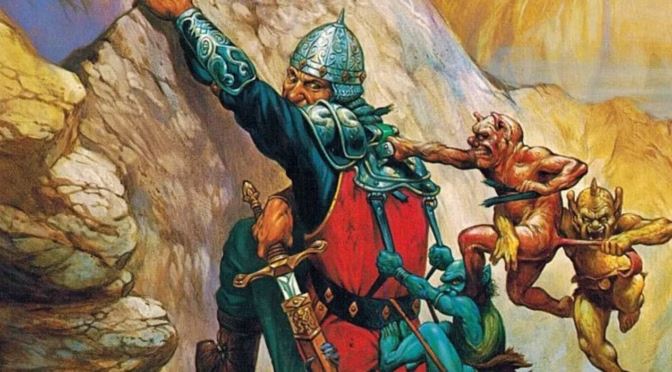
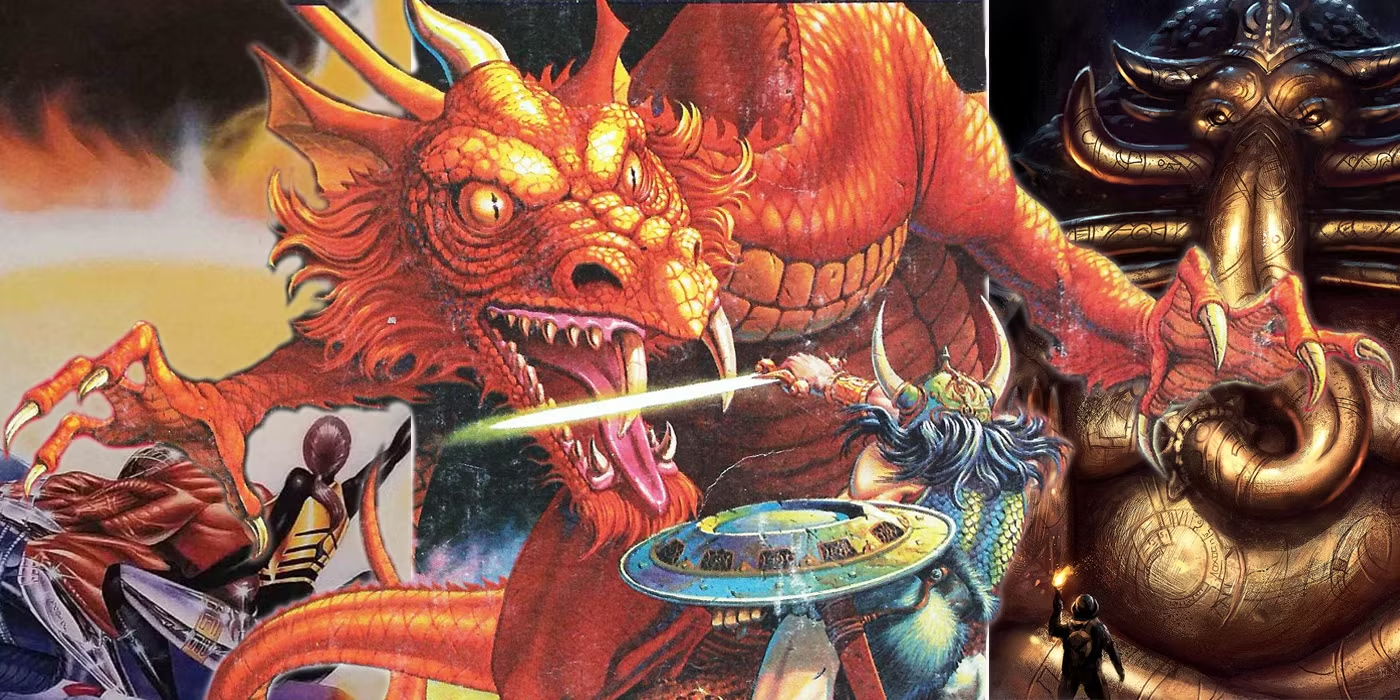
Art isn’t window dressing in D&D, it’s foundational. It’s part of the Ethos as much as dice and dragons. It sets tone, defines expectation, and tells you what kind of fantasy you’re stepping into before you’ve read a single rule. D&D fans are ruthless about it. There are unwritten rules here, no official guidebook, just decades of accumulated taste, and if you miss the mark, people notice immediately.
And somehow, 5.5 missed it.
The best word for the art direction is sanitized. Safe. Soft. Focus-grouped into submission. And that’s a problem, because D&D art has never been about playing it safe. It’s been heavy metal album covers, grimdark nightmares, heroic last stands, bizarre fever dreams, sometimes all on the same page. It’s supposed to have teeth.

What we got instead feels like it was run through a corporate filter designed to remove anything remotely sharp. The edges are sanded down, the grit is gone, and what’s left feels less like fantasy and more like something that passed an internal brand compliance meeting.
It’s like Iron Maiden deciding their next album cover should feature Martha Stewart smiling politely over a cup of tea.
There are good pieces in there, credit where it’s due, but they’re buried in an overall direction that just doesn’t understand what D&D is supposed to look like. And when the first impression of your game is off, everything else starts uphill.
Fantasy Races (Species)
If you want to find a fault line in D&D’s Ethos, look no further than its fantasy races. This has always been contentious territory. Fans argue about it constantly, and have for decades. It’s also why you have to be especially cautious when making changes. The last thing you want to happen is for the fan base to suddenly become unanimous about what the ethos of D&D is regarding races.
What belongs? What doesn’t? What feels like D&D?
The addition of Dragonborn and Tieflings was controversial back in the day. Half-Orcs have been debated since the AD&D days. Drow as player characters? Still a lightning rod. Even ability score modifiers, those little nudges that push races toward certain classes, have sparked endless arguments about whether they reinforce fantasy or restrict it.
The key thing is this: these changes have always been gradual. Painful, sometimes, but gradual.
5.5 didn’t do gradual. It ripped the bandage off and called it progress, creating a domino effect that led to unanimous sanctions from the community. Wizards of the Coast managed to take something the community was divided about and led them to take a stand on the topic, one that opposed the decisions they made in 5.5. It was the worst possible outcome for them.
Renaming “races” to “species.” Removing half-races like Half-Elves and Half-Orcs as meaningful mechanical options. Stripping out ability score modifiers entirely. Flattening distinctions. Smoothing edges. And then, of course, the orc shift, moving them cleanly out of “monster” territory and into fully normalized player options, which for many players wasn’t just a tweak, but a fundamental redefinition of the setting’s logic.
This one change quite literally invalidates most of the official D&D settings and their lore.
Individually, you could argue for any of these changes. That’s not really the issue. The issue is all of them at once.

Because Ethos isn’t just about what you change, it’s about how much you change, and how fast. And 5.5 didn’t nudge the system forward; it shoved it. Hard. The result wasn’t clarity, it was confusion. Tables arguing. Players divided. A constant, low-level friction about what D&D is even supposed to be anymore.
And then there’s the presentation. In 5e, races got space, three, four pages to breathe, to define culture, identity, flavor. In 5.5, they’re condensed, abbreviated, reduced to something closer to a stat block with a portrait. Vague. Non-committal. Stripped of the texture that made them feel like part of a living world.
In the end, these changes broke the ethos in the eyes of the community and in some ways, helped to unify it, which will make it even more difficult to both keep the changes introduced in 5.5, they will have to backtrack if they want to recapture the D&D audiances buy-in but it also means they won’t be able to alter it in the future.
At this stage, this aspect of 5.5 was just outright rejected by the D&D fan base and while there are echo-chambers like the D&D Beyond forum where you will find support for it, it’s a misleading message for Wizards of the Coast. Again, you have to remember to think about the vocal minority; they might be loud, but it’s not their wallets you’re after. You need the core D&D community to buy into these changes, and they have very coldly rejected them.
Power Creep & Dungeon Masters
Power creep in D&D isn’t new. Even in Dungeons & Dragons 5th Edition, you could feel it, slow, steady, almost polite. A subclass here, a spell there, a magic item that maybe pushed things a little too far. The community tolerated it because it moved in inches, not miles.
5.5 doesn’t move in inches. It lurches forward like an out-of-control steam train.
But here’s the thing, power creep isn’t really a player problem. Players love power creep. Of course they do. Winning is fun. Being strong is fun. Having a character sheet that reads like a loaded weapon is very fun. When players bulldoze encounters or make reckless decisions knowing they’ve got fifteen different ways to get out of trouble, their takeaway isn’t “this is broken,” it’s “this is awesome.”
The real cost lands squarely on the shoulders of the Dungeon Master.
Because the DM is the one trying to hold the whole thing together. They’re the ones responsible for making the game feel challenging, coherent, and, most importantly, meaningful. And when every character at the table is effectively a walking solution to every conceivable problem, that job stops being fun and starts feeling like unpaid overtime.
When players trivialize encounters, bypass obstacles with a spell checkbox, and shrug off danger like it’s a mild inconvenience, the DM is left trying to constantly escalate just to keep up. Bigger monsters. Harder fights. More convoluted scenarios. And all of it starts to feel artificial, like you’re inflating difficulty just to punch through an ever-growing layer of mechanical padding.
It’s exhausting.

And this was already a problem in 5e. There’s a reason you see so many groups full of eager players desperately searching for someone, anyone, willing to run the game. The shortage of Dungeon Masters isn’t anecdotal anymore, it’s systemic. We’ve reached the point where people will literally pay hourly rates to complete strangers just to have someone sit behind the screen and manage the chaos.
5.5 didn’t fix that problem. It made it dramatically worse.
From personal experience, running 5.5 feels like trying to challenge a party of superheroes who showed up to a goblin fight out of sheer boredom. The characters are absurdly capable from the outset, stacked with options, layered with safety nets, and equipped to handle just about anything you throw at them without breaking a sweat. Fear? Gone. Tension? Optional. Consequences? Negotiable at best.
They’re not adventurers anymore, they’re demigods with a starter kit.
And from the DM’s side of the table, that’s not exciting. It’s tedious. It’s a constant uphill battle to create stakes in a system that seems actively opposed to having them. The adventure design doesn’t help either, balance is all over the place, and the claim of “backwards compatibility” feels more like a technicality than a reality. Sure, you can run old 5e adventures, but be prepared to gut them, rebuild encounters, and essentially do the designer’s job for them if you want anything resembling a challenge.
Which brings us back to Ethos.
D&D has always been about the climb. Zero to hero. That’s the fantasy. You start fragile, uncertain, maybe a little incompetent, and you earn your power over time. Levels matter because they represent that journey.
5.5 skips the journey. You don’t grow into power, you spawn with it.
And when you remove the climb, what you’re left with isn’t empowerment. It’s boredom with better stats. This community complaint about 5.5 I personally get from experience. Running 5.5 as a DM sucks balls.
Conclusion
The truth is, I could probably write three more articles like this, each one picking apart a different way 5.5 sidesteps the D&D Ethos, but at some point you stop adding evidence and start repeating yourself.
Because the core issue isn’t complicated.
D&D has an Ethos. A real one. Not something printed in a rulebook, not something you can bullet point in a design meeting, but something that exists all the same. You can argue over the details, sure. People have been doing that for decades. But when you move too far, too fast, and too often away from it, the result becomes obvious. Not academically obvious, viscerally obvious.
5.5 isn’t a bad game because of any single decision. In fact, taken on its own terms, it’s not even a bad game at all. Mechanically, there’s a lot to like. It’s clean, it’s accessible, it’s polished.
But it’s not a good version of Dungeons & Dragons.
It misses too many of the grounded, intangible pieces that make D&D feel like D&D. And when you sit down to play, that absence becomes impossible to ignore. Everything looks familiar at a glance, but the moment you interact with it, something feels… off. Slightly twisted. Like you’re reaching for something you recognize, only to find it’s been subtly reshaped into something else.
It’s the same problem Dungeons & Dragons 4th Edition had. Familiar components, unfamiliar experience.
And that disconnect creates these strange, almost surreal moments at the table that don’t quite fit the fantasy the game is supposed to evoke. It’s hard to define until you see it happen in real time, like a Halfling Fighter casually swinging a massive two-handed battle axe with maxed-out Strength like it’s just another Tuesday. Is it “allowed”? Sure. Does it feel like D&D? Not even a little.
That’s the problem.
I can’t give you a perfect definition of what D&D is. Nobody can. But I know it when I see it, and more importantly, I know when I don’t.
And judging by the wider community, I’m not alone.
The energy around D&D right now feels… thin. The buzz is fading. The excitement that carried 5e into the mainstream spotlight is sputtering out. You can see it in the content space, you can feel it in conversations, there’s just not much to latch onto. For a game that once felt unstoppable, that’s a pretty telling shift.
And yeah, this edition kind of sucks, not as a game, but as a D&D game.
But here’s the good news: it doesn’t matter as much as it sounds like it does.
No one is coming to your house to confiscate your books. Dungeons & Dragons 5th Edition still exists. 3.5 still exists. And 2nd Edition, glorious, bloated, beautiful 2e, is still sitting right where you left it, waiting to be played.
D&D doesn’t disappear when a new edition misses the mark. It continues, just not under the banner of the new edition.
And if history tells us anything, it’s this: Wizards of the Coast has been here before. They stumbled with 4e, and they course-corrected.
They’ll do it again.
Probably right after they finish insisting this one is exactly what we wanted.