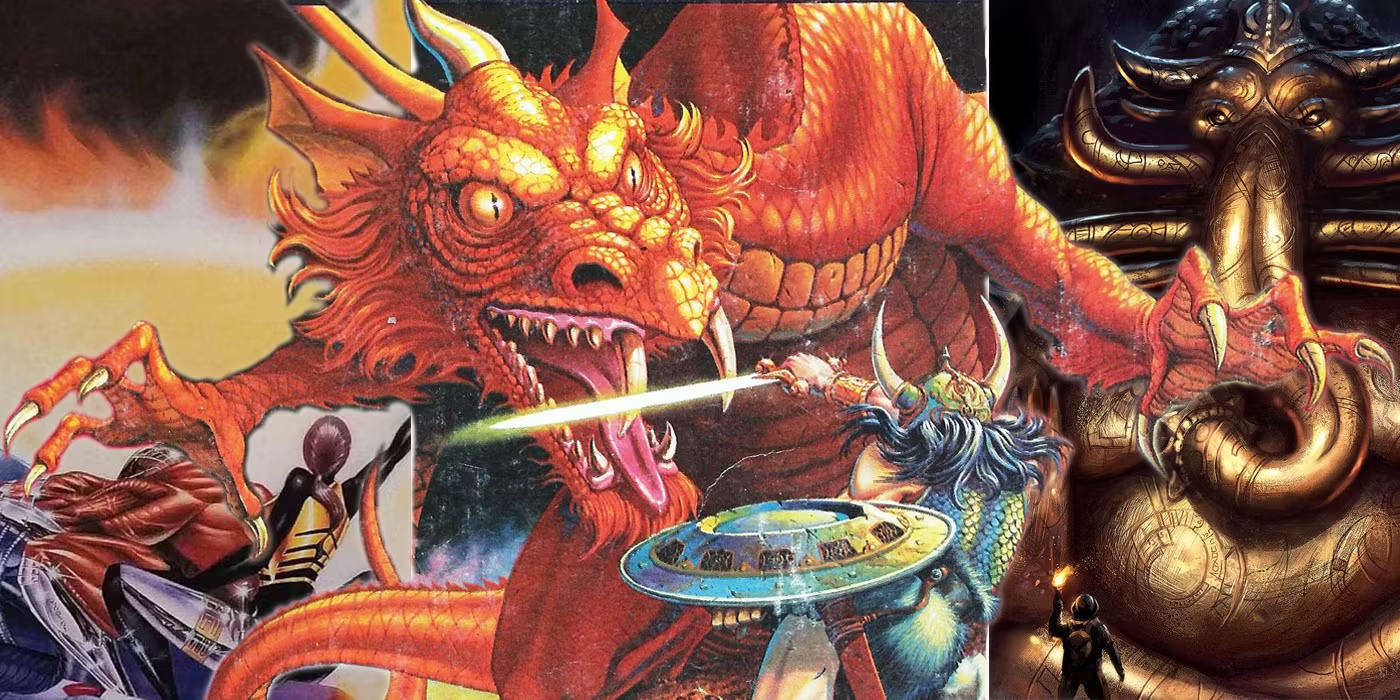
In Theory: Why 2nd Edition AD&D?

Over the past few months, I’ve been dropping not-so-subtle hints about my affection for Advanced Dungeons & Dragons 2nd Edition across this blog. But my Top 10 Versions of Dungeons & Dragons article back in February didn’t just hint, it basically proposed marriage; it was my number 1 pick.

While I don’t think this is a big reveal, I have in the past kind of avoided simply stating it outright because that tends to draw… attention.

As expected, a few loyal readers have (politely) raised an eyebrow and asked me to explain myself. Now, I don’t usually feel the need to justify my tastes, this isn’t a courtroom, and I’m not on trial for “liking THAC0 unironically.” But the questions seem to come from genuine curiosity rather than thinly veiled judgment… mostly.

So the question is simple: what is it about 2nd edition AD&D that clicks for me? Why, out of all the editions of Dungeons & Dragons, would I pick one that, aside from the occasionally misunderstood Dungeons & Dragons 4th Edition, is often labeled as one of the least popular?

Now, I’m not entirely convinced that’s true. In fact, I’d argue 2nd edition is one of the more popular versions of the game. Do I have hard data to support that claim? Absolutely not. But in the grand tradition of internet discourse, I’m comfortable asserting it confidently anyway, and besides, no one else seems to have the numbers to contradict that claim either.

I suspect this “unpopular” reputation comes from the timing. 2nd edition was around when TSR, the company behind D&D, was heading straight toward financial ruin. Naturally, people connect the dots and assume the game must have been the problem, and in fact, it’s often blamed for TSR’s demise.

TSR’s demise is one of the great tragic stories in the legacy of D&D, with many characters, plots, and crazy events that have fascinated gamers for years. Several books have been written on the subject.

But if you actually dig into the history of TSR’s downfall, you’ll find something surprising: it had very little to do with the game itself and everything to do with spectacularly questionable management decisions. We’re talking the kind of business strategy that makes you double-check if it was actually real or a parody. Entire books have been written on this subject as an illustration of what not to do as a corporation.

But I’m wandering off into history-lesson territory, and that’s not why we’re here.

I came to answer a question.

And answer it I shall.

The Origins Of Ethos In Dungeons and Dragons

I touched on the “ethos” of Dungeons & Dragons in my last article, specifically in relation to D&D’s latest incarnation, D&D 5.5, but I feel the need to circle back and give it the attention it truly deserves in the context of 2nd edition AD&D. Because if early editions invented the ethos of D&D, then Advanced Dungeons & Dragons 2nd Edition took that rough idea, wrote it into stone as commandments, and formed the official religion. Everything we consider to be THE ethos of D&D largely comes from 2nd edition AD&D, even in modern versions of the game.

A big part of that comes down to one thing: 2nd edition AD&D is absurdly verbose, and I mean that as the highest compliment.

Pick up just about any 2nd edition book, and you’ll quickly realize something important, especially compared to other versions of the game: this game was created by writers, not designers, people who gave far more importance to the narrative weight of the game rather than its mechanics.

Until the 2nd edition AD&D Monster Manual, the concept of the monster book was about some basic information, a nice picture, and a clean monster stat block. Useful, yes, but inspiring? 2nd edition AD&D monster descriptions took up 1 or 2 pages, describing them in excessive detail. It was the first time monsters were more than just “things to kill”, there was a story behind every creature. Unfortunately, in modern D&D monster books, we have reverted to making monster entries stat blocks.

And it shows, mechanically, 2nd edition sometimes leaves a lot to be desired, which might hint at why many D&D players frown at its presence or mention, and I get that. There are balance issues, odd design choices, and plenty of “did anyone actually playtest this?” moments scattered across spells, monsters, and adventures alike. It’s the kind of system where you occasionally squint at a rule and just decide, as a group, to emotionally move past it because there is just no way to justify its existence.

I do believe when the 2nd edition was being designed, it was forced to work under certain constraints, namely backwards compatibility with the 1st edition, so I do believe part of the design problem stems from that, but for the most part, as a design, 2nd edition AD&D is just kind of meh… but with moments of brilliance that in my opinion make it THE best version of the game. We will get to that in a minute.

But the writing is phenomenal, of that there is no question. D&D is a game about stories, and writing trumps rules in my humble opinion. It’s the creative center of D&D, it’s where lore and mechanics converge to create the ethos, and it’s why, in my humble opinion, 2nd edition AD&D becomes such a critical part of franchise history.

Between the pages, you can feel the beating heart of D&D lore coming alive in a way it never did before or since. Not hinted at. Not loosely suggested. Fully realized and fully committed to Sword and Sorcery in all of its glory.

Spells don’t just tell you what they do, they invite you to imagine what they could do. Monsters aren’t just stat blocks; they’re given histories, ecologies, and so much more than you could ever ask for. You don’t just learn what an orc is, you learn how it lives, what it fears, and probably what it argues about over dinner.

And the sheer volume of it all is astonishing. The “Complete” series, the endless player and DM option books, the sprawling settings, the amazing monster books, 2nd edition didn’t believe in giving you just enough. It believed in giving you everything, plus a few extra pages just in case you were getting comfortable.

There is no question that the Complete book series for 2nd edition AD&D is, pun intended, complete overkill. It’s actually common to refer to this expanded content as “bloat”, but I find that to be an insane concept. It’s only bloat if you try to use everything at the same time, which there is literally no reason to ever do. These books are about inspiration, and 90% of the content in each book is narratively focused. These books are story juice!

These books were wildly creative. Deeply flavorful. Occasionally unhinged in the best possible way. There’s a richness to the writing that makes D&D feel distinct, lived-in, creating a deeply ingrained ethos in your soul. For me personally, 2nd edition AD&D defined what D&D is forever.

I, however, was not the only person who garnered such affection from the writing behind 2nd edition AD&D. This game inspired an entire generation of designers who created some of the most memorable D&D video games ever made, not to mention the volumes of books written with 2e as a backdrop. From the Baldur’s Gate series to the Neverwinter Nights games, from Planescape Torment to the Gold Box Era games. From the Forgotten Realms saga’s to the Dragonlance epics. Ask anyone what their favorite D&D PC or video D&D game adaptation is or their favorite D&D book, and I will show you how 2nd edition AD&D writing was the primary influence.

What 2nd edition really did was bring the core ideas and growing ethos of the game into sharp focus. Things that felt a bit blurry in earlier editions suddenly became established constructs of the game. The identity of D&D, its tone, its style, its voice, was no longer implied. It was spelled out for you, in loving, excessive detail.

Later editions leaned heavily into the idea that “D&D can be whatever you want it to be.” And to be fair, that’s a perfectly valid philosophy. The game has always relied on DMs and players to shape it into something personal, even in the 1e days, perhaps specifically in the 1e D&D days.

But 2nd edition took a different approach. It didn’t just hand you a toolbox, it handed you a fully furnished house and said, “You can redecorate if you want… but you really don’t have to.” More than that, it anticipated player desires and offered solutions to some of the deepest and often most convoluted questions. It was, in a word, excessively thorough.

In my view, that’s where 2nd edition truly defines the ethos of Dungeons & Dragons. It answers the question: What is D&D? in no uncertain terms. Where modern D&D would say “Here is what D&D could be, it’s up to you though, don’t take my word for it, I just want to make you happy, I don’t want to tell you what to do, in fact, never mind, do what you want, any D&D at your table is real D&D, we don’t actually have an opinion.” I don’t want to say that the alternative approach is wrong, it’s not, but if you want to play D&D within its core ethos, explicitly defined and gloriously written, 2nd edition AD&D is the only version of the game that comes even close to doing that. By comparison, everything else is intentionally vague at best.

This is 100% complete information in 5.5 D&D regarding what a Dwarf is. This is it. Three paragraphs describing a Dwarf in the most static, inconsequential way possible. If you didn’t already know what a Dwarf was before reading this, it would be utterly useless. As it stands, the core information is brave people who sometimes have beards who live in the mountains. The text doesn’t even commit to them being short out of fear of offending someone. At best, I would describe this as ZERO effort from a writing perspective.

2nd edition D&D was not just a set of rules, but a culture. A tone. A shared understanding. A very real “thing” that you can recognize instantly, and even people who weren’t fans of the edition would ultimately be influenced by its existence.

When you hear a 2nd edition AD&D player describe D&D, it will always be with confidence, arrogance even, but this stems from the simple fact that they didn’t invent it, it’s not some version in their head or homebrew, they read it, straight from the horse’s mouth in exceedingly, almost painful detail.

Mode Switching and Execution Complexity

Two of my biggest gripes with Dungeons & Dragons, both before and after Advanced Dungeons & Dragons 2nd Edition, are what I call mode switching and execution complexity. And yes, I realize those sound like terms stolen from a software engineering meeting, but stay with me.

Let’s define them before we wander too far into the dungeon.

Mode switching is that very obvious shift in playstyle when the game goes from “we are telling a story” to “everyone grab a miniature and roll initiative.” Combat happens a lot in D&D, but to me, a fight is still part of the story. It’s the climax, the tension release, the cinematic payoff. It shouldn’t feel like you’ve paused the movie to boot up an entirely different video game.

But that’s often exactly what happens in all versions of D&D after 2nd edition.

A fight breaks out, and suddenly the roleplay screeches to a halt. Outcome the miniatures, the grids, the measuring tools, and we transition, sometimes dramatically, into what is essentially a tactical combat mini-game with its own rules, pacing, and logic. It’s like switching from a novel to a board game mid-sentence.

There is no question that a beautiful tactical board in full color and mini’s is a fun experience, and I don’t think it’s hard to understand why people like tactical combat. The problem is that the rest of the game takes place in our imagination, and the switch alters the perception of what the game is. Story mode and combat mode are two very different things, often in direct opposition to each other.

Closely tied to this is the execution complexity is the moment combat begins, time compresses into 6–10 second chunks, movement becomes squares, and actions start to feel like selecting abilities from a hotbar. Attacks, spells, effects, they’re no longer described; they’re executed. Press the button, resolve outcome, next turn. The rules stuffed into these systems are complex and intertwined with exceptions and sub-sections. Even in a well-designed game its a coma-inducing experience with the pace of continental drift, hardly the stuff of cinematic combat.

Now, I get why this exists. There’s a certain appeal to tight, tactical combat systems. But for me? That level of depth and mechanical layering pulls me out of the story rather than deeper into it. It’s the antithesis of role-playing. I expect to do that when playing Warhammer 40k, but not D&D.

And this is where 2nd edition AD&D quietly does something brilliant mechanically. I can’t say if it was intentional or not; we don’t know that much about the design thinking behind 2nd editin AD&D, other than being a derivative of 1st edition AD&D, but it nails it just the same.

It sidesteps all of this, not by removing tactics, but by embedding them inside the narrative.

Combat in 2nd edition is fast, brutal, and dangerous, but it never stops being part of the story. It doesn’t switch modes. It just intensifies the cinematics; it asks for more adjectives, not less.

First, a combat round is about one minute long. That alone changes everything about the dynamics of battles in the game. Suddenly, there’s room for description, for dialogue, for actual acting. Your character isn’t just swinging a sword or executing power X, they’re circling, shouting, reacting, and making choices that feel like part of a living scene.

Second, and this is the real magic, all combat actions are declared before they are resolved, and before initiative is rolled. This is a crucial dynamic shift, it’s the key design decision that transforms 2nd edition AD&D combat from a tactical mini game to a strategic narrative game. It switches the game from a sport to an actual battle.

  • The DM describes what the monsters and NPCs are doing.
  • The players describe what their characters intend to do.
  • THEN the initiative is rolled, and actions are resolved in that order with narrative adaptations made on the fly.

That sequence fundamentally changes how combat feels. Instead of reacting to a mechanical order of turns, players are asked a much more interesting question:

“Here’s what’s happening, what do you do over the next minute?”

It’s proactive, not reactive. Narrative first, mechanics second.

While describe then execute is a strange concept in modern D&D, largely due to the nature of how tactical combat systems must be executed, in the overwhelming majority of RPG’s, especially those that don’t directly try to emulate D&D, this is the standard. The normal way is the way 2nd edition AD&D does it, initiative tactical combat, is the outlier in RPG mechanics.

Even initiative itself, while technically a simple d10 roll, is influenced by real in-world factors, weapon speed, number of attacks, whether you’re using ranged weapons, what armor you’re wearing, and so on. It’s not just a number generator; it’s a loose simulation of physical reality, stuffed in one place, yet defined by the decisions players made in how they equipped themselves and their style/approach to combat. All of the realism and factors are bundled up into a single mechanism that gets out of the way of the narrative play right after it’s executed, but has a tremendous impact on how combat ultimately resolves.

There’s enough granularity to keep things tactically interesting, but not so much that it strangles the flow of the story. The system isn’t obsessed with rigid operational execution; it’s trying to interpret what’s happening in a believable way in a story about a battle, rather than being a mini-battle game.

Compare that to earlier editions, like Advanced Dungeons & Dragons 1st Edition, which aimed for something similar but got buried under mechanical weight and was overall focused on Dungeon survival as a core feature of the game. Or later editions, 3rd, Dungeons & Dragons 4th Edition, and 5th, which lean heavily into structured, tactical execution. Those systems work well if what you want is a combat-focused miniatures game, but they undeniably shift the experience into a different gear.

I want to be clear on this point, in my mind, the 1st edition AD&D Dungeon Master Guide by Gary Gygax is a masterpiece, it is the definitive work that breaks down the work of a DM. This is an important book, but it does very little to inspire writing, narrative creativity or the premise of creating adventures. It’s really a book that is more about problems and solutions of being a DM and how to referee the game. That is a critical part of running D&D, but when you sit down to create an adventure, this book offers very little to the creative process; it more helps you understand the conceptual principles.

And just to be clear, I’m not saying that’s bad. Plenty of people love that style, and I don’t fault them for it, but to me, it’s actually always kind of a fresh hell. It trips up the narrative in incalculable ways and resolves stories in an almost silly mockery of reality, dirtying the waters of storytelling. I just don’t like tactical combat in my RPG’s, any RPG’s, least of all my beloved Dungeons and Dragons.

What I love about 2nd edition is how seamlessly it connects combat to the rest of the game. The act of saying “this is what I do” is the same whether you’re negotiating with a king or fighting for your life. The way it plays out, how the story shakes out, is pretty much the same. Some dice rolls to determine success and failure, and an attached collaborative narrative to those results.

That consistency matters to me a great deal. It’s really why I play RPG’s in the first place. I want it to be a movie in my head, not a game that I try to win at the table.

It also gives real meaning to choices that might otherwise feel purely mechanical. Weapon selection isn’t just about damage; it’s about speed and timing. Armor isn’t just protection; it affects how you move and act. Spells aren’t just “strong” or “weak”, they’re fast, slow, risky, or reliable.

It adds an extra dimension without adding unnecessary friction.

The result is a system that feels tactical within a narrative framework, rather than replacing the narrative with tactics. Combat becomes a vivid, flowing scene instead of a start-and-stop simulation.

And perhaps most importantly, it’s actually simple to run, it gives players and DM’s room to be creative, dynamic, to adapt as they go, and combat is described, rather than executed. The one main difference between 1st and 2nd edition AD&D is the rules weight associated with bringing these dynamics to the table.

There’s a rhythm to it. A cadence. Describe, declare, resolve. Repeat.

It just… works, and no wonder, as this is the core rhythm of role-playing in general. This is how most RPG’s work today, that tactical depth and mode switching is largely a product of modern D&D, not really of modern RPG’s. Modern RPG’s function actually function as 2nd edition AD&D, which oddly makes 2nd edition AD&D the most modern version, from a design perspective, ever made.

Storywriting and DM Inspiration

I’ve already sung the praises of the writing in Advanced Dungeons & Dragons 2nd Edition, but there’s an important side effect worth calling out: what it actually does to the people sitting at the table, especially the DM.

Because inspiration isn’t just a “nice to have” in Dungeons & Dragons, it’s the fuel the entire game runs on.

For DMs in particular, inspiration is everything. Your first duty isn’t to the rules, or balance, or whether that goblin encounter is “appropriately tuned.” Your first duty is to the story and to the world the player characters inhabit. You’re building something that needs to feel alive, believable, and flexible enough that players can meaningfully interact with it (and, inevitably, derail it).

And here’s the thing, when you’re given rich, detailed, and thoughtfully written material to work with, that job becomes less of a burden and more of a joy.

2nd edition AD&D is, quite frankly, a goldmine for inspiration.

You can crack open the Player’s Handbook, the Dungeon Master’s Guide, the Options books, or, perhaps most dangerously, the Monster Manual, and within minutes you’re spiraling into ideas. Not “oh, that’s neat” ideas, but full-on campaign arc ideas.

I’m not exaggerating when I say you can open the Monster Manual to a random page and accidentally invent a three-month campaign before you’ve finished your coffee.

The level of detail is sometimes overwhelming, sure, but it’s purposeful. There’s intent behind the words, a sense that someone really sat down and thought, “How do I make this creature feel like it actually exists and make it a worthy addition to a narrative game?” And that effort shows. We haven’t seen such dedication in D&D books in a long time. Modern D&D books, have fallen out of this habit.

It feeds the creative monster in your brain. Constantly.

With 2nd edition, I never feel like I’m running out of ideas; I feel like I’m trying to keep up with them.

And honestly, I can’t say that about most other editions of D&D.

You could make a case for 3rd edition; it had its moments, no question, but when I look at later editions, like Dungeons & Dragons 4th Edition and 5th, I personally find them… lacking in this department. Not bad, necessarily, just flat.. vague. The writing feels cleaner, more structured, more “accessible”… and somehow far less inspiring. It’s like the difference between reading a rulebook and reading a story.

Everything works. Everything is clear.

But nothing grabs you by the imagination and refuses to let go.

Now, to be fair, Advanced Dungeons & Dragons 1st Edition had flashes of brilliance. I have often spoken about the mystic nature of that game. Especially buried deep within its Dungeon Master’s Guide. There are sections in that book that are still among the most inspiring things ever written for a DM.

But they’re exceptions, not the rule, and AD&D 1st edition, I think, is a very difficult game to run unless you ignore most of the rules.

Overall, 1st edition often feels more concerned with telling you how to run a game, how to manage players, enforce rules, and maintain control. Useful, yes. Inspiring? Less so. It can feel a bit like being handed a manual for operating heavy machinery when all you wanted was to tell a story.

2nd edition strikes a different balance. I think at the time it was written, there was a general understanding that role-playing was more than Dungeon Crawls and rules management.

It gives you structure, but not shackles. Guidance, but not micromanagement. And layered on top of that is this constant stream of evocative, flavorful writing that makes you want to create.

It doesn’t just support storytelling. It encourages it.

And that’s not something you can easily design into a system… but somehow, 2nd edition AD&D pulled it off.

The Perfect Game For Me

If I were to describe my ideal version of Dungeons & Dragons in abstract terms, it would come down to four core ideas: Sword and Sorcery, narrative combat, fantasy realism, and a wide but grounded range of character customization, though each comes with some caveats. That probably sounds straightforward, but, as with most things in D&D, the devil is in the details.

Sword and Sorcery

When it comes to general preferences as to the type of fantasy I want, Sword and Sorcery is the clear winner. I want more Baldur’s Gate grittiness than Final Fantasy power fantasy. I want a sword to be a dangerous weapon, a monster to be a legitimate threat, and I want the life of an adventurer to be hard.

I want rarity to matter, spells to be special, and magic weapons to have character. I want the world and the rules to support each other, rather than support the wacky ideas of an anything-goes fantasy. I want being a Dwarf to mean something, not just a “shorter human”.

Sword and Sorcery is based on classic fantasy, and while I can appreciate modern high and power fantasy from a distance, I find it excruciatingly boring. Most of all however, I don’t want to run or play in a game that favors the players; I want the zero to hero story, I want the game to have stakes and not through a veil of pretend stakes where everything is engineered to give you the illusion of danger, but is balanced for your level, but real, objectively, and observable stakes.

Sword and Sorcery is a different type of fantasy. It’s really kind of about ordinary people in extraordinary circumstances that become extraordinary people as a result of the experience. In a Sword and Sorcery fantasy, the story is about how the adventures go from zero’s to hero’s. Once they achieve that legendary status, the game is over. They retire.

In a game of Sword and Sorcery, when a fight breaks out, I want the players to feel their characters are in imminent danger and the decisions they make over the next few minutes to be life or death.

Narrative Combat

I’ve already talked about this at length, but it really is the cornerstone for me, so it’s worth revisiting in this context. Combat needs to feel gritty, dangerous, and just a little bit terrifying. Not in an over-the-top, grimdark noir sense, but in a way that makes players stop and think before they draw steel. In my ideal game, combat is not the default activity; it’s a consequence with potentially terrible risk. It’s something that happens when plans fail, negotiations break down, or risks are taken too far, and at best, a part of a well-laid plan. It should never feel routine; players should always fear that this time, their character might die.

That danger feeds directly into the narrative and tension of the sort of fantasy I want to create at the table. When combat is lethal, every decision carries weight. That wizard with a single Sleep spell suddenly isn’t underpowered; he’s the reason the party survives the encounter. Victory stops being an expectation and becomes something earned, something the players feel at the table. That sense of “we barely made it” is, to me, one of the purest expressions of what D&D is supposed to be narratively.

At the same time, I don’t want combat to bog the game down. This is where things get a bit paradoxical. I want it to be fast and simple to execute, but still rich with meaningful choices. Not so simple that it becomes a repetitive dice exercise, but not so complex that players have to pause the scene to decode their character sheet. The decisions should come naturally from the situation, from the character, from the story, not from scanning a list of abilities for the “correct” option. This is all about syncing the activities in the game as a matter of practical execution with the narrative of the story.

Class and equipment play a huge role in this. A fighter shouldn’t just deal more damage; they should feel different in how they approach a fight. The same goes for equipment; what you carry should reflect how you fight, not just how much damage you can output. A lightly armored duelist and a heavily armored warrior shouldn’t just have different numbers; they should create different moments at the table.

More importantly, I don’t care about balance. An Amazon with no armor and a spear should be weaker than a knight in full plate mail. I don’t believe in the equalization of power. Your character choices should not be driven by trying to be good at combat, but by the narrative you want to bring to the table. I don’t care if the game is fair; I don’t need it to be.

Spellcasters, in particular, should stand apart. Their identity shouldn’t come from raw power alone, but from preparation, timing, and intent. The spells they choose shape how they interact with the world, and that should be visible in play. Two wizards with different spell selections should feel like entirely different characters, not just variations of the same template. I don’t need 30 Wizard sub-classes to create distinct “wizard types”, a magic-user is a magic-user, just like a fighter is a fighter. What makes them distinct is how they use those powers.

When all of this comes together, with lethal stakes, fast resolution, and meaningful choices, combat naturally becomes narrative. Players stop thinking in terms of mechanics and start thinking in terms of actions, risks, and consequences. The fight becomes a story in motion rather than a separate game layered on top of it, more importantly, what comes before the fight has an elevated level of importance.

Fantasy Realism

The second pillar is what I think of as fantasy realism, though it’s less about realism in the traditional sense and more about internal logic. The world doesn’t have to mirror reality, but it does need to make sense on its own terms. What happens mechanically should reflect the perceptions of the characters and make sense to the players.

This is where the idea of associated versus dissociated mechanics comes into play. A mechanic is associated when it makes sense within the world, when it represents something the character is actually doing. The character and player can lean on the reality of the world and know that the mechanics work to reflect it. A dissociated mechanic, on the other hand, exists purely for gameplay purposes, disconnected from the logic of the setting and player character realities.

A simple example would be something like tripping an opponent. In a grounded fantasy world, that’s just something anyone can attempt. It’s part of physical interaction. But if it becomes a limited-use “ability” tied to an abstract resource, it stops feeling like an action and starts feeling like a button you press. The moment that happens, the player’s focus shifts away from the situation and toward the mechanics.

That shift might seem small, but it has a ripple effect. Once players begin thinking in terms of “what can I activate” instead of “what would I do,” the connection to the world weakens. The game starts to feel less like a lived-in reality and more like a system to be navigated.

Fantasy Realism is a rather odd thing, it’s about normalizing weird things that never existed, but still tries to establish them within the context of that fantasy as a real thing. In a sense, many weird things can’t exist in a fantasy for it to be a realistic fantasy. It’s a bit of a circular argument, but for example, a Light Spell does certain things, but there are many things it can’t do. Why? Fantasy Realism. Try to make sense out of that!

This isn’t about rejecting mechanics or demanding strict realism. Fantasy, by definition, isn’t realistic. Magic exists, monsters roam the world, and none of it needs to align with real-world physics. What matters is consistency. The world needs to have its own logic, and the mechanics should support that logic rather than constantly breaking it.

When that consistency is maintained, players naturally engage with the game in a narrative way. They act within the framework of the world because the world makes sense to them. When it isn’t, they fall back on the rules as written, and the experience becomes more mechanical than immersive.

For me, maintaining that sense of fantasy realism is critical. It’s what keeps the game grounded, even when everything happening in it is entirely fantastical.

Character Customization

The final piece of the puzzle is character customization, and while most editions of D&D handle this reasonably well, I still have a couple of preferences that shape what I consider ideal.

First, I want customization to stay grounded in a gritty, low-fantasy tone. I’m not looking for an endless stream of increasingly exotic options that need to be retrofitted into settings. I prefer something closer to the original feel of settings like the Forgotten Realms, where the world has a clear identity and the available character options fit naturally within it.

When I say I want a wide range of choices, I don’t mean anything goes. I mean a variety of options that feel like they belong to the same world, drawing inspiration from classic fantasy rather than constantly expanding into something more abstract or exaggerated. There’s a tone to it, a kind of grounded fantasy aesthetic that I find much more compelling.

The second aspect is that I want character options to emphasize narrative identity over mechanical power. A small bonus or a unique ability is fine, but the real value should come from how those choices shape the character as a person, not how effective they are in combat.

This ties back to the idea of starting from zero. No matter how interesting the concept is, I want characters to begin as relatively ordinary individuals and grow into something greater through play. The journey matters more than the starting point. If a character feels fully formed and mechanically complete at level one, something is lost.

What I’m looking for is that moment where a player understands who their character is, not because of a build they optimized, but because of the choices they’ve made and the experiences they’ve had in the game.

Bringing It Together

When I look at these four ideas together, they describe more than just a set of preferences. They describe a particular feel, a way the game unfolds at the table.

For me, Advanced Dungeons & Dragons 2nd Edition captures that feel better than any other edition. Not because it’s perfect, but because it aligns with these principles at a fundamental level. It doesn’t need to be bent or reshaped to fit this style of play. It already lives there.

And that, more than anything else, is why it remains my personal gold standard.

Problem Mechanics

Now, before anyone accuses me of wearing rose-tinted glasses the size of dinner plates, let me be very clear: I am fully aware that Advanced Dungeons & Dragons 2nd Edition comes with its fair share of… let’s call them quirks. Some of them are dated, some of them are clunky, and a few of them make modern game designers visibly uncomfortable.

I get it. I really do, I’m not making a sales pitch for THAC0 here.

Whenever 2nd edition comes up in conversation, the same usual suspects tend to be dragged into the spotlight like they’re on trial for crimes against game design. So let’s address them properly.

Class and Race Limitations

The Player’s Handbook outlines various restrictions, race/class combinations, ability score requirements, and so on. These are often presented as a major sticking point, but for me, the solution is almost laughably simple: I ignore them, always have, and I’m yet to sit at a table in all my years of gaming where things like this were enforced. In fact, in the 80’s it was unanimously agreed that this sort of thing was generally stupid; it was the OSR that brought them back. Actual old school gamers didn’t really do this, or at the very least, it was understood that it wasn’t important in most cases. It was used when it was relevant to the game and ignored when it wasn’t.

Unless I’m running a very specific setting where those limitations serve a narrative purpose, they don’t really add anything meaningful. They’re not essential to the mechanics, and they certainly aren’t critical to the storytelling. More than anything, they feel like artifacts of a different design philosophy, one that hasn’t aged particularly well nor was particularly well thought out to begin with.

If someone wants to play a paladin with a strength of 8, go for it. You’ll just be… a very underwhelming paladin. And honestly, that sounds like a character concept with legs.

To me, these “restrictions” read less like hard rules and more like suggestions from another era, perfectly safe to ignore without the system collapsing into chaos.

Rolling for Ability Scores

This one tends to divide people, but I’ve always been a fan of rolling ability scores. There’s something inherently fun about not knowing exactly what you’re going to get. It adds a bit of unpredictability to character creation, a sense that you’re discovering the character rather than engineering them.

And importantly, starting with less-than-perfect stats isn’t a problem in 2nd edition, it’s a feature. Characters grow over time, both mechanically and narratively. Beginning with average or even mediocre abilities gives the game texture. It creates room for development.

Not every hero needs to be born exceptional. Some of them can earn it the hard way. In my experience, the most forgettable characters are always optimized characters.

THAC0 and Descending Armor Class

Ah yes, the infamous THAC0. The mechanic that launched a thousand internet arguments.

Here’s my honest take: I’ve never actually used it in any variant of D&D.

The very first DM in the very first game I ever played with flipped the math, turned everything into ascending values, and we just… kept doing that. Problem solved. No confusion, no headaches, no existential crisis over subtraction.

If your THAC0 is 18, congratulations, you have a +2 to hit. If your armor class is 7, that’s AC 14. Done.

Some things are just objectively true, and it’s crazy to me to think that there are people out there who still make the argument that THAC0 and Descending AC are better. It’s not, it wasn’t in the 80’s, and it never will be. Just because something is modern doesn’t mean old school players have to come up with cacamany ways to justify shitty mechanics. THAC0 sucked… PERIOD.. END OF STORY! I can understand that some people still use THAC0 because they are used to it, perfectly fine, but if you’re arguing that it’s better…let’s just agree to disagree because you are objectively wrong.

This is one of those debates that has always puzzled me. People act like THAC0 is some insurmountable barrier to entry or defend it like it’s a meaningfully different construct, when in reality it’s just a different way of expressing the same numbers. If you don’t like it, change it. The system doesn’t break. The dice don’t revolt. Everyone survives.

It’s a non-issue masquerading as a major flaw, literally the most inconsequential mechanic in all of D&D, yet it has prevailed as the most common debate. It’s absolutely bizarre to me.

Thief Skills and Non-Weapon Proficiencies

This is where I start to get a bit more opinionated.

I really struggle with how skills have evolved in later editions of Dungeons & Dragons. Earlier systems, even into 3rd edition, kept things somewhat grounded. But by the time you get to Dungeons & Dragons 4th Edition and 5th, skills often feel less like character traits and more like mechanical levers you pull to bypass situations.

And that’s where it breaks for me.

At its core, a “skill” is supposed to represent something your character is good at. It’s part of who they are. But in practice, it often becomes a gamble, “I invested in this, now let’s see if the dice agree that I’m actually competent today.”

That disconnect is hard to ignore, and it’s also what has led to the dice odds slowly over time favoring the player more and more, arriving in a way back to where the whole concept started. A representation of what you can do, rather than what you can sometimes do if you’re lucky with the dice.

Take knowledge, for example. If your character has spent years studying the arcane, why are we rolling dice to see if they remember something about magic? Either they know it, or they don’t. That’s a judgment call based on their background, training, and abilities, not a coin flip.

The same goes for physical capability. If you’re strong enough to lift something, you lift it. If you’re not, you don’t. Rolling dice doesn’t suddenly make you stronger, it just adds randomness where it doesn’t really belong.

Now, there are exceptions. High-stress situations, sneaking past a guard, spotting a hidden trap, those make sense as rolls. Pressure introduces uncertainty. That’s where dice shine but it is also a great place to put a class with specialized abilities for that purpose, aka, The Thief!

And this is why I’ve always preferred the way 2nd edition handles it.

Thief skills, in particular, are a great example. They’re specialized, class-based abilities that reinforce identity. If you’re playing a thief, you own that space. You’re the one finding traps, picking locks, and moving silently. That’s your role, it’s a specialization, and no one should be as good at it as you, and this makes sense within the logic of a fantasy world.

And roles matter.

When someone chooses to play a fighter, they expect to be the best warrior in the group. A wizard should feel like the master of magic. A thief should be the undisputed expert in stealth and subterfuge. When skill systems flatten those distinctions, something important is lost.

Non-weapon proficiencies, on the other hand, strike a nice balance. They represent additional talents and areas of knowledge, things that define your character beyond combat, without turning every interaction into a dice roll. They’re more like declarations of capability than lottery tickets.

And that’s really the core of it for me.

Your character’s abilities should be something you can rely on. They’re part of your identity, not a gamble. The dice come into play when circumstances are uncertain, when stress, danger, or chaos make success less predictable.

An archer doesn’t miss during practice. But in the middle of a life-or-death battle? That’s a different story.

Stress changes things. That’s where randomness belongs.

Outside of that, I want the game to trust the character, and by extension, the player, to simply be good at what they chose to be good at.

Conclusion

To be frank, I could probably keep talking about Advanced Dungeons & Dragons 2nd Edition all day. There is so much about this version of the game that resonates with me that I could easily write an entire series of articles. In fact, the biggest challenge with this piece has not been finding things to say, but figuring out where to stop.

At the end of the day though, I think the simplest explanation for why I love this game is also the most honest one.

I love how it feels.

I love the rhythm of it, the atmosphere of it, and the way the mechanics and writing align with my personal vision of what Dungeons & Dragons should be. The game feels dangerous without being oppressive, imaginative without becoming absurd, and narrative without abandoning mechanics entirely. It occupies this strange middle ground that no other edition has quite managed to capture for me.

Now, the point of this article is not to convince you that 2nd edition AD&D is the definitive version of D&D. I think far too much energy online is spent trying to persuade strangers that their preferences are somehow objectively wrong. Preference is preference. We all come to this hobby looking for different things, and that is perfectly fine.

What I wanted to do here was explain why this particular edition speaks to me the way it does.

The truth about D&D and any RPG really is that whatever sort of D&D you’re having fun playing and creating for, is the best kind of D&D. Period. It might not be for me, but that doesn’t make it bad. It just makes it bad for me.

If this article has sparked your curiosity, though, I would offer a couple of pieces of advice before diving into 2nd edition AD&D.

First, focus on the writing and the experience at the table rather than the myths that have grown around the game over the years. A lot of people judge 2nd edition purely by reading isolated mechanics on paper or the perceptions of keyboard warriors with a cause, and I honestly think that gives a very misleading impression of how the game actually plays. This is a fantasy writer’s version of D&D, designed for fans of reading fantasy books. That is the game’s secret.

The experience of playing it is very different from the way the rules read in isolation. There is a narrative rhythm to the game that only really reveals itself after some time with it. The flow of play, the pacing of scenes, the structure of combat, the emphasis on storytelling and atmosphere, all of it comes together into something that feels genuinely distinct from every other version of D&D, even from Advanced Dungeons & Dragons 1st Edition, despite how much DNA they share.

Second, and perhaps more importantly, explore the settings and expanded material. Read the Complete books. Read the setting guides. Read the monster entries in full instead of just scanning stat blocks. The more you explore, the more you begin to understand what I mean when I talk about the game’s connection to sword and sorcery fantasy and narrative storytelling.

These books are unapologetically verbose. They want you to sit down and immerse yourself in the world. They want you to imagine things. Sometimes they feel less like rulebooks and more like someone desperately trying to infect you with enthusiasm.

I will also say something about modern D&D that might come across as a bit controversial, though I genuinely mean it fairly, and it’s directed at Wizards of the Coast more than the fans.

Modern editions of D&D have actually done a pretty good job of achieving their design goals. Personally, I find them too high-powered and too tactically focused for my tastes, but that does not mean they failed. Quite the opposite. If your goal is to create a more mechanically balanced, tactical, character-driven fantasy combat game, then modern D&D absolutely succeeds at that.

It would be unfair to criticize the designers for accomplishing exactly what they intended to accomplish. Besides, for me, lowering the power levels, adapting the game to be less tactical and more story-focused, these are things within my power to adjust. Modern systems are flexible enough to achieve this. There are even 3rd party source books that help achieve just that.

Where I think modern D&D struggles, however, is the writing.

And here I will admit my bias and disappointment openly.

Personally, I find the writing in the latest material, particularly 5.5 core books, to be painfully sanitized and overly simplistic. It often feels less interested in sparking imagination and more concerned with flattening every edge and sanding away every rough corner. There is very little mystery to it, very little atmosphere, and almost none of the rich, excessive enthusiasm that defined older editions, especially compared to 2nd edition AD&D. It has no style or reckognizable theme of its own; it is, in a word, bland and generic, in the worst and unappealing way. From a writing perspective, it’s a complete catastrophe.

Older D&D books felt like they were written by eccentric fantasy nerds who desperately wanted to pull you into their worlds.

The latest core books coming out of Wizards of the Coast feel like they were reviewed by a corporate committee whose primary concern was making sure nobody anywhere might misunderstand a sentence.

That sounds harsh, I know, but it is genuinely how I feel when comparing the two.

That said, I have not completely given up hope. I’m glutten for punishment, and foolishly, I am actually quite excited about the upcoming Forgotten Realms books. I would love nothing more than to be pleasantly surprised. In many ways, this feels like my first and final real attempt to reconnect with modern D&D on its own terms.

Because at the end of the day, I do not want to dislike modern D&D.

I want to fall in love with it again. I want to be part of it, I want to look forward to new books and be excited about using them, and I want to be inspired by them.

I can always fall back on my beloved 2nd edition AD&D, but I’m always hoping for a better future.

Gamefound: Syncanite Foundation Launches

Syncanite Foundation: Gamefound Crowdfunder

Early this year, through what can only be described as pure cosmic luck, I stumbled across a strange little gem called Syncanite Foundation. It did not take long before it crashed headfirst onto my list of the 20 Best Games, and honestly, it earned that spot in all the right ways.

What grabbed me immediately was just how different the game felt. Syncanite Foundation is packed with unusual mechanics, a stunning visual identity, and production values that practically scream passion project. Every system in the game feels soaked in lore and atmosphere, creating an experience where thematic gameplay and player interaction sit front and center. This is not a game where everyone quietly builds their own little engine in a corner. The table talk, tension, alliances, and betrayals are part of the experience.

I previously wrote a full review of the game and, spoiler alert, I absolutely loved it. That said, I did point out a few production issues at the time. Most of them were cosmetic rather than game-breaking, but there was clearly room for improvement.

Apparently, the creators agreed.

Since my review, the team behind Syncanite Foundation has been quietly working away behind the scenes, polishing and refining the experience piece by piece. All of that effort has now culminated in a brand new Gamefound campaign that has just gone live.

For existing fans, this is genuinely exciting stuff. For newcomers, though, I can already imagine the reaction. Looking at the mountain of information, updates, expansions, and extras attached to this project can feel a little like trying to decode alien technology. So, I figured I would put together a short article sharing my thoughts on the campaign, what stands out, and whether this strange and fascinating game deserves your attention.

Who is Syncanite Foundation For?

Before you even think about reaching for your wallet, I think it is important to talk about what Syncanite Foundation actually is and, more importantly, who it is for. Board games come in all shapes and sizes, and despite what marketing departments would love you to believe, not every game is meant for every table.

Syncanite Foundation is a big and elaborate experience; its mechanics are verbose and evolutionary, but above all else, confrontational. This is a take that game in it’s purest form.

In my opinion, Syncanite Foundation feels like an old school game wearing modern clothes. Beneath the slick mechanics and gorgeous presentation lurks something far meaner than your average cozy game night experience. This is not the sort of game that gently pats you on the back while everyone quietly builds an efficient engine and celebrates participation trophies.

No, this thing feels like an underground cage fight from an eighties action movie where somebody gets punched simply because they made eye contact at the wrong moment.

At its core, Syncanite Foundation is a deeply confrontational game. In fact, betrayal is not just part of the experience; it is practically the main course. Winning often feels less about building yourself up and more about dragging everyone else down into the mud before they can do the same to you. Alliances are temporary, trust is dangerous, and mercy is usually a tactical error.

Personally, that is exactly my kind of nonsense.

My gaming group consists of the sort of loud, whisky-swirling maniacs who treat social manipulation as a competitive sport, and Syncanite Foundation delivers that experience beautifully. It is an absolutely glorious asshole simulator, and I mean that as the highest possible compliment.

That said, I can absolutely see this bouncing off groups who prefer quieter Euro-style games where players peacefully push cubes around a board while calculating victory points in quiet contemplation, then shaking the victor’s hand in respectful admiration. No, after you’re done playing Syncanite Foundation, there are going to be some f-bombs.

Most people who regularly buy board games already know what kind of players they are and what kind of group they play with, so you probably already know whether this sounds amazing or horrifying.

If you enjoy games like A Game of Thrones: The Board Game, Diplomacy, Twilight Imperium, or classic Dune, then there is a very good chance Syncanite Foundation will click with you. Not because these games necessarily share mechanics or themes, but because they all thrive on tension, negotiation, manipulation, betrayals, desperate deals, and devastating double crosses.

Syncanite Foundation embraces all of that with absolute passionate enthusiasm, and that full commitment is exactly why you would buy this game.

What’s In The Box?

I usually prefer simple and elegant game design. Tight systems. Clean execution. Efficient components. My general philosophy is very much “keep it simple.”

There is, however, one major exception to that rule.

If I truly love a game, then all restraint immediately leaves my body. At that point, I want the deluxe version of everything. I want oversized components, absurd table presence, thematic nonsense, and enough accessories to make it look like a minor royal family financed the production. If possible, I would also like a live tiger sitting beside the table so I can pet it while making diplomatic threats in character.

Thankfully, the people behind Syncanite Foundation seem to understand this very specific form of board game insanity.

The funny thing is that even the core package already feels excessive in the best possible way. If you are completely new to the game and unsure whether you are about to become obsessed with it, the base version alone still delivers a ridiculously premium experience. Yes, it is a little expensive, but honestly, it costs about the same as one decent night out, and you are no doubt going to get far more entertainment out of this box than overpriced cocktails and regret.

The production quality is excellent, the presentation is gorgeous, and overall, the value feels genuinely strong.

Now, if you do decide to fully embrace the madness, there are a couple of add-ons I can easily recommend.

The Great Council Box is probably the standout. The premium game mat alone is a nice upgrade, but the real attraction is the expanded player count. It allows two additional players to join the chaos, which is absolutely worth it if you have a larger gaming group. Few things are more painful than gathering everyone together only to realize somebody has to either sit out because the table is full or you have to choose another game. Thankfully, Syncanite Foundation scales surprisingly well with more players, which only amplifies the tension, paranoia, and inevitable betrayals.

Then there are the Dignitary Packs, which add special character cards that give each player a little extra personality and flavor. These might sound minor on paper, but they add a surprising amount to the overall experience for a relatively small investment. It is the kind of addition that makes the game feel closer to the lore and just a little more personal and memorable.

The big talking point, however, is the new Crimson Protocol expansion.

This is the headline addition for the current Gamefound campaign, and while I have not had hands-on experience with it yet, I do find the direction extremely interesting.

Crimson Protocol is mainly focused on reigning in some of the chaos of the base game. From interviews with the designer, it’s clear that many compromises were made for playability in the core game, and the Crimson Protocol expansion is like a director’s cut.

One criticism sometimes aimed at Syncanite Foundation is that the game can occasionally feel a little wild and unpredictable. Certain random systems can create moments where everything spirals into glorious chaos, which is sometimes hilarious and sometimes feels like the universe personally decided to ruin your evening. House rules are not uncommon among experienced groups looking to tighten things up a bit.

Crimson Protocol appears to directly address that issue by introducing additional control over some of the game’s more chaotic elements. That sounds very appealing to me and I suspect many existing fans will feel the same way.

That said, there is probably a tradeoff here.

Syncanite Foundation is already a fairly dense and demanding game, and I would not be surprised if Crimson Protocol increases the complexity even further. If you are brand new to the game, I am not necessarily saying you should avoid it, especially since crowdfunding campaigns have a nasty habit of creating fear of missing out, but there is also something to be said for learning the core game first before diving into the deep end of the madness pool.

As for the rest of the extras, there is definitely some fun nonsense in there. The vinyl soundtrack is honestly kind of awesome purely on vibes alone, and the novel could be genuinely interesting if you enjoy digging into the lore. Beyond that, though, most of the remaining add-ons feel more like flavor than necessity.

Still, if you are already falling in love with the game, flavor is exactly the kind of irrational luxury purchase board gamers live for.

Very exciting stuff!

Review: Dewan (2025)

Designer: Johannes GoupyYoann Levet

Publisher: Space Cowboys

When Dewan first landed on my table, my eyes didn’t go to the rulebook, the components, or even the promise of gameplay. They went straight to that absolutely mesmerizing cover art by Arthus Pilorget. It’s surreal, vibrant, and just the right kind of strange, like a dream you can’t quite explain but don’t want to wake up from. There’s an immediate sense of identity here, a bold, artistic swagger that practically demands your attention. And yeah… I love it.

Beneath that dazzling, slightly offbeat exterior lies something far more restrained: a deeply abstract puzzle game. There’s nothing wrong with that, far from it, but when the art sets the stage this dramatically, part of you can’t help but expect something equally theatrical underneath. Maybe that’s unfair. Maybe that’s just the spell the artwork casts. Either way, I always like to capture my raw, first impression, the unfiltered “wow” before the mechanics settle in. So yes, let the record show: very cool art.

Anyway, enough gawking, consider me thoroughly impressed, and let’s dive in.

I feel compelled to put this piece on my blog; it really defines the term, artwork! Anyone who says that A.I. will replace artists is kidding themselves, a machine can copy it, but nothing like this will ever originate from a machine, no matter how much we invest in them.

Dewan sits comfortably in that delicious design space of deceptively simple mechanics wrapped around a surprisingly deep strategic core. At first glance, it feels approachable, almost gentle… but give it a few plays, and suddenly you’re in deep waters, wrestling with decisions that feel sharper, tighter, and far more consequential than expected. It’s a slow burn in the best way, subtle at first, then steadily revealing layers of tension, bite, and competitive edge. And make no mistake, this game can get spicy once players find their footing. It’s a lot more confrontational than it appears or the rules suggest; there is strong, in-your-face interaction here.

What really elevates Dewan, though, is its ever-shifting landscape. The game is map-based, and crucially, you build that map yourself at the start of each session. The result is that no two games feel remotely alike. Forget rehearsed openings or safe, go-to strategies; this is a game that thrives on adaptability. You’ll need to think on your feet, pivot constantly, and embrace the chaos of a board that refuses to play by familiar rules. I really liked that a great deal; it speaks to replayability and longevity, so we are off to a great start.

I find it interesting how wildly different I saw this map during the first 3 plays of this game and how I see it now. The learning curve is not steep, but there is understanding and meaningful knowledge, a transition that takes a few plays to appear.

I also struggled to pin down a clean comparison, and that’s a fantastic thing. In a hobby full of echoes and iterations, Dewan feels refreshingly, confidently unique.

So right out of the gate, we have a strong opening and a lot of great potential. The question is, does Dewan deliver on the promise? Let’s find out!

Overview

Final Score: christmas_starchristmas_starchristmas_star christmas_star(4.05 out 5) Outstanding Game!

If you really want to get a grip on Dewan, the cleanest way to unpack it is to think in three interlocking layers: the razor-thin scoring system, the slick card-driven action engine, and the ever-present, quietly cutthroat area control on the map. The game demands that a player be efficient, which, coincidentally, is how I would describe the way the game was designed.

Let’s start with the path to victory, because this one is tight. Points are scarce, precious, and just a little bit elusive. You’re not racking up big numbers here; instead, most of your scoring trickles in through the completion of story cards (think elegant little objective puzzles). These ask you to control specific terrain types, mountains, forests, and deserts, and convert that control into a sort of resource checkbox. There are a few bonus avenues for points, plus a shared scenario card that sweetens the pot for everyone, but the real magic lies in efficiency, not overwhelming acquisition.

The trick is to chain your story cards together so they overlap in clever, satisfying ways, squeezing maximum value out of minimal effort on the board. It’s less about doing more and more about doing just enough, brilliantly. If that sounds like a hobbit riddle, well, the game kind of is that.

The Story cards tell you what resources you must collect, but you unlock these as you go, and there is no telling what cards will be available when it’s your turn to pick one. This might be the only time a bit of luck can help you. Finding a way to make use of the same resource in more than one story is key to a successful run.

Actions are governed by the card system, the pulsing, strategic heartbeat of the game. Each round, you’re faced with an illusively tense choice: play cards to move across the board and establish settlements (your claim to territory), or pause to draft new cards from a constantly shifting market. It’s simple on paper, but in practice every decision feels like a tiny, meaningful gamble. Efficiency, again, is everything. Waste a move, and you’ll feel it, and while you may have a plan, opportunities difficult to pass up come up all the time, and knowing when to take them and when to pass is kind of the key to the game.

At the start of the game, the board feels wide open, brimming with possibility. Resources seem plentiful, and on the dynamically built map, opportunities are abundant. You might even think, “Hey, this isn’t so hard.” The game will correct that perception rather quickly.

Because Dewan hides a beautifully designed rule at its core: connected territories of the same type only count as one terrain type. I would imagine when the designer came up with that, the rest of the game laid out for him like a solved puzzle.

You might think that having 5 deserts so close together is a lucky break; it will make checkboxing deserts quick and easy, but the reality is that you are looking at one big desert, which is catastrophically bad. It not only forces you across it, meaning you need to collect desert cards to move through them, but settling more than one of these deserts is useless.

Those four cozy mountain tiles clustered near your starting position look like a goldmine… but mechanically, they’re just a single, lonely mountain. Suddenly, the board shifts from inviting to demanding. That one rule, simple, elegant, slightly cruel, completely reshapes how you approach the game. You can’t just carve out a neat little slice of the map and call it a day. You’ll need to spread out, stretch your reach, and compete across the entire board, and you can be certain your opponents will be doing the same.

And here’s the kicker: moving across that board costs cards. Every step, every expansion, every ambitious grab for territory eats into your limited hand. So once again, the game whispers its central mantra, do more with less. The game could have been called “Optimization,” and that would have been on point.

There’s a lot more bubbling beneath the surface, layers of nuance, timing, and tactical brinkmanship, but even at a high level, you can feel it: Dewan is one of those games where the rules are deceptively simple, but the decisions are gloriously, brain-meltingly complex.

And that’s fascinating. Genuinely.

But also very abstract, and if I’m being honest, just a little outside my personal taste. I can absolutely appreciate what it’s doing; there’s a deep, rewarding well here for players who want to dive in, explore, and master its many subtleties. This is a game that could easily sustain dozens, maybe hundreds, of plays for the right audience. It’s well designed, well balanced, everything you could want as a general board game fan, but general is not my sweet spot.

Three times during the game, you will be allowed to slip a card under your board, which gives you both the terrain and resource on that card. This requires good timing and preparation, but is quite important for scoring purposes.

For me, Dewan lands squarely in that familiar category of:
“This is excellent… just not entirely my thing,” which simply means I’m happy to play it, but it won’t necessarily find its way into my permanent collection.

It’s not so much a judgment as it is a preference, but I will say that games like Dewan sometimes win me over, over time. I’m not in a rush to cull it. I recognize that while I have my preferences, sometimes these sorts of puzzly games win me over, and Dewan certainly has the potential to do just that.

Components

Score: christmas_starchristmas_starchristmas_starchristmas_starchristmas_star
Tilt: christmas_starchristmas_star

Pros: Outstanding quality through and through, the art is just a cherry on top!

Cons: I would have liked to see a rules reference for this one.

The component quality, judged across my three core pillars: physical durability, artistic execution, and clarity, puts Dewan on a clear path toward a perfect score.

Frankly, there’s very little to criticize here. The components are crafted from thick, resilient stock that feels built for countless plays. Visually, the game leans fully into its charming, whimsical art style, maintaining a cohesive and inviting aesthetic across every piece. The iconography does present a slight learning curve at first, but once it clicks, it reveals itself to be clean, intuitive, and thoughtfully placed; everything communicates exactly what it needs to, exactly where you expect it. And the box insert is exceptionally well-designed, snug, practical, and oddly satisfying in its precision.

The rulebook, however, is where things get a bit more nuanced. My initial instinct was to criticize it. It adopts a “teach-as-you-play” approach rather than functioning as a structured reference guide. While this makes onboarding smooth and approachable, it becomes less convenient when you need to answer a specific question mid-game. Instead of quickly locating a rule, you may find yourself digging through the flow of the gameplay explanation to uncover it.

The vivid and colorful art make this game a pleasure to look at, but I have to say it again, art this good belongs on something less abstract; this artist should be working on RPG’s!

This is a hill I will happily die on: every game should include a dedicated rules reference for quick lookups, especially for edge cases and commonly misunderstood elements.

In Dewan, those questions will most often revolve around iconography and scenario cards, which can feel slightly opaque during your first few plays. That said, this is far from a dealbreaker. The game itself is elegantly simple, and once those early uncertainties are resolved, you’re unlikely to revisit the rulebook at all. The rules are streamlined, logical, and easy to internalize.

Overall, this is a beautifully produced, impressively polished game, one that doesn’t just meet modern board game production standards but confidently exceeds them.

Theme

Score: christmas_starchristmas_star
Tilt: christmas_star

Pros: If we were judging the theme on art alone, this would be 5 stars!

Cons: The theme is mostly irrelevant to the game, but as an abstract game, it doesn’t really need a theme.

The theme isn’t exactly the beating heart of Dewan, in fact, it barely registers as a pulse. Outside of its enchanting, fairy tale-inspired art style, there’s very little here to anchor the experience in a meaningful narrative, leaving me with surprisingly little to dig into.

Beyond a scattering of light flavor text in the rulebook, the game offers only the faintest hint of context. You’re… expanding a village, exploring, for reasons that remain charmingly vague and conveniently unexplained. It all feels more like a decorative backdrop than a driving force, pleasant to look at, but ultimately insubstantial. It’s an abstract game, plain and simple.

What this game lacks in theme, it makes up for in great gameplay and, more importantly, amazing style. The vivid use of light here is amazing!

I’m not even sure what else can be said. This is precisely where my tilting system earns its keep. While Dewan’s theme is undeniably thin, almost ethereal in its absence, it also doesn’t detract from the experience in any meaningful way. The game isn’t trying to tell a story, and it doesn’t need to.

So yes, the theme may be wispy, but crucially, it’s also harmless, an aesthetic flourish rather than a foundational pillar in an otherwise abstract puzzle game beautifully executed.

Gameplay

Score: christmas_starchristmas_starchristmas_starchristmas_star
Tilt: christmas_starchristmas_starchristmas_starchristmas_star

Pros: Fantastic design, I foresee this game winning some awards.

Cons: Can be quite unforgiving, takes a few plays before it clicks.

While the theme in Dewan barely leaves an impression, the gameplay is the undeniable centerpiece, the beating heart and razor-sharp mind of the experience.

For a game with such elegantly simple rules, Dewan hides a remarkable amount of depth beneath its surface. It’s one of those deceptively “light” designs that quickly reveals a dense, cerebral core the moment you start making meaningful decisions.

If I had to distill what makes Dewan stand out, it’s that it belongs to a lineage of games rooted in mathematical integrity. This is a design built on balance, probability, and precision rather than flashy mechanics or familiar systems. It feels engineered in the best possible way, echoing the philosophies of designers like Reiner Knizia, Vlaada Chvátil, and Alexander Pfister. In that sense, Johannes Goupy and Yoann Levet have crafted something that feels refreshingly deliberate and structurally sound, without the usual copy/pasting that makes it easily definable as “just like X game”.

Where many modern games lean on familiar frameworks, worker placement, deck building, and action selection, Dewan confidently carves its own path. It doesn’t rely on genre shorthand. Instead, it builds tension and decision-making from first principles, and the result is something that feels both fresh and intellectually satisfying.

From the very start, variability defines the experience. Randomized terrain, shifting board layouts, and scenario (or “story”) cards ensure that no two games unfold the same way. Yet impressively, this randomness never undermines balance. The scenario cards feel meticulously tuned, difficult to achieve regardless of your starting position. You won’t luck into an easy 8-point score just because the board happened to favor you. That level of consistency in a dynamic setup is no small feat; it’s careful, disciplined design. Anyone who has ever tried to design a game knows just how painful balancing dynamic mechanics can be. It’s clear this game went through rigorous testing to achieve this result.

The pacing is another standout strength. Every village placed tightens the board, increasing both spatial pressure and urgency. The game subtly transforms into a race, not just to score efficiently, but to act before opportunities disappear. You want to craft perfect, optimized turns… but the game rarely affords you that luxury.

This is a pretty fast-paced game, you’re going to take maybe 12-15 actions before the game ends, and you know you’re doing well if you are the one putting the pressure on other players to keep up. There is definitely a race here; faster is in fact, better. The result is that in a typical game night, you are probably going to play this more than once.

This creates a fun and sometimes frustrating tension. Dewan is a puzzle under pressure, a game where careful planning collides with the constant need to adapt and race to the finish. Mistakes are not easily forgiven; there just aren’t enough turns for you to course correct a mistake.

Player interaction is also more pronounced than it first appears. This isn’t a solitary optimization exercise; it’s a shared, contested space. You need to track opponents closely, anticipating their moves, disrupting their plans, and adjusting your own strategy accordingly. Blocking becomes just as important as building, and though this skill takes time to develop, it is more often than not the key to a tight victory.

One particularly elegant design choice is the terrain drafting system. When selecting terrain cards, you must take two adjacent cards rather than freely choosing any combination. It’s a small rule with enormous implications. Even when the exact pieces you need are visible, they’re often just out of reach. This forces compromise, sacrifice, and creative problem-solving, adding another layer of often painful decisions to the puzzle.

Drafting cards in Dewan is really very key. I’m not even exaggerating that one bad decision, especially when playing with experienced players, can make the difference between winning and losing. It’s very unforgiving, which I actually liked quite a bit.

And that’s really the magic of Dewan. With only two types of actions per turn available, the game manages to feel surprisingly weighty, filled with difficult choices. Every choice ripples outward, interacting with the board state, your objectives, and your opponents’ plans. It’s tight, demanding, and deeply engaging.

That said, this style of design comes with its trade-offs. There’s no real catch-up mechanism. Strong, optimized play is rewarded, and mistakes can be costly. In fact, the game is so tight that even a single bad call can and often will cost you the game. It is a puzzle game that demands perfection. In many games, you may find yourself identifying the likely winner well before the final turn. Fortunately, Dewan keeps things brisk, typically wrapping up in 30–45 minutes, so even a losing position never overstays its welcome. You won’t have to wallow in your defeat for long.

At its core, the gameplay loop is beautifully simple: control space, match terrain to objectives, and position your camps to maximize scoring opportunities. But the path to doing so is filled with clever constraints and constantly shifting decisions that keep every turn engaging.

Dewan succeeds because it embraces one of the purest goals of game design: when you lose, you know exactly why, and you immediately want to try again with a better plan.

That’s not just good design. That’s great design.

Replay-ability and Longevity

Score: christmas_starchristmas_starchristmas_starchristmas_star
Tilt: christmas_starchristmas_starchristmas_star

Pros: Dynamic starting setup and unique scenarios make this game very replayable.  Works with all player counts equally well.

Cons:  Playing with new players can be a little unfair; it’s not that much fun until it clicks for everyone.

The first couple of plays of Dewan, I have to be honest, felt a little… samey. Not bad, not boring, just oddly flat. The competitive edge hadn’t quite surfaced yet, and I struggled to see where the long-term excitement or replayability was supposed to come from. It all felt a bit too neat, a bit too contained, like a clever puzzle that might not have much more to say after a few rounds.

And then, somewhere around the third or fourth play, it clicked for me and I’m glad I stuck around to see it.

That’s when it hit me: everything I thought I had learned was not nearly as useful as I expected. The game’s dynamic, randomized setup completely reshuffles the puzzle every single time. What worked before doesn’t necessarily work again. There’s no “perfect opening,” no reliable flowchart to follow, no cozy strategy to fall back on. Dewan quietly pulls the rug out from under you and says, “Figure it out… again.”

And that’s where it comes alive.

Each session feels like a brand-new puzzle with familiar rules but a wildly different personality. The structure stays consistent, but the execution constantly shifts. The game is constantly demanding adaptation. It’s like solving a new riddle using the same language, recognizable, yet endlessly surprising.

Now, sitting here after about a dozen plays, I feel pretty confident saying this: the replayability here is, for all practical purposes, limitless. You might eventually step away from it, but it won’t be because you’ve “solved” it or fallen into repetitive patterns. This game doesn’t let you do that.

You’re not going to score a lot of points in this game, and most end-of-game scoring is going to be very tight. Every point matters in this game; you have to squeeze it for everything you can get out of it, there is no room for sub-optimal play.

If you have a soft spot for light, puzzly Euro games, the kind that reward clever thinking, efficient play, and a willingness to adapt on the fly, then Dewan is going to feel right at home on your table. It’s a sharp, thoughtful design with a wonderfully dynamic core, and that ever-changing setup does a ton of heavy lifting when it comes to keeping things fresh.

A great design, a tight balance, and endlessly shifting starting conditions, together, give Dewan a replayability that feels not just strong, but effortlessly alive.

Conclusion

I always find games like Dewan uniquely difficult to review, and not because they’re flawed, but because they’re so clearly, so quietly excellent. After decades of playing board games with near-obsessive enthusiasm, and more than ten years of dissecting and reviewing them, you develop an instinct for design, an ability to recognize when something is finely tuned, meticulously balanced, and thoughtfully constructed.

And make no mistake: Dewan is exactly that. It is subtly, almost deceptively, brilliant.

But the beauty of a conclusion is that the analysis is done. The score is set. The critical lens can finally be set aside, and I can just speak as a player.

And as a player, I can say Dewan is a game I deeply respect more than I personally love. It’s excellent, I’m just not its target audience.

It’s an elegantly engineered experience that will absolutely resonate with the right audience. For me, though, it sits just outside my usual preferences. That said, I have no doubt it will continue to hit the table. Its quality all but guarantees it, people will discover it, appreciate it, and want to play it again and again. And importantly, I never found it frustrating or grating in the way more abstract, puzzle-heavy games sometimes can be. It’s thoughtful without being exhausting, challenging without being punishing.

In the end, Dewan is a game I would confidently recommend to players who appreciate clever, finely crafted systems and enjoy abstract, brain-burning puzzles wrapped in a clean, distinctive design.

It may not be my perfect game, but it is, without question, a remarkably well-designed one that will make it someone’s top 10 list.

In Theory: Why D&D 5th succeeded and 5.5 is failing

Let’s get one thing straight before we wade into the swamp.

I don’t have a dog in this fight.

I play what I like, I ignore what I don’t, and I move on with my life. It’s a surprisingly effective strategy that I highly recommend to anyone currently drafting their 14th Reddit manifesto about “the death of the RPG hobby.” As far as I’m concerned, the best version of D&D already came out decades ago, 2nd Edition AD&D, and it’s been entertaining fans like me for decades, not asking for a rebrand, a rules refresh, or a marketing campaign with buzzwords like “evolution.” It just exists in its glorious awesomeness.

I think of all the games that embody the D&D Ethos, I think 2nd edition AD&D is it. It is the most D&Dish of D&D’s, and I think that is why it remains my absolute favorite.

So, whatever Wizards of the Coast decides to do with the modern game? Interesting, sure. Important? Not really. Their wins and losses don’t keep me up at night. I’m more of a curious observer than a concerned shareholder.

But I am interested in the trajectory of Dungeons & Dragons and RPG hobby as a whole. The way it changes, the way it stumbles, the way it occasionally trips over its own shoelaces while insisting it meant to do that. It’s fascinating. And more importantly, it makes for good writing opportunities. And if this blog is going to talk about anything relevant in tabletop gaming, it has to talk about D&D.

So here’s the situation.

Dungeons & Dragons 5th Edition wasn’t just successful; it was a phenomenon. It dragged the game out of niche obscurity and shoved it into the mainstream spotlight. Podcasts, streams, celebrity games, you couldn’t throw a d20 without hitting a new player. It has done nothing short of kick-starting a golden age of Dungeons and Dragons.

Then came its so-called successor: Dungeons & Dragons 2024 edition 5e Revised or 5.5, or whatever name it’s going by this week. A game that arrived wrapped in bold claims, corporate confidence, and just enough ambiguity to make you wonder if you were buying a new edition or a software patch.

I had my beefs with 5th edition D&D, there is no question about that, but no one could ever accuse 5e of not being a card-carrying member of Dungeons and Dragons. It was a game that adhered to the D&D ethos through and through.

And despite being labeled “the best-selling D&D ever” by Wizards of the Coast, a claim with little evidence that deserves its own investigation, it landed with all the impact of a damp fireball. No explosion. No spark. Just a quiet fizzle. The fanbase’s reaction has been cruel at best, outright hateful at its worst.

So the question is simple: What happened? Why did it happen?

And maybe most importantly, how do you follow up a golden goose by serving scrambled eggs?

Let’s get into it.

We have been here before

History doesn’t repeat, but in D&D, it definitely rerolls.

The whole 5.5 situation is not new. Not surprising. Not even particularly creative. We’ve watched this exact episode before, just with worse branding and fewer YouTube reactions.

Let’s rewind to the late 2000s.

Back then, Dungeons & Dragons 3.5 Edition was riding high, arguably the biggest thing D&D had been in years. But like all editions, it eventually drifted into the Long Tail: that slow, inevitable phase where releases keep coming, but excitement quietly packs its bags and leaves. The shelves are full, the rules are bloated, and even the diehards stop buying new books.

So Wizards of the Coast did what they always do when the engine starts sputtering: They scrapped it and started over.

They assembled a top-tier design team, seriously, no sarcasm here, these were heavy hitters in RPG design, and told them to fix D&D. Modernize it. Streamline it. Give it structure. Give it teeth. Make it, you know… a proper game.

And out came Dungeons & Dragons 4th Edition. A game so divisive it made alignment debates look like polite dinner conversation.

It was a bit of a disaster, and Wizards of the Coast’s official D&D franchise would get knocked off its throne for the first time since it rose to it. But here’s the uncomfortable truth, brace yourself: 4th Edition wasn’t a bad game.

There, I said it. Take a moment. Breathe.

4th edition Dungeons and Dragons had a lot of problems when it came to the D&D ethos, but a far bigger offense of the game was how much it had in common with MMORPG’s like World of Warcraft. It was, in a way, a tabletop version of an MMO . I think fans found that particularly insulting.

If you examined it objectively, stripped of the logo, it was a tight, tactical, well-balanced game, frankly ahead of its time. A heroic tactical fantasy RPG that really defined a new sub-genre in RPG’s that would catch on and in the future (as in now) trigger inventions like 13th Age and Draw Steel, for example. Compared to the glorious chaos of Advanced Dungeons & Dragons 1st Edition (which reads like it was assembled during a wizard duel) or even 2nd Edition, my beloved, bloated masterpiece, it was smooth. Clean. Playable without needing a legal degree. It should have been a success, but it wasn’t.

So why did it crash? Why did a good game get rejected by the very audience it was built for?

Because the designers solved the wrong problem. And here’s where 5.5 walks straight into the same rake.

Both 4th Edition and this new “definitely-not-a-new-edition-we-swear” version suffer from the same fatal flaw: Once again, the designer forgot the D&D Ethos.

Not balance. Not mechanics. Not accessibility. Ethos.

That invisible, irrational, deeply ingrained identity that makes D&D feel like D&D and not just “generic fantasy system #27 with better UI.”

There are many games without the D&D logo, that adhere to the D&D ethos more than some versions of actual D&D. Castles and Crusades is a great example; it is, without question, a version of Dungeons and Dragons.

4e didn’t feel like D&D, that was the primary and unanimous complaint from fans.

And 5.5…Well… it feels like D&D after a corporate wellness seminar.

Same mistake. Same cause. And if history is any indication, same result, just with better marketing copy.

What is the D&D Ethos?

I think not everyone understands what the D&D Ethos is, in fact, it’s often confused with lore, but the two are not really the same thing.

This is where things get messy.

The idea of “Ethos” isn’t neat, it isn’t quantifiable, and it definitely isn’t something you can drop into a design document and explain. It’s slippery. It’s instinctual. It’s institutional. You know it when you see it, and more importantly, you really know when it’s missing.

The easiest way to explain it is through example.

Take ability scores: they are primary attributes of a character that range from 3–18. Why? Why, after 50 years, are we still clinging to this relic like it’s a sacred text? Why six abilities? Why generate a number that, in most cases, doesn’t even matter mechanically because the game only cares about the modifier?

From a pure design standpoint, it’s nonsense. You could streamline it tomorrow, clean it up, make it more intuitive, more modern, more elegant.

But we don’t. The secret is the reason we don’t is because you really can’t. It’s part of the D&D ethos.

That 3–18 range comes from rolling 3d6, a method for generating ability scores from the past that most D&D tables don’t even use anymore. We’ve got arrays, point buy, all sorts of cleaner systems, but the bones are still there in modern D&D. Not because they’re optimal, but because they’re D&D. It’s legacy code baked into the DNA of the game. It doesn’t need to make sense, it needs to feel right.

That’s Ethos.

The modern 5e D&D character sheet doesn’t really look all that different than a 1st edition AD&D character sheet. The more things change, the more they stay the same, and that is the way the fan base wants it.

And once you start looking, you see it everywhere. Spell slots and Vancian casting. Hit Points that somehow let you survive being stabbed repeatedly until you suddenly fall over at zero. Armor Class as an abstract number instead of, you know, actual armor doing anything logical. A shortsword doing 1d6 damage because… it always has. Wizards being squishy and allergic to armor. Fighters being walking meat grinders. None of this is sacred because it’s good design, it’s sacred because it’s D&D design, it’s part of the D&D ethos.

Could you improve these systems? Absolutely. If you were building a modern fantasy RPG from scratch, you probably would. But that’s the problem, D&D isn’t a modern game, not really. It’s a game held together by decades of expectation, tradition, culture, and a fanbase that knows exactly how it’s supposed to feel. You can update it, sure, but every change is a negotiation with history, and fan base expectations, and these two things are immovable forces of nature.

Sure, fair-weather fans and new arrivals might come in and demand modernization, but the core D&D community, the vast overwhelming majority fan base, is not vocal. Their world is at the table, it’s a place of practicality that is executed away from online spaces like Twitter and DnD beyond. The noise always comes from vocal minority groups who don’t understand or care for D&D’s legacy, but when it comes down to it, the cash cow that is Dungeons and Dragons answers to the core fan base, and as 4e discovered and as 5.5 is discovering now, these people vote with their wallets. You’re not going to get feedback on your new evolved edition of the game, you’re not going to hear about it until you see the needle drop on your spreadsheets.

The D&D Beyond Forums is a strange place where not only is it an echo chamber of a vocal minority, but the messaging is enforced by the moderators. The only thing you’re allowed to do on these forums is agree that Wizards of the Coast does everything right and whatever the latest thing they released is wonderful. Disagree with anything, and you will be moderated. The result is a place where no real D&D debates and discussions are allowed. If Wizards of the Coast uses this forum, presuming it represents the D&D community, things like 4e and 5.5 are going to continue to happen in the future.

This is because, just like me, every D&D fan already has the edition of the game they love, so if whatever is new doesn’t register with them, they (we) just go back to playing the game we already love. No reason to make a fuss about it.

This is exactly where Dungeons & Dragons 4th Edition stumbled. The design was tight, the math worked, the systems were clean, but it drifted too far from that underlying D&D Ethos. It stopped feeling like D&D. What players got instead was a well-designed, highly functional fantasy system that just happened to be wearing a D&D nametag. And fans didn’t want “well-designed.” They wanted recognizable. They wanted D&D.

Because that’s the real trap. Designers can push the Ethos. It’s not frozen in amber. But it evolves slowly, cautiously, over time. From a business standpoint, every deviation is a gamble, and you never quite know which sacred cow is actually load-bearing. Push too far, too fast, and suddenly you’re not evolving the game, you’re replacing it, abandoning the very thing that made you famous to begin with, and perhaps most importantly, this disconnects you from the fan base.

4th Edition crossed that line and faceplanted.

And 5.5? It walked right up to the same line, took a confident step forward… and then acted surprised when the ground gave way underneath it.

But what specifically about the 5.5 design has departed so far from the core D&D Ethos that has fans abandoning the game like it’s the latest coronavirus? Understanding that, is the real magic trick here.

Where 5th edition succeeded and 5.5 failed

One thing you have to understand is that this is almost never about one catastrophic mistake. D&D doesn’t collapse because of a single bad decision, it erodes. Slowly. Quietly. Painfully. Breaking away from the Ethos isn’t a dramatic explosion; it’s death by a thousand very deliberate, very “well-intentioned” cuts.

It’s the little things that get under people’s skin. The tweaks. The “quality of life improvements.” The subtle reworks that, on paper, look harmless, but in practice feel like someone rearranging your house while insisting it’s for your benefit. That irritation builds. It spreads. It turns into a kind of collective Barbarian rage that starts at one table, then another, and before long it’s everywhere. Not all at once, but steadily, like a slow infection.

And this is why when Wizards of the Coast says 5.5 is the best-selling D&D of all time, I’m not even inclined to argue. That’s probably true. Of course it is. Dungeons & Dragons 5th Edition was massively popular, and those players were always going to buy the “next version,” whatever label it shipped under. New books are exciting. Updates are exciting. I bought in too. Most of us did.

But sales happen at launch. Opinions take time.

That Barbarian rage? That comes later.

So let’s talk about the cuts.

The Art

Art isn’t window dressing in D&D, it’s foundational. It’s part of the Ethos as much as dice and dragons. It sets tone, defines expectation, and tells you what kind of fantasy you’re stepping into before you’ve read a single rule. D&D fans are ruthless about it. There are unwritten rules here, no official guidebook, just decades of accumulated taste, and if you miss the mark, people notice immediately.

And somehow, 5.5 missed it.

The best word for the art direction is sanitized. Safe. Soft. Focus-grouped into submission. And that’s a problem, because D&D art has never been about playing it safe. It’s been heavy metal album covers, grimdark nightmares, heroic last stands, bizarre fever dreams, sometimes all on the same page. It’s supposed to have teeth.

Art like this is typical for the 5.5 books. I don’t know what this is, what game this belongs to or what setting it is meant for, but whatever it is, it does not belong in a D&D book. This is .. nonsense.

What we got instead feels like it was run through a corporate filter designed to remove anything remotely sharp. The edges are sanded down, the grit is gone, and what’s left feels less like fantasy and more like something that passed an internal brand compliance meeting.

It’s like Iron Maiden deciding their next album cover should feature Martha Stewart smiling politely over a cup of tea.

There are good pieces in there, credit where it’s due, but they’re buried in an overall direction that just doesn’t understand what D&D is supposed to look like. And when the first impression of your game is off, everything else starts uphill.

Fantasy Races (Species)

If you want to find a fault line in D&D’s Ethos, look no further than its fantasy races. This has always been contentious territory. Fans argue about it constantly, and have for decades. It’s also why you have to be especially cautious when making changes. The last thing you want to happen is for the fan base to suddenly become unanimous about what the ethos of D&D is regarding races.

What belongs? What doesn’t? What feels like D&D?

The addition of Dragonborn and Tieflings was controversial back in the day. Half-Orcs have been debated since the AD&D days. Drow as player characters? Still a lightning rod. Even ability score modifiers, those little nudges that push races toward certain classes, have sparked endless arguments about whether they reinforce fantasy or restrict it.

The key thing is this: these changes have always been gradual. Painful, sometimes, but gradual.

5.5 didn’t do gradual. It ripped the bandage off and called it progress, creating a domino effect that led to unanimous sanctions from the community. Wizards of the Coast managed to take something the community was divided about and led them to take a stand on the topic, one that opposed the decisions they made in 5.5. It was the worst possible outcome for them.

Renaming “races” to “species.” Removing half-races like Half-Elves and Half-Orcs as meaningful mechanical options. Stripping out ability score modifiers entirely. Flattening distinctions. Smoothing edges. And then, of course, the orc shift, moving them cleanly out of “monster” territory and into fully normalized player options, which for many players wasn’t just a tweak, but a fundamental redefinition of the setting’s logic.

This one change quite literally invalidates most of the official D&D settings and their lore.

Individually, you could argue for any of these changes. That’s not really the issue. The issue is all of them at once.

I know that removing Half-Races like Half-Elves from the game was politically motivated, which in its own right was egregious, but the problem you really run into is that in much of the D&D lore, half-race characters are some of the most memorable and beloved characters in D&D. Tanis Half-Elven from the Dragonlance series novels, for example is an absolute legend and it’s destructive to the game to erase that from the ethos of the game.

Because Ethos isn’t just about what you change, it’s about how much you change, and how fast. And 5.5 didn’t nudge the system forward; it shoved it. Hard. The result wasn’t clarity, it was confusion. Tables arguing. Players divided. A constant, low-level friction about what D&D is even supposed to be anymore.

And then there’s the presentation. In 5e, races got space, three, four pages to breathe, to define culture, identity, flavor. In 5.5, they’re condensed, abbreviated, reduced to something closer to a stat block with a portrait. Vague. Non-committal. Stripped of the texture that made them feel like part of a living world.

In the end, these changes broke the ethos in the eyes of the community and in some ways, helped to unify it, which will make it even more difficult to both keep the changes introduced in 5.5, they will have to backtrack if they want to recapture the D&D audiances buy-in but it also means they won’t be able to alter it in the future.

At this stage, this aspect of 5.5 was just outright rejected by the D&D fan base and while there are echo-chambers like the D&D Beyond forum where you will find support for it, it’s a misleading message for Wizards of the Coast. Again, you have to remember to think about the vocal minority; they might be loud, but it’s not their wallets you’re after. You need the core D&D community to buy into these changes, and they have very coldly rejected them.

Power Creep & Dungeon Masters

Power creep in D&D isn’t new. Even in Dungeons & Dragons 5th Edition, you could feel it, slow, steady, almost polite. A subclass here, a spell there, a magic item that maybe pushed things a little too far. The community tolerated it because it moved in inches, not miles.

5.5 doesn’t move in inches. It lurches forward like an out-of-control steam train.

But here’s the thing, power creep isn’t really a player problem. Players love power creep. Of course they do. Winning is fun. Being strong is fun. Having a character sheet that reads like a loaded weapon is very fun. When players bulldoze encounters or make reckless decisions knowing they’ve got fifteen different ways to get out of trouble, their takeaway isn’t “this is broken,” it’s “this is awesome.”

The real cost lands squarely on the shoulders of the Dungeon Master.

Because the DM is the one trying to hold the whole thing together. They’re the ones responsible for making the game feel challenging, coherent, and, most importantly, meaningful. And when every character at the table is effectively a walking solution to every conceivable problem, that job stops being fun and starts feeling like unpaid overtime.

When players trivialize encounters, bypass obstacles with a spell checkbox, and shrug off danger like it’s a mild inconvenience, the DM is left trying to constantly escalate just to keep up. Bigger monsters. Harder fights. More convoluted scenarios. And all of it starts to feel artificial, like you’re inflating difficulty just to punch through an ever-growing layer of mechanical padding.

It’s exhausting.

If you look up D&D 5e on youtube, most videos are going to be about “how to DM”. The reason is that in modern D&D in general being a DM is exceedingly difficult, and the books really do very little to teach you. In 5.5, the situation has become progressively worse.

And this was already a problem in 5e. There’s a reason you see so many groups full of eager players desperately searching for someone, anyone, willing to run the game. The shortage of Dungeon Masters isn’t anecdotal anymore, it’s systemic. We’ve reached the point where people will literally pay hourly rates to complete strangers just to have someone sit behind the screen and manage the chaos.

5.5 didn’t fix that problem. It made it dramatically worse.

From personal experience, running 5.5 feels like trying to challenge a party of superheroes who showed up to a goblin fight out of sheer boredom. The characters are absurdly capable from the outset, stacked with options, layered with safety nets, and equipped to handle just about anything you throw at them without breaking a sweat. Fear? Gone. Tension? Optional. Consequences? Negotiable at best.

They’re not adventurers anymore, they’re demigods with a starter kit.

And from the DM’s side of the table, that’s not exciting. It’s tedious. It’s a constant uphill battle to create stakes in a system that seems actively opposed to having them. The adventure design doesn’t help either, balance is all over the place, and the claim of “backwards compatibility” feels more like a technicality than a reality. Sure, you can run old 5e adventures, but be prepared to gut them, rebuild encounters, and essentially do the designer’s job for them if you want anything resembling a challenge.

Which brings us back to Ethos.

D&D has always been about the climb. Zero to hero. That’s the fantasy. You start fragile, uncertain, maybe a little incompetent, and you earn your power over time. Levels matter because they represent that journey.

5.5 skips the journey. You don’t grow into power, you spawn with it.

And when you remove the climb, what you’re left with isn’t empowerment. It’s boredom with better stats. This community complaint about 5.5 I personally get from experience. Running 5.5 as a DM sucks balls.

Conclusion

The truth is, I could probably write three more articles like this, each one picking apart a different way 5.5 sidesteps the D&D Ethos, but at some point you stop adding evidence and start repeating yourself.

Because the core issue isn’t complicated.

D&D has an Ethos. A real one. Not something printed in a rulebook, not something you can bullet point in a design meeting, but something that exists all the same. You can argue over the details, sure. People have been doing that for decades. But when you move too far, too fast, and too often away from it, the result becomes obvious. Not academically obvious, viscerally obvious.

5.5 isn’t a bad game because of any single decision. In fact, taken on its own terms, it’s not even a bad game at all. Mechanically, there’s a lot to like. It’s clean, it’s accessible, it’s polished.

But it’s not a good version of Dungeons & Dragons.

It misses too many of the grounded, intangible pieces that make D&D feel like D&D. And when you sit down to play, that absence becomes impossible to ignore. Everything looks familiar at a glance, but the moment you interact with it, something feels… off. Slightly twisted. Like you’re reaching for something you recognize, only to find it’s been subtly reshaped into something else.

It’s the same problem Dungeons & Dragons 4th Edition had. Familiar components, unfamiliar experience.

And that disconnect creates these strange, almost surreal moments at the table that don’t quite fit the fantasy the game is supposed to evoke. It’s hard to define until you see it happen in real time, like a Halfling Fighter casually swinging a massive two-handed battle axe with maxed-out Strength like it’s just another Tuesday. Is it “allowed”? Sure. Does it feel like D&D? Not even a little.

That’s the problem.

I can’t give you a perfect definition of what D&D is. Nobody can. But I know it when I see it, and more importantly, I know when I don’t.

And judging by the wider community, I’m not alone.

The energy around D&D right now feels… thin. The buzz is fading. The excitement that carried 5e into the mainstream spotlight is sputtering out. You can see it in the content space, you can feel it in conversations, there’s just not much to latch onto. For a game that once felt unstoppable, that’s a pretty telling shift.

And yeah, this edition kind of sucks, not as a game, but as a D&D game.

But here’s the good news: it doesn’t matter as much as it sounds like it does.

No one is coming to your house to confiscate your books. Dungeons & Dragons 5th Edition still exists. 3.5 still exists. And 2nd Edition, glorious, bloated, beautiful 2e, is still sitting right where you left it, waiting to be played.

D&D doesn’t disappear when a new edition misses the mark. It continues, just not under the banner of the new edition.

And if history tells us anything, it’s this: Wizards of the Coast has been here before. They stumbled with 4e, and they course-corrected.

They’ll do it again.

Probably right after they finish insisting this one is exactly what we wanted.

Review: Epochs: Course of Cultures – 2025

Designer: Jeffrey CCH

I do enjoy a good civilization game. In fact, if one were to casually browse my gaming shelves (an expedition not unlike cataloguing a particularly nerdy wing of the British Museum), one would find no shortage of grand historical ambitions neatly packed into cardboard. Titles such as Through the Ages, Western Empires, and Nations just to name a few sit there rather smugly, silently judging lesser boxes. One might even say, though only after a modest pause for dramatic effect, that I am something of a connoisseur.

I know, more or less, what I want from a civilization game, but I do delight in being surprised by games in this genre, providing something unexpected. This is precisely where Epoch: Course of Cultures emerges, like a well-dressed time traveller stepping out of a slightly unreliable machine. It presents a civilization-building experience that feels comfortingly familiar, yet curiously novel, an impressive feat that would likely earn a small, approving nod from Sid Meier himself. I would even argue this game has done more for the genre itself than the latest PC disappointment, Civilisation 7, though that is not as extraordinary feat as you might imagine it to be. A topic perhaps for another day.

Overview

Final Score: christmas_starchristmas_star christmas_star(3.6 out 5 Stars)

Epoch: Course of Cultures is, at its heart, an action selection civilization builder, which is a wonderfully polite way of saying, “you will spend a great deal of time making big key decisions and then immediately wondering if they were terrible ones.” Beneath the surface, it carries many of the familiar mechanical bones of the genre, but with just enough curious mutations and original ideas to keep things feeling fresh, competitive, and pleasantly tense in that “I may have just doomed my people” sort of way.

Now, civilization games do have a reputation for being… Chronologically challenged. In that context, Epoch sits comfortably in the middle ground. When compared to titans like Through the Ages or Western Empires, a four-hour playtime feels almost refreshingly restrained, like a historical epic that politely ends before your snacks run out. That said, it’s quite the affair compared to your standard board game play time, especially at the preferred 4 player count.

One of the central concepts behind a good civilization game in my opinion, is that it should feel massive, epic.. sprawling even. That approach however, usually comes with several drawbacks, the time needed to play often being one of the primary reasons you rarely get to play them. I love my Western Empires, but getting 5+ players together for a 12+ hour game is exceedingly rare, so it becomes a beloved dust collector instead.

What Epoch does rather cleverly is take a seemingly simple action structure and quietly turn it into something far more devious. On your turn, you’ll do something wonderfully straightforward: play a card representing a development in your civilization, and then choose an action, settling new lands, advancing culture, investing in science, and so on. All very reasonable, yet that play of a card leads to all the actions that include all the core ideas of civilisation building. Production, technology, construction, trade, etc.. All very civilised. And yet, beneath this calm exterior lurks a deeply strategic, wonderfully thinky puzzle that will have you staring at the board as though it has personally offended you.

And there is quite a lot of board to stare at. The game comes with an impressive collection of pieces, icons, tracks, and other paraphernalia that suggest great complexity. But in truth, mechanically speaking, especially by civilization game standards, Epoch is surprisingly approachable. It’s less “arcane ritual” and more “well-organised chaos.”

There is so much built into your action selection card play in Epoch that it feels wonderfully intuitive and powerful each time you pick something. It’s a decision that will pay out over the course of the entire game, making each action central to a larger, grand strategy.

What truly elevates the experience, however, is how tight it feels and how interactive it is in a way modern games in general have been gradually pulling away from. Every action matters. Every decision nudges your civilization forward in a way that feels tangible and earned, with an impact on the other players directly. This subtle but blatant interaction makes you constantly aware of your opponents, because unlike many modern civ builders, Epoch is not afraid to let you go to war. In fact, escalation towards war is one of the core features of the game. Each player’s choices ripple into yours, shaping your next move, whether you like it or not, it’s really only a matter of time before you clash. This is a refreshing change from many civilization games, which can sometimes feel like a group of people politely playing solo games in the same room, with occasional brushes like “oh no, you took the card I wanted”. Here, the interaction is real, the tension is present, and the consequences are just inconvenient enough to be delightful.

Civilization: A New Dawn shares a lot of similarities as a design with Epoch, both games feature an explorable terrain board and an action selection system that drives the game forward, but unlike Epoch, A New Dawn landed rather flat with me and it was the shortage of meaningful interaction between players that I would blame as the root cause for it.

In its own way, Epoch will challenge classics like Through The Ages, though the question remains, where does it rank in the great scheme of this very robust genre? I don’t think you can get away with making a Civilization builder without comparisons, so we will be doing a bit of that in this review.

Components

Score: christmas_starchristmas_starchristmas_starchristmas_starchristmas_star
Tilt: christmas_star

Pros: Very flashy and usable.  Things are easy to find the iconography is exceptional.

Cons: There are a lot of pieces to this game, and you’re going to need a larger-than-standard table to play it, especially 4 players.

I consider component quality to be important in a civilization game only because these games are, at their core, sprawling puzzles masquerading as historical progress. You are expected to maintain a bird’s-eye view of everything at all times, an impressive feat, given that your brain is already busy calculating the long-term consequences of a decision you made fifteen minutes ago involving what seemed, at the time, to be a perfectly innocent grain surplus.

Analysis Paralysis is not just a possibility here, it’s more of a lifestyle choice. When a single action can ripple five to ten turns into the future, you need clarity. You need visibility. You need iconography that doesn’t require a degree in interpretive archaeology to understand. In short, you need the game to communicate with you clearly, ideally without muttering cryptic symbols like an ancient alien artefact.

Traditionally, this clarity comes from strong, simple rules, but equally important is how the components themselves convey information. After all, if the board looks like a tax form designed by chaos theorists, no amount of good rules will save you and this tends to be the case in many civilisation-building games.

Fortunately, this is where Epoch positively beams with competence. From the cards to the player aids, from the iconography to the general visual presentation, everything is crisp, readable, and, dare one say, rather attractive. It carries a certain aesthetic familiarity that fans of Sid Meier’s work will recognise immediately, as if the game itself quietly aspires to be invited over for tea with Civilization and not embarrass itself.

And it succeeds. This is a production that balances beauty with functionality in a way that feels almost suspiciously well thought out. You will, after all, be staring at this game for several hours, possibly long enough to begin assigning personalities to your resource tokens, so it’s rather important that the experience is visually pleasant. (There are, one suspects, entire galaxies that have been abandoned for less.)

There is no question that Epoch is a sprawling game with tons of “things” on the board, which can be quite intimidating for the average board gamer. This is rather misleading because, despite the very busy board, Epoch is a pretty straightforward game you might compare to your average Euro in terms of complexity.

Like most civilization games, Epoch isn’t something you’ll casually throw onto the table on a whim. It demands time, attention, and a willingness to explain rules to your friends that may, at some point, sound like you are describing the tax policies of a small but determined nation. However, thanks to excellent organisation and intuitive design, the learning curve is far gentler than it could have been. The same game with lesser components would have been far more complex.

In fact, during my very first play, I already felt surprisingly in control, an unsettling sensation in a genre that usually delights in making you feel like a confused ruler shouting at maps. By the second play, it was all strategy, all the time. And much of that ease comes down to components that are not just well-designed, but designed for use.

Well done indeed. Top marks here, no need to consult the Guide on this one.

Theme

Score: christmas_starchristmas_starchristmas_star
Tilt: christmas_starchristmas_star

Pros:  It nails civilization building with class while including things that are often omitted in other Civilisation-building games.

Cons: It’s missing historical figures, with technological progress being a heavily abstracted concept that has little impact on the game beyond resource collection.

I suspect this section can be handled with the sort of efficiency normally reserved for highly competent civil servants and improbably well-organised galaxies.

The theme of Epoch: Course of Cultures is civilization-building and history, and I’m pleased to report that it achieves this with very little fuss and a reassuring amount of success. It looks like a civilization game, it plays like a civilization game, and, most importantly, it feels like a civilization game while you’re sitting at the table making questionable long-term decisions. In short: it does exactly what it says on the tin, which is more than can be said for a surprising number of things in the universe.

That said, there is a small crack in the otherwise polished marble.

One of the great joys of the genre is the sense that each civilization has its own identity. That playing Persia should feel meaningfully different from playing Egypt, beyond simply having a different colour and a slightly more exotic name to mispronounce.

Epoch gestures in this direction, offering each nation a minor, slightly quirky advantage you can develop over time. It’s a nice touch, pleasant, even, but its impact on the actual gameplay is… modest. So modest, in fact, that you may find yourself forgetting who is playing what entirely, which is rarely a good sign in a game about civilizations and their supposedly rich identities.

These differences don’t meaningfully steer your strategy, nor do they create distinct playstyles. You won’t find yourself passionately debating the merits of one civilization over another, or dramatically declaring, “Ah, but you see, this is exactly what the Persians would do.” Instead, everyone is essentially playing the same game with very slightly different accents.

There is also a noticeable absence of historical figures. No great leaders, no visionary scientists, no wildly overconfident generals making bold claims about invading Russia in winter. It’s a small thing, perhaps, but these human elements often provide a strong sense of connection to history, anchors that make the experience feel less abstract and more alive.

I think Through The Ages is the king of themes when it comes to Civilization builders, mainly because it’s so all-inclusive of the tropes that you hope to find in a Civilization building game. From the people, wonders, techs and buildings, everything has that Sid Meier feel to it, and this is despite the fact that the game doesn’t feature a map at all.

Here, the world of Epoch is curiously… people-less. Civilizations rise, expand, and occasionally go to war, but they do so without the guiding presence of anyone you might recognise from a textbook, or indeed, from a particularly enthusiastic documentary narrator.

It’s not a dealbreaker by any means. The theme works. It lands. But it never quite reaches that smile-inducing moment where everything clicks and you feel like you’re part of a grand historical tapestry. It doesn’t have that “role-playing” aspect of running a personality.

It’s more… a very well-organised spreadsheet of history. Perfectly functional. Just missing a few memorable personalities and faces.

Gameplay

Score: christmas_starchristmas_starchristmas_starchristmas_star
Tilt: christmas_starchristmas_starchristmas_starchristmas_star

Pros: Solid, streamlined framework that makes the game easy to teach and learn, making it a far more approachable civ builder than the vast majority of its competition.

Cons: It doesn’t really compete with the classics, it’s a fun alternative, but it’s not going to replace anything.

A proper civilization game, in my view, must achieve three things, rather like a good cup of tea, except vastly more complicated and with a higher likelihood of military conflict.

First, it must deliver a genuine sense of growth and expansion. Not just numbers going up (though we do love a good number), but a feeling that your civilization is becoming something distinct. Your choices should matter. Your path should diverge. You should feel, at least in some small but satisfying way, that you are carving your own slightly questionable decisions into the annals of history.

Second, it ought to feel grounded in history, or at least in something that politely waves in history’s general direction. Playing as different civilizations should feel different. Whether you lean into military dominance, technological supremacy, or industrial might, there should be a strategic identity to your choices, and ideally a way to feel quite smug about them when they work.

Third, and perhaps most importantly, it needs to hold up over repeated plays. A civilization game that can be “solved” is about as useful as a guidebook that confidently tells you the restaurant is at the end of the universe but forgets to mention it’s closed on Tuesdays. There must be room for variation, for adaptation, for strategies that evolve based on circumstances rather than habit. There has to be a way for a local meta to form, and the game must have built-in ways to challenge and reforge that meta without expansions. That is the only way to get replayability long-term with a Civilization game.

Now, achieving all of this in a single board game is, frankly, a bit unreasonable. But that is the burden of the genre. When you are competing with giants like Through the Ages and Western Empires, the inevitable closing line of any review tends to be, “It was very good… but X or Y Civ Builder does it better.”

So, where does Epoch land? Well, rather respectably, actually.

It doesn’t kick down the doors of the genre and declare itself emperor, but it does bring enough interesting ideas to justify its place at the table. One of the most notable things it does is reintroduce something many modern civilization games have quietly abandoned: the map.

Not having a map as part of a Civilization building game was a trend created by Through The Ages, and for a time it caught on, which included games like Nations and Age of Innovation, for example. A map brings a much higher level of design complexity, eliminating it is a clean way to avoid some of those traps. It works for some games, but it does feel like something is missing from the experience, even when it works.

It is not just a decoration here. This is, gloriously, a game about actual presence, about being somewhere, owning territory, and occasionally sending small, determined groups of people to stand on it and argue with other groups of people. Much like Western Empires, there is very much a “dudes on a map” experience.

This is important because somewhere along the way, designers occasionally forget that Sid Meier’s Civilization, the grand inspiration for much of the genre, is, in many ways, also a war game. Position matters. Resources matter. Territory matters. And, crucially, these things can be taken away from you by someone who has decided your empire looks a bit too comfortable.

Epoch understands this, it embraces it.

War is present, impactful, and, importantly, expensive. Starting a conflict is not something you do lightly, unless you are either (a) winning and feeling confident, or (b) losing and feeling vindictive. Both are valid historical precedents.

Dudes on a map are handled quite simply with cubes in Epoch, as the actual military strength elements are driven by cards you can purchase. This makes the execution of war simple, but the strategy behind it, when you should do it, how you should do it etc.., that is an entirely different question. Even after several plays, it was not clear to me where war falls in Epoch so far as strategy goes.

There are two main approaches: a more measured declaration that gives your opponent time to prepare, or a full “I have made a terrible decision and will now commit to it immediately” war-monger stance that lets you attack anyone at once. Both options carry consequences, both reshape the board, and both inject the game with a delicious sense of tension.

Now, a brief warning: Epoch has what might be described as an “old-school personality.” Player interaction can feel… direct. Occasionally pointed. At times, even a bit mean. If you are accustomed to modern board games where conflict is more of a polite disagreement than a full-blown geopolitical incident, this may come as a shock. Personally, I think it’s wonderful. But consider yourself warned, this is less pillow fight, more street brawl conducted with spreadsheets.

Perhaps the most elegant part of the design, however, is how it condenses the entire 4X experience, explore, expand, exploit, exterminate, into a single, streamlined core game loop.

You play a card. You take an action. That’s it.

And yet, that one action encapsulates everything: production, development, technology, expansion, trade, governance, and the general sense that you are somehow both in control and one poor decision away from ruin. Each move feels significant. Each turn alters the board in a meaningful way. You are not idly passing time; you are doing things, and they matter.

I especially liked the handling of government in Epoch. Each government type comes with unique benefits ot the exclusion of other possible selections. It’s a tough choice and needs to be made in cohesion with the rest of your general strategy. There is no going back and making a mistake here can be quite costly.

It’s immensely satisfying.

More importantly, it’s intuitive. Unlike some of its more illustrious cousins, Epoch doesn’t require a lengthy lecture on “how to actually play well” after you’ve learned the rules. You understand what you want to do almost immediately. By your second game, you’re strategising with confidence rather than fumbling through historical guesswork.

This is, frankly, one of its greatest strengths as it is often a key weakness in even the best of the civilisation-building genre games. I love my Western Empires, but unless you have played it a dozen times, I’m going to crush you so badly you’re going to think the game is broken, and there is no shortcut to that education but repeat plays. Epoch is clever enough to avoid that problem.

Randomness, another traditional troublemaker in the genre, is handled with a commendable degree of restraint. Yes, the map can favour some players over others (as maps, and indeed life, tend to do), but the advantages are never so overwhelming that you can predict the winner from the opening placement. The game provides enough tools for clever play to overcome a less-than-ideal start, which is exactly how it should be.

That said, no civilization game escapes compromise, and Epoch is no exception.

The most noticeable absence is the tech tree, that beloved web of dependencies where one discovery unlocks another in a satisfying chain of progress. Here, technology is far more abstract. You invest in it, you gain benefits, but you’re not building toward specific unlock paths in the traditional sense. There’s no “research pottery to unlock granaries” moment. It’s more fluid, less structured, and for some players, that will feel like something is missing.

While I was not a huge fan of Fantasy Flight Games, Sid Meiers Civilization, it did include the tech tree in a hierarchy, and that felt quite right to me. You got a strong sense of progress, and “tech advantage” was a concept built into the game.

Wonders, too, lack a certain… well, wonder. Rather than grand, multi-turn projects that define your civilization, they are more transactional, appearing, being purchased, and providing benefits without much ceremony. There is no standing atop your cardboard empire declaring yourself a golden god of architecture. It’s all a bit more… efficient.

War, while excellent in concept, also carries an interesting limitation: it is often too expensive to be used as a precise strategic tool. Instead, it tends to emerge at the extremes, either from a dominant player pressing their advantage, or from a struggling one lashing out in desperation. The nuanced, tactical “check your opponent” war is less common, simply because your resources are usually better spent elsewhere as this is still a game about victory points.

And yet, despite all of this, it works.

The game remains deeply strategic, richly interactive, and thoroughly engaging. Resource management is meaningful, positioning matters, and the sense of building something over time is both tangible and rewarding. It ticks a remarkable number of boxes for a 4X civilization game, even if it approaches some of them from unusual angles.

There is certainly room for expansion, perhaps a bit more depth in certain systems, a touch of refinement here and there, but what’s already here is compelling.

In short: it’s a civilization worth building again.

Replayability and Longevity

Score: christmas_starchristmas_starchristmas_star
Tilt: christmas_starchristmas_starchristmas_star

Pros: Plenty of reasons to play it several times, lots to explore.

Cons:  There is a cap somewhere, some limit before you shelv it and never come back to it,  this is not an instant repeatable classic.

It may not be entirely fair, but civilization games carry with them a certain grandeur. They are not simply games; they are events. And when you reach for one on the shelf, you are not just picking something to play, you are making a decision of mild historical importance.

That decision, in my experience, is governed by two variables:
How much time do you have, and how many players are involved?

Tell me those two things, and I will tell you which civilization game to play with the quiet confidence of someone who has spent far too long thinking about this.

Many of these “slots” are already occupied by titans.
Large group, plenty of time? Western Empires, no hesitation.
Small group, plenty of time? Through the Ages, a masterpiece.
Large group, limited time? Nations will do the job admirably.

The awkward gap, the one that has always been a bit of a problem, is small player count with limited time. This is the Bermuda Triangle of civilization games, where ambition goes in and slightly disappointing “filler” experiences come out. Sadly, Epoch doesn’t quite solve this particular cosmic mystery either.

Instead, it settles into the 3–4 players, ample time category, which places it in direct, and rather bold, comparison with Through the Ages and Nations, just to name a couple.

Now, this might sound like a dangerous place to be, but here’s the interesting part: Epoch holds its ground surprisingly well.

In fact, it has a distinct advantage. Games like Through the Ages, as brilliant as they are, can be notoriously unforgiving to new players. Your first few games often feel less like building a civilization and more like being politely but firmly dismantled by someone who understands the system better. Nations can suffer from a similar issue.

Epoch, on the other hand, is refreshingly approachable. It’s intuitive. New players can sit down, grasp the flow, and feel competitive far more quickly. With a bit of light strategic guidance, you can have a genuinely good experience right out of the gate, which is, frankly, a rare and valuable trait in this genre.

It also tends to run a bit shorter than both Through the Ages and Nations, making it a strong candidate when you want something substantial, but not life-schedulingly so. And compared to other games attempting to fill this niche, such as various adaptations of Sid Meier’s board game, it stands out as the more compelling option.

Epoch is a very busy game with a lot of levers, it certainly falls into the “heavy” category by most people’s standards, but I would argue for how involved the game looks, it’s considerably simpler than that. If you’re accustomed to playing Heavy Euro’s, you’re not going to find this game complicated at all. It’s actually pretty straightforward.

So yes, there is absolutely a place for Epoch on the shelf.

The more difficult question is: how long does it stay there?

After three plays, I found myself in an interesting position. I hadn’t exhausted the strategic possibilities, nor had I identified any clearly dominant paths to victory. The game is dynamic enough to keep things engaging, but at the same time, the overall experience didn’t vary as dramatically from session to session as one might hope.

The map provides the most noticeable variation, but not to the extent that it fundamentally reshapes your approach. You adapt, certainly, but you don’t reinvent.

My instinct, always a slightly unreliable but occasionally insightful companion, suggests that after perhaps six to ten plays, the game may begin to lose a bit of its novelty.

Now, to be fair, that is not a damning criticism. Most games do not survive more than a handful of table appearances. In fact, if a game sees five plays, it is already outperforming a significant portion of the hobby.

But civilization games are not most games.

This is a genre where longevity is king. Where titles like Through the Ages can be played a hundred times over a decade, and Western Empires, despite requiring what feels like a small lifetime to complete, still returns to the table again and again because of that glorious grandeur.

By that standard, Epoch may fall just short of true immortality.

It is absolutely replayable. It is enjoyable. It earns its place.
But whether it will still be called upon ten years from now, with the same enthusiasm reserved for the genre’s greatest legends, I find unlikely. It lacked that true… umpf! A terrible description, but fans of Civ games know what I’m talking about here.

Conclusion

Epoch: Course of Cultures is, without question, a very good game. If what you’re after is an engaging, strategic experience wrapped in a historical civilization-building theme, and you don’t necessarily feel the need to compare everything to the sacred texts of the genre, then this is an easy recommendation. Particularly for Euro game fans, it delivers exactly the sort of tight decision-making, meaningful trade-offs, and competitive race for victory points that keeps the brain pleasantly occupied and occasionally mildly distressed.

It is thoughtful. It is strategic. It is, in all the right ways, a game that asks you to care about what you’re doing.

However, and this is where we gently adjust our monocle, if you are a full-fledged civilization-building enthusiast, the sort who speaks reverently of Through the Ages and Western Empires as though they were ancient and slightly temperamental deities, then Epoch may feel like it falls just short of true greatness.

Not because it does anything wrong, but because it doesn’t quite ascend to that rarefied level of “instant classic.” It is not, at least not yet, a card-carrying member of what can only be described as the Civilization Building Illuminati, a shadowy group of games that have achieved long-term dominance over gaming tables everywhere, and possibly influence global events (though this is difficult to verify).

That said, there is something important to note: I still very much want to play it again.

Epoch is a very engaging puzzle; there are plenty of moving parts that create depth in the strategy to keep you invested. I think its a good civilization game. It does not, however, dethrone any of the classics in my opinion. It’s kind of doomed to be an alternative to other Civ games I would rather play, given an allotted amount of time. No objections to playing Epoch, but if you ask me “What Civ Game do you WANT to play”, by default answer is not going to be Epoch.

After multiple plays, it hasn’t worn out its welcome. It hasn’t been solved, shelved, or quietly judged. It remains engaging, inviting, and, perhaps most importantly, fun. And in a genre that can occasionally take itself a bit too seriously, that counts for a great deal.

In fact, I would go so far as to say that Epoch feels almost tailor-made for digital play. A platform like Board Game Arena would suit it perfectly. Its streamlined action system, relatively low mechanical overhead, and clean structure would likely translate into a smooth online experience, one where a full game might be completed in about an hour, rather than requiring the careful scheduling of one’s social calendar and possibly a packed lunch.

And really, any civilization that can be built in an evening, or a very long lunch break, is doing something right.

So no, Epoch may not rewrite the history books of the genre. But it absolutely earns its place among them, and for many players, that will be more than enough.

Dedicated To All Things Gaming