Tag Archives: Top 10

The Big Board Gaming Weekend – 2025

Like every year, my gaming crew gathered for a four-day pilgrimage of BBQ, beer, and board games. We call it Hassela Weekend, named after the sleepy little Swedish countryside village where it all goes down. Now in its ninth legendary year, it’s the crown jewel of our gaming calendar and this blog post is the tale of our latest adventure. Enjoy the chronicles!

The Fellowship of the Ring: Trick-Taking Game

We began our journey into the weekend with a cozy warm-up while waiting for the rest of the party to arrive. Enter a charming little trick-taking game for four players, The Fellowship of the Ring: The Trick-Taking Game. This beautifully crafted card game is built on the bones of The Crew, the cooperative classic that made a splash in the board game world just a few years ago.

The crew was quite a hit, for a simple trick-taking game to break into the top 100 on boardgamegeek is a big deal.

The concept is straightforward: work together to complete card “tricks”, without knowing what cards your companions are holding. But, like a mischievous ring of power, there’s a twist. Each mission has special conditions that determine how those tricks must be completed. Unlike The Crew, though, the challenges here aren’t static; there’s actual strategy in planning your quest.

Players choose story-driven characters tied to specific chapters in the Fellowship’s saga, and those roles shape the rules and order of play for each mission. The characters you pick affect not only the constraints but also your chances of success, making the pre-mission phase feel like preparing for a trek through Moria with the wrong crew.

The difficulty escalates with each completed mission, starting out light-hearted and deceptively manageable, until suddenly, you’re Gandalf deep in the Mines, clutching your forehead, wondering where it all went wrong. What starts as a breezy filler becomes a real mental challenge as the tension builds.

Personally, I loved it. It fills the same niche as The Crew, a quick, cooperative brain-teaser but I’m a sucker for the theme, and I found the mission structure tied to the characters far more compelling than The Crew’s more generic objectives.

So, if The Crew hooked you, and you’ve ever dreamed of traveling with Frodo and friends, this one’s a no-brainer. The artwork is gorgeous, the components are solid, and it’s easy to teach yet sneakily addictive. A perfect first step on our Hassela Weekend.

Vampire: The Masquerade – Vendetta

During our Hassela Weekend, each player gets to pick a handful of games to bring to the table, and with five or six of us in attendance, that means you’ve got two, maybe three slots to make your mark. So when I chose Vampire: The Masquerade – Vendetta from a massive library of games, know that it wasn’t just a pick, it was an endorsement of the highest order.

You see, most of us in this group are old blood when it comes to Vampire: The Masquerade. We know the World of Darkness like it’s etched into our souls and in some cases, quite literally. Let’s just say one of the crew may or may not be walking around with their favorite clan’s sigil tattooed on their arm. The passion is real.

Vendetta may not be the RPG, but it’s the next best thing. For a brief, deliciously dark hour, it captures the political paranoia, the whispered alliances, and the backstabbing brilliance of the setting with unnerving precision. It oozes theme. On paper, it’s a simple game: you’re battling for control over various city locations to gain influence (points). But in practice, it’s a shadow war made up of meticulous card placement and expertly executed card abilities.

There are quite a few vampire-based card games out there. I think Heritage tries to be a bit closer to the RPG with the legacy concept, and while I think it’s an excellent game, at some point you have to ask yourself if you’re going to take it this far, why not just play the RPG?

Nothing in this game is fair, and absolutely nothing is safe. You’re constantly watching your back, guessing what your rivals will do, trying to outplay them with deception and ruthless timing. Each clan is a twisted mirror of power, all potent in their own right, but no two alike. Success hinges on your ability to read the room and strike at just the right moment.

We played it with six players for the first time, which splits the table into pairs of unholy alliances. It changes the vibe a little bit: you still want to win, but now you’re also dancing with a partner, plotting your shared rise to power. It works, but I think I prefer to plot the destruction of my enemies on my own.

I adore this game. But I imagine, its fangs don’t bite quite as deep unless your group knows the lore. So much of the nuance, the tension, the delicious little faction details will fly under the radar if you’re not already initiated. But for us, it’s perfection. Vendetta is one of the best V:tM tabletop games out there next to the RPG, ruthless, stylish, and soaked in blood-soaked atmosphere.

Raise The Goblets

Raise the Goblets is, in a word, gloriously dumb, and I mean that as the highest compliment. This is the kind of game that absolutely belongs in your collection, not because it’s deep or strategic, but because it turns your table into a laughing, backstabbing mess of theatrical absurdity.

Firmly planted in the “silly party game” category, this one’s all about slipping poison into your fellow nobles’ drinks while desperately trying not to sip something fatal yourself. The goal is to stay alive, take someone out, and toast to your own devious brilliance.

Each player gets a character with a special power, and then the chaos begins: goblets are swapped, rotated, passed, and spiked with poison, antidote, or occasionally, some actual wine. The whole thing plays like a medieval dinner party gone horribly wrong, and it’s magnificent. At some point, everyone has to drink what is in front of them, but while you can occasionally sneak a peek on your turn, there is so much manipulation going on that most of the time, you haven’t a clue what’s actually in your cup.

At Hassela, we tend to fill our days with heavy, brain-melting games, so something like Raise the Goblets is essential. It’s our palate cleanser, light, chaotic, and guaranteed to generate a few dramatic “death” scenes and outbursts of laughter.

It’s easy to teach, ridiculously fun, and family-friendly in a “Disney villain banquet” kind of way.

Blood Rage

There are games and then there are symphonies.

Eric Lang’s Blood Rage isn’t just a game; it’s the hammerfall of modern board game design. In over ten years of writing for Gamers Dungeon, it remains the only title I’ve ever awarded a perfect 5 out of 5. A decade of reviews, thousands of hours at the table, and still nothing has dethroned it.

Its appearance at our annual Hassela gaming retreat is never in doubt. Even on the rare years it doesn’t make it to the table, its box sits there like a slumbering god, watching, waiting. Blood Rage isn’t a question of if, it’s when.

You might wonder why the devotion?

Because this game is pure, unflinching execution. There are no dice, no randomness, no fate to plead with. Just you, your strategies, and the brutal elegance of a system that rewards only the sharpest minds. The best player will win. No excuses. No mercy.

That’s what makes Blood Rage so satisfying. It’s chess with axes. A ballet of blood and fire. Every move matters. Every draft is a prophecy. Every battle, a poem written in steel and rage. It is area control refined to the finest and deadliest edge.

The theme is flawless. This game doesn’t just use Viking mythology, it embodies it. Ragnarok isn’t just a backdrop, it’s the ticking heart of the game. The art is ferocious, the miniatures stunning, and the production so good it makes lesser games look like goat herding simulators.

The question I often get asked is whether it’s really that perfect, and the short answer is nothing is perfect-perfect, but this is as close as you are ever going to get.

If I were to be brutally honest and in the spirit of Odin’s wisdom, I must be, I’d say there is one hairline crack in this otherwise indestructible blade: the monsters. They’re mighty, they’re beautiful, but over the years of play, we’ve seen their impact dulled by one simple truth: they still need an open spot on the board to function. And when the smartest play is to deny those spots, even the most fearsome beast becomes a caged wolf.

Whether that is a real flaw or just a wrinkle is debatable. A battle scar on a veteran warrior, perhaps. And maybe, in some poetic way, it makes the game better because even the monsters bow to the gods of positioning and control. I don’t know, my crew theorizes about this, and I think most of us agree that we wish the monsters were just ever so slightly more effective in breaking up some of the uncrackable strategies that we have developed.

Blood Rage is more than essential in my opinion. It’s foundational. If you care about game design, hell, if you even pretend to, this belongs on your shelf. Not just to play, but to study. To admire. To inspire.

Wonderful game, top marks since the first time I played it.

Valor and Villainy: Minions of Mordak

First introduced to our crew last year, Valor and Villainy: Minions of Mordak made a triumphant return to the Hassela Weekend lineup, proving its staying power with a second round of magical mayhem and villainous gloating.

Honestly, I’m not surprised. Our group is a bit of a chimera: part deep-strategy tacticians, part storytelling adventurers. The games that tend to hit hardest are the ones that walk the line between tactical depth and thematic flair. Valor and Villainy fits that bill like a wizard in a bathrobe, funny on the outside, but hiding real power under the hood.

It’s got a delightfully goofy fantasy setting, brought to life with hilarious writing and some top-tier cartoon art. But don’t be fooled, it isn’t all jokes and japes. Underneath the humor is a legitimately tactical engine. Sure, it looks like a lightweight romp, but there’s meat on these monster-slaying bones.

That said, it does lean toward the adventure side. Most of the game is spent planning your turn to bash baddies, grab loot, and prepare for the grand finale: the showdown with Mordak, the all-powerful antagonist controlled by one lucky player. Mordak’s job is simply to wipe the floor with the heroes before they grow too powerful.

Now, we’ve had a few sessions where the villain felt like little more than a magical punching bag, and I started to wonder if the balance was a bit off. But this year’s Mordak player brought the heat, playing smart, conserving resources, and nearly turning the tables. The entire game came down to a single, heart-pounding die roll. The heroes won again… but only just. Mordak can win. We know this now, and I think everyone witnessed just how it’s done. The days of easy take-downs are over.

It’s a fun ride. Not my personal go-to genre, but as with all things at Hassela, it’s about shared experiences and giving everyone a turn at the wheel. And really, this one’s a crowd-pleaser, easy to learn and teach. A perfect family game. Picture a parent as Mordak cackling across the table while the kids band together to save the realm. That’s good gaming right there.

Viticulture

I’m not here to stomp on Viticulture. It’s a genuinely clever, tight, and thoughtfully strategic game. It has that elegant Euro charm: plant your vines, harvest your grapes, make your wine, and hope the tourists show up. But in the context of the Hassela weekend? It just didn’t pour right.

There are two reasons why.

First: Viticulture sings best at 3, maybe 4 players. At 5 or 6 (and yes, we played with 6), the game stretches out like a long, slow summer in Tuscany. What’s usually a crisp, hour-long worker placement game becomes a two-to-two-and-a-half hour grind. And for a game this streamlined and abstract, that extra time doesn’t add richness; it adds fatigue. The decisions don’t get deeper. They just get slower.

Second: Viticulture is one of those games where the magic reveals itself on the second and/or repeated plays. If it’s your first time or your first time in a long while, you’ll likely spend the first half of the game just trying to remember how the wine even gets bottled. The strategy, the timing, the flow, they all click beautifully, but only once you know what you’re doing. For newcomers, it’s a slow realization that dawns just a bit too late to be competitive, leading to a kind of disappointment. If you could just get a do-over, you would do so much better.

And unfortunately, at Hassela we had the perfect storm: a full six-player game with half the table either new or rusty. That meant long pauses, muddled turns, and a general sense of “wait, I fucked that up!” No one hated it, but no one walked away glowing either. It was… fine. Just fine. And for a game with this much potential, that felt like a bit of a letdown. Especially for me, since I too had that rusty feeling, but after the game, it started coming back to me, and I remembered why I bought and brought the game with me in the first place.

I think Viticulture is a great game. Just not for six players. And not for a weekend like Hassela, where table time is precious and first impressions matter. I’d be surprised if it makes the invitation list again next year, but who knows? Maybe one day, with a smaller group and a little more wine knowledge, it’ll get the second chance it deserves.

Oath

Oath was, oddly enough, the highlight of the weekend for me. But not because I had an amazing play experience, far from it. The actual game session was long, confusing, and at times frustrating. What made it stand out was something deeper: a fascination with the game’s design, its mechanics, and its ambition. It felt like standing at the gates of something brilliant, even if I couldn’t quite get inside or even fully understand what I was looking at.

Right from the start, Oath pulled me in like the first chapter of an epic fantasy novel. The visual design is stunning, with that distinctive Kyle Ferrin artwork (of Root and Arcs fame) giving the game a unique sense of place and personality. But it wasn’t just the art, it was the concept that really gripped me.

At its core, Oath is a political war game. One player begins as the ruler—the Chancellor and everyone else is an outsider, a potential usurper. But it’s not as rigid as that sounds. Mid-game, you can choose to join the Chancellor and become a Citizen, aligning your goals with theirs… or even betray them later down the line. You can be exiled. You can rise. You can fall. The system is feudal, chaotic, personal, layered with intrigue and shifting alliances. That alone is compelling.

But Oath goes further: it’s a legacy game, not in the tear-up-cards sense, but in how the outcomes of each game shape the world for the next. The sites, the factions, the ruling powers, they evolve. Over time, you create the history of this fictional land. And that idea, that’s the sort of thing I live for in board games. Concepts like this add a layer of personalization that develop into rivalries that can become almost a sub-game within a game, and I think in a way that is what Oath is going for here.

Cole Wehrle, in my eye’s, is one of the most intriguing designers to come along in quite a while. From Root to Arc and John Company, he is putting out games that are redefining what it means to sit around a table with your friends and play a board game. I think Oath might just be one of the most interesting one in his design history yet.

Unfortunately, our session didn’t quite live up to that promise. It wasn’t bad, it was just… off. The game’s mechanics are surprisingly clean and elegant. Move around the map with your warband. Conquer sites. Play and manipulate cards. Manage your limited supply of resources. Simple enough. But the depth isn’t in the actions, it’s in how those actions interact with each other, and in the timing, the strategy, and the layers of emergent storytelling. And we just weren’t ready for that, or perhaps better to say that we didn’t find it in what amounted to a kind of learning game.

Most of us spent the first half of the game just trying to figure out what the hell we were supposed to do, not because the rules were complicated (they weren’t), but because the game’s nuance is subtle and entirely dependent on understanding your position in the system. It’s not obvious. It doesn’t hold your hand. And if you don’t “get” it early, it’s easy to get lost.

The result was a session that stretched well past five hours for a game that, if everyone knew what they were doing, probably could have been played in two. Six players were too many, especially for a table where most of us were new to the game, and others who had played it had formed negative opinions on previous, but similar learning games, resulting in the game living up to the resulting negative expectations. Four players might have been better. But even then, I think Oath demands a group that’s fully bought in and committed to playing multiple sessions, building a shared history, and exploring the game’s complex social and political possibilities.

And at the Hassela board game event, that just wasn’t the vibe.

What makes this hard is that I genuinely think Oath might be a masterpiece. I really do. But it’s a strange one, difficult to categorize. It’s not exactly a war game. It’s not a pure legacy game. It’s not just a Euro, or an area control, or an RPG-adjacent narrative builder. It’s Oath. And I think that’s the problem, it might just be a little too unique for its own good.

You have to love this kind of game to even want to “get it.” It’s not about rules comprehension, though; it’s about being attracted to this peculiar blend of theme, tension, abstraction, and emergent narrative. You need a group willing to lean into the strangeness and stick around long enough for the game to reveal its depth. At least this is my impression, whether Oath actually has that depth I would hope to find remains to be seen and I’m not sure I’m going to get the opportunity to find out.

Oath will probably end up back on the shelf, gathering dust based on this first playthrough. I don’t think it quite gripped anyone in the same way as it did me. And that’s a shame. Because I want to try again. I want a second run, maybe even a full campaign with the right group. I want to see what this game can become and whether or not the game I’m hoping to find there actually exists. But I don’t know how to get there, or how to convince four to six other people to go there with me.

I’m not sure any of that makes sense, but basically, to me, the game I experienced during this weekend and the game that is in the box, I suspect, are not the same thing. I like to think of myself as being pretty perceptive and in tune with game design, given that I have been playing and writing about games for several decades at this point, and what I can say is that it’s quite rare for me to find something truly unique like Oath.

I think there is something under the hood here, and I’m very curious to explore it further.

Empires: Age of Discovery

Age of Discovery has long been a flagship title at our Hassela weekend, our own trusted galleon in a sea of changing tastes. It’s hit the table many times over the years, usually to triumphant applause. But this time… something felt different.

It wasn’t the game’s fault, per se. The sails are still crisp, the cannons still loaded. But perhaps the winds of modern board gaming have shifted. Worker placement games have evolved dramatically in the past decade, and Age of Discovery, once a towering conquistador of the genre, now feels a bit like an old empire grappling with new revolutions.

That said, Age of Discovery is more than just a worker placement game, and perhaps that is at the heart of the issue. It’s an abstract colonization simulator disguised in a worker placement cloak. The placement of your workers is only the opening maneuver, a careful disembarkation before the real expedition begins. What unfolds after is a tense struggle for land, gold, exploration, and domination. This is a game of empires, and if you fall behind, you will get crushed.

And in true imperial fashion, it’s not always polite.

Age of Discovery has teeth. Actions taken here can leave scars, players jockeying for position, muscling one another off prime territory, blocking moves, stealing opportunities. It’s not the gentle farming of Agricola or the tidy capitalism of Viticulture; it’s a game that evokes the cutthroat nature of colonial expansion, where every decision echoes with ambition and consequence. In a six-player game, 2-3 players are just going to get left behind in the dust, and you might have a couple of people actually competing by the end for the crown and glory. The game lacks comeback mechanics, so it’s not uncommon to see your empire’s impending failure as early as the end of the first age, a quarter into the game. That is a tough pill to swallow.

Personally, I still think it’s one of the best worker placement games ever made. If I drew up a map of the top 10, Age of Discovery would land firmly near the top. But I’ll admit my chart is a bit outdated. I haven’t explored many newer worker placement titles, maybe because I found my favorite harbors long ago and dropped anchor.

Still, Age of Discovery has what I want: thematic depth, strategic brutality, and a sprawling table presence. It feels like the Age of Exploration. You send your settlers across vast oceans, claim the unknown, clash with rivals, and build your legacy one exploited province at a time. Sometimes the endeavor is a failure, and as brutal as it can feel to be defeated, it’s part of the game.

One drawback I do think the game has is that it can feel a bit long, especially at six players and especially if you’re doing poorly. But then again, empire-building isn’t a short-term project.

If you like your Eurogames with salt in the air and the occasional knife in the back, Empires: Age of Discovery is worth charting a course for. Just remember, this is no friendly trading voyage. This is conquest. This is colonization. And in this game, history is written by the victor.

Bang The Dice Game

Just a quick mention, this staple of the Hassela weekend has been played every year since we discovered it. I have no idea if it’s a “good game” by any measure of the definition beyond the simple fact that it’s silly fun. It’s a perfect filler, and it has the charm of combining hidden identity and the chaos of dice into one game. It’s not quite of the same caliber as Love Letter or Coup, but sometimes games weasel their way into a gaming group’s playlist for ineffable reasons.

Make of that what you will.

Red Rising

Once labeled “absent of any endorphins” at last year’s gathering, I was genuinely surprised to see Red Rising return to the table at Hassela. Yet there it was, quiet and unassuming.

Red Rising is a strange creature. On its surface, it seems like a mere diversion; its rules are straightforward, even sparse, but beneath that veneer lies a machination of choices, a lattice of decisions so tight and intricate that you can actually miss it, which is what I think happened last time we tried it.

Every card you place is both a sacrifice and a step toward dominion. You build alliances in your hand while burning them on the table, all in service of progress across shifting tracks that you have to pace carefully. Every move is a compromise.

What makes it so treacherous and perhaps brilliant is that the end looms like a whisper, never certain, always threatening because it’s based on the very tracks that score you points. You don’t know exactly when someone will trigger the final curtain call, and getting caught unprepared before your hand is ready is devastating, yet stalling it for fear of the end is equally bad. It’s a rare thing: a game where the tension builds without spectacle, a slow-burn conspiracy played in plain sight. I would argue that at the very least, we can call Red Rising clever.

And perhaps that’s why it was better this time. We understood the contours a bit more, the rhythm of its strange economy. The crew around the table, fond of card-driven intrigue, seemed to resonate with it more deeply this time around. The verdict is still out, but for now, Red Rising has earned a cautious reprieve.

It’s a quick affair, once the rules and the general strategy of the game are known. Not quite a filler, not quite a feast, but something like a tactical interlude between wars. I’d return to its cold, calculating corridors again, but I’m not sure I’m ready to recommend it. I would put it in the “curiosity” category. I think some tables might like it.

Dead of Winter

I have a rather tumultuous relationship with Dead of Winter. Sometimes it grips me like a survival thriller I can’t put down, tension rising, frost creeping up the edges. Other times, it drags like a limp dick through snow, cold, sluggish, and joyless. And then, just when I think I’m done with it, some spark reignites the flame like an ex-girlfriend who seems less crazy in a bikini.

The truth is, Dead of Winter has a lot going for it. I love the premise, zombie apocalypse survival with narrative tension. I love games with storytelling, and this one clearly has effort behind its writing. The Crossroads system is brilliant, and mechanically, the game is clever. It should be one of my favorites in theory.

But it’s not.

And the reason is simple: I absolutely loathe the win conditions.

At the core of Dead of Winter lies a conflict, not just between the colony and the undead, but between the game’s mechanics and my philosophy as a gamer. Each player receives a personal objective. To win, you must both ensure the colony’s survival and complete your private task. Tasks that, more often than not, directly jeopardize the group’s success.

Now, thematically, I think it’s on point. It captures the desperation and selfishness of a crumbling world. But as a player, as someone who sees games as a battlefield of wits and willpower, I just can’t abide by it.

Because here’s the deal: I don’t play to help someone else win. If I’m going down, I’m dragging the whole colony into the snow with me. And when that moment comes, the moment I sabotage the group to chase my own victory, tempers flare. People see it as not just selfishness in a game environment, but a sort of player selfishness, and get genuinely upset as a result. I don’t just get in-game exiled, but it draws out real-life irritation. And I get it. But I also don’t. Because to me, a game is a war with rules. We all know what we signed up for. I’m here to win.

The problem is Dead of Winter wants it both ways. It wants cooperative tension and personal ambition. It wants trust and treachery. And in that tug-of-war, it often creates a confused, emotionally charged experience. One I’m not always in the mood to navigate. The game leaves me with an odd kind of dread, not from the zombies or starvation, but from the awkward social fallout that’s almost guaranteed to follow when I sabotage our chances chasing my own victory. It’s made worse by the fact that the game is pretty unforgiving; more often than not, if someone pursues their personal victory, they are likely to tank the game.

Add to that the pacing issues; it’s just too damn long. Even in its shorter forms, I often feel like the frost sets in around the third crisis too many. And this time at Hassela, we chose a long, brutal scenario; it really dragged on, we were on like our third hour when we finally lost the game, and we were technically only 50% done. I think had we actually won and finished the game, it would have easily hit the 5-6 hour mark if not longer.

That said… I still can’t fully walk away from it, and the end game result from this weekend’s game is exactly why. It was hands down the best execution of a betrayer that I have seen in this or any other game, ever..period. Despite screwing us in plain sight, one of the players had us all convinced that he “accidentally” put in the wrong card in the crisis deck, a moment of theatre only a true psychopath could have pulled off. It’s brilliant and hilarious stuff like that, that can only happen in games like this and that may be reason enough to play it.

There’s something compelling about the way Dead of Winter wraps theme, story, and survival in such a sharp, splintered package. It’s a game I admire. It’s a game I sometimes enjoy, but it certainly has some glaring flaws that get in the way of the fun.

Lords of Waterdeep

The final game of the weekend was a stone-cold classic: Lords of Waterdeep, played with the Scoundrels of Skullport expansion.

It’s a simple D&D-themed worker placement game, elegant in its clarity, yet layered with just enough interaction and tension to keep everyone leaning forward. It’s clever without being exhausting, competitive without being cutthroat. A perfect wind-down after three intense days of gaming.

By the fourth morning, we were all running on fumes. The last game is always a bit of a solemn occasion. You can feel the end creeping in: the bags are half-packed, the snacks are dwindling, and the sunlight feels more like Monday than Sunday. But Waterdeep has a way of waking you up. Something about the logic of it, the satisfying little cube puzzles, the gentle engine-building rhythm, just gets your brain clicking again.

There’s interaction here, sure. Intrigue cards, blocking key spots, stealing quests. it’s not a passive game. But the stakes feel friendly. It’s the kind of game where even when someone snatches the agent space you desperately needed, you sigh, smile, and adjust. And let’s be honest, that is the real villain of Waterdeep: someone taking the spot you were eyeing for the last three turns.

I’ve always had a soft spot for this one. It knows what it is. No fluff, no filler, just clean mechanics and a clear path to victory. Everyone knows what to do. Everyone has a shot. Games are often close, especially at our table, where we’ve all played it so many times that victory is more about finesse than luck.

I’m not even sure if it’s still in print. It might be one of the last survivors from our early days, a game that predates Hassela, and for some of us, even predates our friendships. An oldie, but a goodie. And the perfect note to end on.

Conclusion

That’s it, that’s Hassela 2025, the 9th year – done. As is always the case, the games are mostly just a distraction, while I love the competition, the whole point is for a crew of friends to get together and spend a few days away from the hustle and bustle of our lives.

All and all I think it was a good list this year, but I was a bit disappointed that we didn’t introduce more new games. Oath was really the only completely new game to me , unless you count the Fellowship of the Ring Trick Taking Game, which was fun but didn’t really feel “new” in the truest sense.

Oath, however, did have me spinning. I love discoveries like that. Hope to see that one hit the table sometime soon.

Hope you enjoyed the article, see you next year, Hassela!

Gaming Theory: Yes, I’m A Bit Of A Hipster – Here Is My Hipster List

In the last year, I realized something about my gaming habits and preferences that perhaps I should have, but never did notice. I seem to be a bit of a gaming hipster!? I think…

When I think about the sorts of games I like, regardless of category or genre, I find my tastes are a bit unusual compared to pretty much anyone I know around me. In fact, it’s kind of a problem because I very rarely get to actually play the games I would play if it were exclusively just up to me. Part of this I think, has to do with my age, I have been playing games for nearly 4 decades at this point, at least 2-3 decades more than most of my peers, which might explain my tastes to some degree; nostalgia and all that.

Regardless, in the spirit of Hipsterism, I thought I would talk about my preferences a bit, which, by default, has produced a kind of Hipster list!

What I will do is choose a genre of gaming, and for each genre, I will assume that I have a gaming group raring to play this weekend. Which game would I choose!?

Role-Playing Game

I’m going to split Role-Playing into three sub-genres because I do see RPG’s as something of a quirk of mine and picking just one game just won’t do.

Fantasy – 1st Edition AD&D
The classics in their original form can still be enjoyed thanks to the Wizards of the Coast reprints.

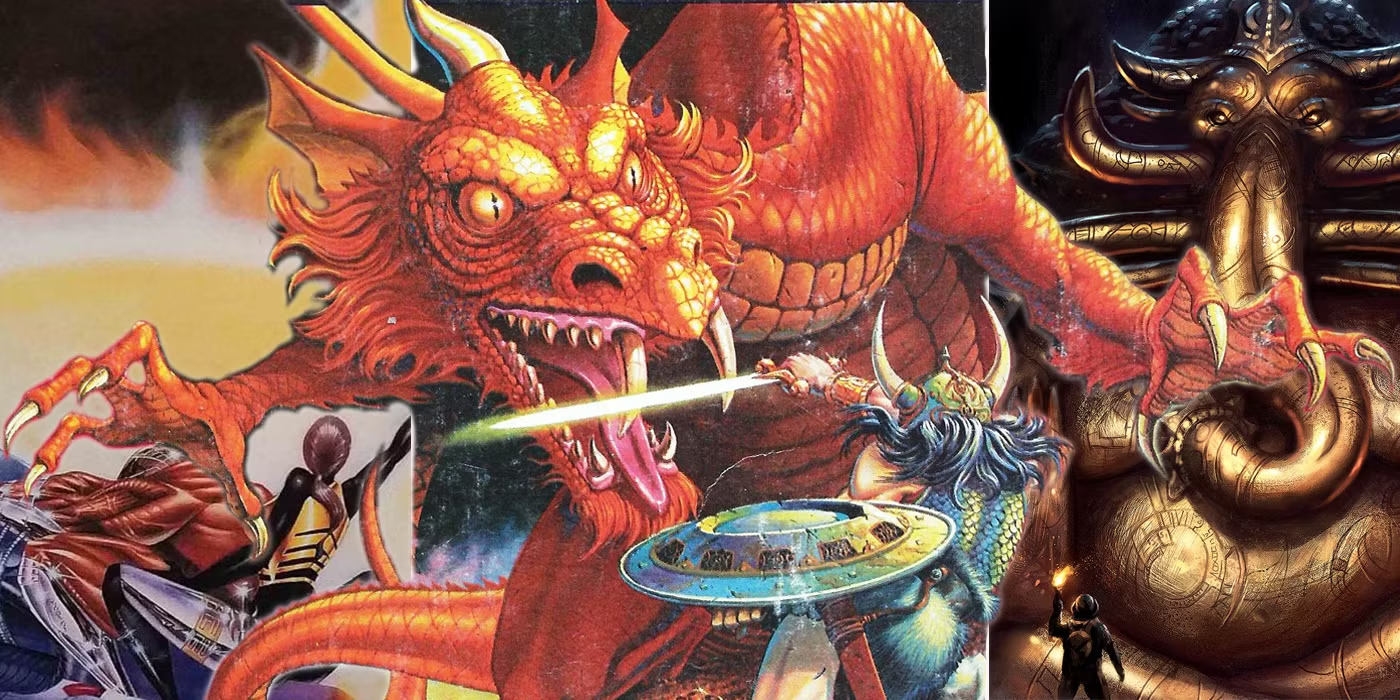
Here’s the thing: I love fantasy RPG’s—truly. I could spend hours agonizing over a top 10 list, shuffling titles around, and second-guessing myself. But one thing is certain: Classic 1st edition Advanced Dungeons & Dragons is one of the most robust and compelling RPG traditions ever created for fantasy storytelling. Hands down.

Note, I did not call 1st edition AD&D a game, because to me, it’s always been more than just that, nor would I exactly escribe it as an RPG by today’s standards. AD&D is unique, a game with a very special approach and essence which did not exist before it in any game and has not been replicated in any games since. Every version of D&D that followed lost sight of this hidden essence, that magic that exists between the game as a rule set and the tradition that was born in Gygax’s definitive work. AD&D as a gaming tradition, an activity, and a collaborative storytelling tool, far exceeded the presumed simplicity of being a rule system and a game. I don’t know that Gygax intended for this to be true about his game, quite to the contrary, I think he was trying to create just that, a definitive rule set with AD&D, but like any art form, happy accidents happen. That happy little accident would never again be repeated, and every edition of the game has tried but failed to recapture the magic of the original.

Mind you, this is not for the lack of trying; in fact, I think most editions of the game have tried very hard to mirror the magic of AD&D, but the truth is that most designers even today can’t fully explain why this original version is different. I don’t think I could fully explain it either; it just is. An intangible quality exists in AD&D that is simply ineffable. As ineffable as it may be, I feel obligated to at least try to explain it, but I say this here and now, this is NOT about nostalgia.

Why do I gravitate toward this strange and inexplicable classic? Because I’ve always believed (as did Gygax) and still do that the most powerful, memorable role-playing happens when players don’t know the rules inside and out of how it’s done behind the screen. In the case of AD&D, it’s mostly because the rules are unknowable, thanks to the cryptic way in which they are described in what I consider the most important book in the RPG hobby ever written, the 1st edition AD&D Dungeon Master’s Guide.

The 1st edition Dungeon Masters Guide is one of the most unique books ever written. It doesn’t just guide you through the process of creating worlds for players to live in, but it teaches you how to present that world in a way that will inspire players to believe in it.

Don’t get me wrong, it’s not a critique of AD&D. Every player, given the chance, will lean into what they know; it’s only natural that when you know the rules of a game, you start using those rules to your advantage as a game. True magic happens when players don’t know how the game works. The less they know, the more they have to trust their natural instincts at the table. Not knowing the rules activates your imagination, and players start acting like people living in a story rather than characters moving through a system. They make choices that feel right, because they don’t have the option to make sure their choices are mechanically sound. This is the magic of AD&D, it refuses you the foundation of rules upon which to make decisions, leaving you to your collaborative imaginations. Some (in fact, most) would argue this is bad game design, but I would argue that it’s perfect game design. It makes the act of role-playing the only avenue for all participants. There is no game here upon which to hang your hat.

And that’s where the magic happens.

Especially in fantasy, where gods walk the earth, monsters lurk in the dark, and magic bends the very fabric of reality. Not knowing how everything works is a feature, not a bug. It creates a sense of wonder, of discovery, of trying things to see what they do. Players aren’t just learning about the world, they’re learning how its very physics of the world operates.

There were many versions of Dungeons and Dragons, both official and unofficial, but every book that followed 1st edition AD&D strived to be a rulebook first, presenting the game as a mechanical architecture for creating a game at the table that everyone, especially players, could understand. Only 1st edition AD&D saw itself as a creative toolkit for collaborative storytelling, targeting the DM as its master.

For me, 1st Edition AD&D will always be my first love and for that it can be easy to write it off as nostalgia and often with old school games this is the case with me, but not so with AD&D. If I had the chance, I’d run a classic game exactly as I believe it was always meant to be played: with a little mystery, a lot of imagination, and just enough chaos to keep everyone guessing.

Science-Fiction – Alternity

I was this close to picking The Aliens RPG by Free League Games. It’s a fantastic system for intense, edge-of-your-seat one-shots. But let’s be honest: once the xenomorphs are out in the open, the mystery that is the Alien movies vanishes, and with it, a lot of the drama. It’s hard to stretch that tension into a long-term campaign without it wearing thin, despite the fantastic game design that went into the Aliens RPG. I love it, but a good foundation for a long term RPG campaign – it’s not. It is a one-shot, nothing more, nothing less.

If Gygax is the pioneer of fantasy RPG’s, there is no question that Bill Slaviscek and Richard Baker were the pioneers of science-fiction RPG’s. Alternity is a master class in how science fiction should be approached as a storytelling game.

So in the end, it came down to a real heavyweight match: Star Wars RPG by West End Games versus Alternity by TSR/Wizards of the Coast. And while both hold their own with style and substance, I give the edge to Alternity for one reason only: The Stardrive campaign setting.

The setting designed by Richard Baker, one of the sharpest minds in the business, pushed Alternity over the top for me. It’s original, ambitious, and packed with the kind of rich lore that inspires long-term storytelling.

The Stardrive campaign setting is an epic tale of humanity’s rise to the stars, and despite being written in the late 90’s, the history of this setting rings more true today than it did back then. It’s a fascinating read, almost as if it’s a prediction.

But Alternity as a system is more than just a great way to bring a setting to life. It’s the unsung pioneer of the d20 era. Before 3rd Edition D&D made the mechanic mainstream, Alternity was already out there, blending class-based progression with skill-based freedom in a way that felt sleek and forward-thinking. It wasn’t just a set of rules, it was a toolkit for building any kind of science fiction world you could dream up. It’s the tragedy of the 21st century that Wizards of the Coast would take the d20 system invented with such perfection and completely botch it over the course of 3rd, 4th, and 5th edition D&D. They had the perfect model for a perfect system and decided to foolishly ignore it, but I digress.

Need spacefaring starships, cybernetic upgrades, rogue AIs, mutant powers, alien civilizations..the list goes on and on! It’s all there. Not just as a flavor, but with clean, well-designed mechanics that make it all sing at the table. There is no science-fiction setting that has ever been or ever will be created that you can’t replicate with perfection with the Alternity RPG.

I still believe that West End Games take on Star Wars is the best version of a Star Wars RPG to date. In effect, it makes Star Wars feel more hard science fiction, unlike the movies that pushed the setting into science fantasy.

Alternity gave us a framework where science fiction didn’t just feel possible, it felt limitless. That’s why, for me, it’s the gold standard for sci-fi roleplaying.

If I was going to run a science-fiction game today, there is no question it would be Alternity. The only exception I would make is for Star Wars, in that case, it would be the West End version of the game.

Other – Mage The Ascension

Over the past thirty years, I’ve run World of Darkness chronicles more times than I can count, and every single one stands out in my memory. There’s something about this universe that sticks with you. It comes in many shades: vampires brooding in neon-lit alleys, werewolves howling at the edge of the apocalypse, and wraiths lost in their own sorrow. But the default flavor has always been Vampire: The Masquerade.

And don’t get me wrong, Vampire deserves its fame. It’s probably the most iconic and approachable entry in the World of Darkness line, and for good reason. But if you came to me right now and said, “Run a World of Darkness game,” I know exactly what I’d pick: Mage: The Ascension.

Like Vampire, Mage puts players in the shoes of powerful supernatural beings. But where Vampire centers on politics, survival, and control over the mortal underworld, something players can more easily connect with, Mage reaches for something far more abstract and far more profound.

One of the big burdens of Mage The Ascension is that it’s focused on a wide range of unique takes on belief systems. It’s one of those RPG’s where everyone needs to read it cover to cover to really understand it, it’s difficult to present it as a GM. White Wolf games require a lot of self-reading because so much of the games storytelling is buried in the details of the setting and aesthetic backdrops, but nowhere is this more true than Mage.

In Mage, your faction isn’t just a club or a bloodline, it’s a belief system. A worldview. And the war isn’t over turf or influence, it’s over control of reality itself.

The Technocracy reigns in the modern age, shaping the world through science, reason, and the rigid laws of physics. But the twist is that, this version of reality is just another kind of magic, one that’s been accepted by consensus. Other mages, the ones who Awaken to alternate truths (the players), fight back not with bullets or blades but with paradigm-shattering ideas. The conflict is philosophical, spiritual, and metaphysical; the journey I can only describe as a mind-bending acid trip.

When you run Mage, you’re telling a story about characters who don’t just cast magic, they reshape the fabric of existence. And the more they push, the more the world pushes back. It’s a game where players don’t just feel powerful, they begin to believe in the power of belief itself.

To this day, I’ve never had the chance to run a full Mage chronicle—and I’ve been itching to do so for years. I love this setting. I ache for the chance to guide a group through its mysteries. If the opportunity ever came up? Let’s just say I’d be all in.

Boardgames

When it comes to board games, the number of categories is ridiculous, and I could make a solid argument for any of them. If, however, you forced me to pick three, forsaking all others, I think this would be the list.

Lifestyle Games – Twilight Imperium
Without question, the single best boardgame ever designed…period.

If I could conjure up a dedicated group of Twilight Imperium fans with the snap of my fingers, I’d be running a weekly game in a heartbeat, and I doubt I’d ever get tired of it. I know because I once had that, and it was and still is to this day, the best boardgaming experience I have ever had. It’s an irreplaceable memory that I will always chase because, in my view, Twilight Imperium is a one-of-a-kind masterpiece.

Twilight Imperium isn’t just a board game. It’s a commitment, a journey, and for those willing to invest the time, it becomes something greater: a lifestyle. This is a game with layers on top of layers. What looks at first like a complex 4X space opera transforms into an ever-evolving, deeply human drama of ambition, alliances, betrayals, and vision.

Yes, it’s long. But that time investment isn’t a drawback it’s what allows the story to breathe. The game unfolds like an epic saga, each session an emergent narrative shaped by the choices, fears, and aspirations of the players around the table. It’s a game that brings out raw human drama, both imagined and real at the table. I have seen how passionate players can get about this game and I thirst for those experiences.

On the surface, Twilight Imperium is a combination of a civilization builder and war game, filled with rich lore, factions with asymmetric powers, and galactic conquest. But dig deeper, and you’ll find a game of psychology, political maneuvering, negotiation, and strategic bluffing. As I like to call it, the real game behind the mechanical one. Every move is loaded with meaning. Every word spoken a ploy. Every silence held can shift the balance of power.

You don’t just play Twilight Imperium, you live it for the duration of the game. You embody your faction’s ethos. You forge uneasy alliances, backstab former friends, and navigate the ever-turbulent currents of the Galactic Council. You calculate every vote, every trade, every fleet deployment with a mix of tactical precision and raw gut instinct.

With two dozen unique factions, dynamic objectives, modular galaxy maps, and endless human variables, Twilight Imperium offers infinite replayability. It’s a true modern masterpiece, an epic that’s far too often overlooked because of its scale and length. But for those who make the leap, the rewards are unmatched.

This used to be a game I played all the time and I can’t think of any gaming experience I miss more, it’s right up there with 1st edition AD&D and Battletech!

Tactical Games – Battletech
Its a cross between boardgaming, miniature gaming and role-playing.

Some might call BattleTech a miniatures game and sure, technically it is. But to me? It’s always been a dice-chucker board game disguised as a tactical miniature game, dressed up in pewter and plastic, pretending to be part of the miniatures crowd while doing its own brilliant thing as a role-playing game. It’s a strange mixture but it works.

BattleTech is incredible for three big reasons.

First, the lore. It’s a sprawling, obsessively detailed tapestry of interstellar warfare, dynasties, betrayals, and battle mechs the size of small buildings. You can trace the fictional design history of a single ‘Mech model, who built it, where it was deployed, how it evolved with more depth and nuance than many real-world war machines. We’re talking more lore than Warhammer 40k, and I don’t say that lightly. If you’re a story-driven gamer like me, this universe is an absolute goldmine of narrative potential. It’s a robust setting that rivals most role-playing games.

Second, the game itself. The core mechanics of BattleTech have remained remarkably intact for over 40 years. In a world where games are constantly rebooted, patched, streamlined, or gutted for new editions and marketing cycles, BattleTech is a white elephant. Buy a rulebook or a miniature in the ‘80s, and your game is still valid today. Still playable. Still awesome. That kind of long-term commitment to players and collectors is practically unheard of in the tabletop world. And here’s the kicker: as of 2025, BattleTech is the third-highest-grossing miniatures game in the world. Proof positive that you don’t need to screw over your fanbase with constant reinvention for a cash grab to make a living in the industry.

But honestly, those first two reasons are just icing on the cake. The real reason you should play BattleTech is this:

It’s a glorious, chaotic, beer-and-pretzels dice chucking tactical slugfest. A crunchy, customizable, story-driven war game where everything that can go wrong probably will — and that’s the fun of it. Yes, there’s tactical play, but this isn’t chess. This is a cinematic, slow-motion trainwreck of overheating engines, ammo explosions, critical hits, and desperate Hail Mary maneuvers. It’s a game where you feel the damage, as your mech gets carved apart limb by limb in a ballet of ballistic fire and reactor meltdowns.

Only one other game I’ve played, Warmachine, gets anywhere near the same granular feel of mechanized combat. Unfortunately, like most miniature games, the constant rule changes, reboots, and updates completely ruined Warmachine. Battletech has stayed the course and remains all about managing your loadout, balancing your heat, and watching as your prized war machine limps across the battlefield, missing an arm and trailing smoke. That’s peak drama. That’s BattleTech.

I love this game. Always have. It’s one of the few on my shelf where pieces I bought in the ‘80s can legitimately still hit the table, no updates needed, no strings attached.

Sadly, like many of my hipster gaming passions, BattleTech isn’t exactly mainstream in my circles. I rarely get to play these days. But if someone asked me to drop everything for a match?

Hell yes. I’d be there in a heartbeat.

Event Games – Western Empire (Advanced Civilization)
The original Avalon Hill version of this game was quite ugly, like many games back then, they lived in your imagination which was kind of the point of table top gaming in general.

If you’ve followed this blog for any length of time, you already know War Room is one of my favorite event games. It doesn’t make the hipster list, though, mostly because I actually get to play it and I believe it to be a well-designed modern game, there is nothing hipster about it. My friends are kind enough to indulge me once a year (usually around my birthday), and while it’s big, bold, and unique, at the end of the day, it’s still an Axis & Allies descendant.

Now Western Empires, or as I still instinctively call it, Advanced Civilization, is hipster gaming royalty.

Shut up and sit down, I think did the best and most honest review of this game I have ever seen, flaws and all, but they their is one observation that they sort of failed to make which is that what they saw as flaws in the game from a gamers perspective are very intentionally designed features. It’s sort of like accusing Star Wars of having too many lightsabers.

I’ve talked about this game plenty before, and for good reason. It’s a sprawling, epic beast of a board game. Designed for a minimum of five players, though let’s be honest, it really wants nine (yeah you heard that right). Clocking in at a cool 12 to 15 hours, it’s less a game and more a full-day historical event. It is, without exaggeration, one of the hardest games to actually get to the table.

To put it in perspective, I haven’t played a live game of Advanced Civilization in over 20 years. Two decades. And yet, I’ve always kept a copy on my shelf. Just in case. Always hopeful that one day this one will get its moment in the sun.

At its core, Western Empires is a game of historical empire-building and economic maneuvering. There’s trading. There’s a touch of area control. Sometimes, it even pretends to be a war game. But really, it’s about managing the wild, unpredictable chaos of history. You stretch your reach, you push your luck, and you try to outmaneuver your rivals not with brute force, but with sharp wits and sharper tongues.

One of the biggest reasons this game rarely hits the table, aside from the sheer time investment and player count requirements, is that modern gamers often expect strategy games to reward clever, clean moves. Western Empires doesn’t care about your strategic brilliance. This is not a game of perfectly calculated efficiency. It’s a game of negotiation, adaptability, and psychological warfare. The best players aren’t the ones with the most optimal city placement, unit movement or strategic planning. They’re the ones who can read a room, spin a trade, and deliver a betrayal with a smile while staying the course of the inevitable and uncontrollable ups and downs of the game’s natural ebb and flow.

You don’t play the game, you play the players. That’s where the real magic is.

There’s really nothing else quite like it. The closest modern comparison might be Small World, and that’s a real stretch for a comparison, as it matches only some of the subtle nuances of mechanics. Western Empires occupies a weird, wonderful niche all on its own.

And that’s why it’s here, on the hipster list. I know full well this kind of game isn’t for everyone. Hell, it’s barely for anyone. Finding eight other souls who are all willing to commit an entire day to a relic of the 80s is an impossible task in most gaming circles. But if I ever found the right group, you better believe I’d make this a yearly tradition, right up there with War Room.

Quirky, chaotic, and criminally underplayed. That’s what the hipster list is all about.

Euro Games –

Miniature Games

When it comes to miniature games I would argue there are also quite a few different ways these games can be categorized, but I think a simple way to do it would be to split it between casual games and competitive games. It’s a broad, but it’s easy to distinguish way to do it. I would only add one third category, which I would call semi-miniature games, in which I would place miniature games that don’t have a miniature painting hobby component at all.

Casual – Warhammer 40k
40k is an all-encompassing hobby, stretching far beyond simply playing the game, and that is kind of the point of it. It’s a bit like loving Star Wars.

Ironically, in 2025, playing the most popular miniature game in the world might be the most hipster thing you can do.

Why? Because the moment Warhammer 40k comes up in conversation, it’s almost guaranteed someone will start rattling off a list of games that are “better in every way” and listing all the things that are wrong with 40k. And they’re not wrong, there are more balanced, more strategic, more thoughtfully designed games out there, lots of them. But sticking with something you know could be objectively replaced by a dozen superior alternatives? That’s peak hipster energy!

But let’s talk about the most fascinating part of the 40k experience: the community.

Across the globe, the Warhammer 40k community treats the game like a competitive titan, and to be fair, it is the largest and most active competitive tournament scene in all of tabletop gaming, by a long shot. The sheer scale of organized play is staggering.

And yet… Games Workshop, the company behind 40k, doesn’t seem to agree. At all.

To GW, Warhammer 40k is primarily a miniature line, secondarily a source of lore and novels, and somewhere far down the list, it’s technically a game. Their support for competitive play feels more like a reluctant nod to what the community chooses to do with their game, than a purposeful commitment or intent for it. The rules are often unbalanced, the game systems are regularly reworked or mismanaged, and it’s clear that game design is not what drives the brand. What we have here is a competitive community built on a system that was never meant to bear the weight of serious play. And somehow… it thrives on that very thing.

In a word, I would argue that Warhammer 40k is not a great competitive game, and when people trash-talk it, that’s really what they are talking about. But it’s a fantastic hobby and a super fun, casual experience, aka, exactly what it’s designed to be.

It’s a beer-and-pretzels dice-chucker in a gothic sci-fi shell, where the real joy comes from painting your army, crafting your own narrative, and then putting it all on the table to roll some dice and blow stuff up. The rules are often clunky, the strategy is there only to a point, but largely buried under layers of “smoke and mirrors.” Winning isn’t about mastering a perfect system, it usually comes down to how well you roll the dice.

And despite all that? I love it.

The mission system is genuinely dynamic, with flavorful objectives and varied scenarios that keep the game feeling fresh. The list-building is wide open, full of creative options and wild combos. But at its core, this is a casual game through and through, one that thrives on the atmosphere around the table and the lore on which it’s based, not in the pursuit of perfection of its gameplay.

Warhammer 40k is about collecting and painting miniatures, swapping war stories, and diving into the endless supply of pulpy, over-the-top lore of a universe where everything is grim, dark, and somehow still gloriously silly.

It’s a hobby. A vibe. A lifestyle, even. Flaws and all, I wouldn’t trade it for anything else.

Competative – Songs of Ice and Fire
I would argue that Songs of Ice and Fire the miniature game is the only rank and file miniature game ever made that actually works well as a game rather than a terrible history lesson about how boring war on the battlefield actually is.

I’ll be the first to admit: I don’t play A Song of Ice & Fire much these days. It’s had a rough road, marred by some truly questionable management decisions over the years and plagued with availability problems. But even with all that baggage, I still consider it one of the most compelling competitive miniature games out there.

This is very much a game that lives in the “I wish” category. I wish it had been better supported, wish it had stuck the landing in balance and they did it all much faster, and wish it still had a place at my table. There’s a part of me that’s still hopeful it’ll stabilize and find its footing again, maybe even make a comeback in my group.

I went in deep on this one. Despite its flaws, I found A Song of Ice & Fire to be one of the most engaging strategy games to hit the miniature scene since Star Wars: Armada. At its core is a genuinely smart design, layered list-building, unique unit interactions, and some fascinating sub-war game mechanics like the NCU board and tactical card play. When it clicked, it really clicked.

Except when it didn’t.

To be fair, most of the problems I ran into weren’t with the design itself — they were with the balance. And yes, you could argue that design and balance go hand in hand (and you wouldn’t be wrong), but I still think there’s a meaningful distinction. A game can be brilliantly designed but hampered by poor balancing decisions, one can be fine-tuned, the other is just a flaw. That’s A Song of Ice & Fire in a nutshell: great foundation, uneven execution.

Now, I haven’t kept up with the latest updates, so maybe things are better these days. But in my local scene, the damage was done, people moved on, and getting a game back into circulation after a group loses faith in it is no small feat.

And then, there’s the personal hurdle: painting.

This one’s tough for me. Being a mass army game, ASOIAF demands batch painting. Lots of similar models, unit after unit, rank after rank. And repetitive painting is my kryptonite. I just can’t stay motivated painting the same miniature ten times in a row. It sucks the joy out of the hobby for me, and ASOIAF is particularly brutal in that regard with no list building avoidance some games offer.

All that said? I still think this is a fantastic game. It deserves recognition. It’s competitive, it’s clever, and when it’s running smoothly, it offers a rich tactical experience that not many miniature games can match. That’s why it earns a spot on the hipster list, a flawed gem that still shines when the light hits just right.

That said… its time may be running out. Modern miniature design is evolving fast, and with games like Warcrow on the horizon, strong contenders are lining up to take this slot permanently.

The Most Fun – Star Wars: X-Wing
In my mind, Star Wars X-Wing is still one of the best miniature games ever made. PERIOD.

When talking about the miniature game hobby, there’s always one title that sparks debate, some say it barely qualifies as a miniatures game at all. I’m talking about X-Wing. And frankly, I don’t buy the skepticism. Slap those sleek ships onto a sprue and suddenly there’d be no doubt where it belongs.

Yes, it’s pre-painted. Yes, it’s more accessible than most. But that doesn’t disqualify it, it redefines the space. X-Wing was designed to walk the tightrope between a serious competitive game and a relaxed casual experience, and it succeeded. Brilliantly. This game brought three key advantages to the table that most miniature games either ignore or fail to execute well. And those three factors are why X-Wing stood tall in the market for years, even managing to shake Games Workshop out of its golden-era complacency.

First, the pacing. X-Wing matches are quick, typically 45 minutes. That’s practically warp speed in miniature gaming terms. It made the game ideal for tournaments and casual nights. You could run multiple matches in an evening, try out a bunch of new lists, and still have time to argue about who really shot first. There’s no hour-long rules refresh or setup slog—just “Hey, want to play?” and you’re in. That kind of approachability is rare in the hobby.

Second, it’s Star Wars. That’s not just thematic dressing—it’s a gateway. The brand brings in people who’ve never even looked twice at a miniature game. You don’t have to explain the appeal of piloting an X-Wing. You show someone the TIE Fighters screaming across the table, and they’re already halfway sold. I’ve never seen a non-gamer pick up Warhammer 40K on a whim. But X-Wing? That’s the one that brings in the curious, the casual, the movie fans, the dads and uncles and kids who just want to fly the Falcon.

Third, and maybe most importantly, X-Wing made high-level tactical play accessible. The rules were simple on the surface, but the depth was staggering. Movement planning, arc dodging, list synergies, action economy, there was real meat on those bones. You didn’t have to learn 200 pages of codex lore to be competitive. But if you wanted to go deep, the game rewarded you. It hit that perfect balance: easy to learn, hard to master.

X-Wing wasn’t just another miniatures game. It was a lightning-in-a-bottle moment in the hobby. It opened the door to a new audience, streamlined what was possible in design, and reminded the rest of the industry that a game could be both fast and deep, fun and tactical, cinematic and competitive.

Whether you play it today or remember it from its heyday, X-Wing deserves its place in the conversation, not just as a miniature game, but as one of the best games to ever grace a tabletop. In my personal opinion, its the single best miniature game that we have gotten in the 4 decades of I’ve been around.

Best Design – Star Wars Armada

When first announced, everyone thought that this would be X-Wing but with capital ships. It certainly looks the part, but Star Wars Armada is an entirely different and far heavier game that demanded a lot more from its audiance.

One final entry I’d like to sneak onto the hipster list—and I say this with as much objectivity as a subjective opinion can carry—is my pick for the best-designed miniature game out there.

To take this crown, a game has to meet a singular, uncompromising criterion: skill must reign supreme. Like chess, where grandmasters fall only to their peers, this kind of game leaves no room for chance to decide the victor. It must be a pure contest of mastery, where the dice are just accessories, not arbiters of fate. And in the world of miniatures, that game is Star Wars: Armada.

Sure, there are dice. But make no mistake, those little cubes only matter when two evenly matched minds clash. In Armada, outcomes are forged not by luck, but by foresight, precision, and relentless practice. It’s a game that rewards not just play, but study. The kind of study that turns casual fans into hardened tacticians.

But here’s where it gets really compelling: Armada doesn’t just test you on the battlefield. It demands mastery before the first ship even hits the table. The list-building is deep, nuanced, and packed with options that will make your head spin if you’re not ready for it. Understanding the shifting meta, anticipating counter-play, these are not fringe skills, they’re the bedrock of victory. The game is highly deterministic, which means your preparation matters as much, if not more, than your moment-to-moment decision-making at the table.

That it’s set in the Star Wars universe, with massive capital ships slugging it out in glorious slow-motion ballet? That’s just the sweet, sweet icing on a very dense, very intimidating cake. But fair warning: Armada is not a casual fling. It’s a demanding, often unforgiving beast that can feel downright brutal if you approach it half-heartedly. You don’t play Armada, you train for it, like a chess grandmaster gearing up for the championship board.

D&D Theory: How The OSR is Re-Writing D&D History

I count myself lucky to have lived through the golden age of tabletop role-playing—the glorious trifecta of the ‘80s, ‘90s, and 2000s. It was a time of wild imagination and fearless design. From the old-school grit of 1st Edition Dungeons & Dragons to the brooding elegance of White Wolf’s World of Darkness, from the sleek reinvention of the d20 system to the rebellious birth of the OSR—those years were, in a word, glorious.

But I was there for the hard times, too. The day TSR gasped its final breath. The strange, gamey detour of 4th Edition. And the day we lost Gary Gygax, the original Dungeon Master, the man who kicked off this beautiful madness in the first place.

It’s been a hell of a ride—but today isn’t about D&D’s past.

Today, we’re talking about the future. Specifically, the way this community—scrappy, brilliant, and unrelenting—is seizing the reins and dragging Dungeons & Dragons forward, not with bloated corporate rulebooks, but with raw creativity. Today we are talking OSR games!

Because while Wizards of the Coast seems hellbent on tarnishing the game’s legacy with one corporate faceplant after another, the real torchbearers are out here in the trenches, putting out some of the most exciting, innovative, and downright fun material the hobby’s seen in years.

So yes, we’ll throw a little well-earned shade at Wizards of the Coast. That’s dessert. But the real feast? It’s the creators. The OSR authors, artists, and designers who are resurrecting the heart of D&D with zines, hacks, modules, and games that feel like they’re alive. This is a love letter to them—and a look at the bold, weird, and wonderful future they’re building for all of us.

Let’s get into it!

What Is The OSR Really?

Let’s get some discourse out of the way for those less informed. Once upon a time, this was a pretty straightforward question. The OSR—Old School Renaissance (or Revival, depending on who you ask)—was a movement of grognards and die-hards who loved the old-school D&D systems so much, they used the Open Game License (spawned in the 3rd Edition era) to breathe new life into them. They published retro-clones, retooled classics, and sprinkled in house rules like spice on a well-worn stew.

But that was just the beginning.

Today, the OSR has evolved into something bigger, weirder, and far more powerful. It’s still about preserving the spirit of the old ways—sure. But more than that, it’s become a sandbox for unfiltered creativity. It’s where designers and dungeon masters throw off the shackles of corporate oversight, social media discourse, and sanitized storytelling. No HR departments, no focus groups, no trend-chasing. Just pure, undiluted game design.

Think of it like the indie film scene: raw, passionate, and often a little rough around the edges—but in the best possible way. The OSR is where the Tarantinos and Lynches of tabletop design hang their weird little hats, crafting games that are as bold and bloody as they are beautiful.

In a word? It’s a movement.

But more than that—it’s the movement that’s shaping the future of tabletop gaming. And, oddly enough, because of Wizards of the Coast’s seemingly inescapable inability to get out of their own way, it’s also very much the future of Dungeons & Dragons itself.

The True Catalyst – Relevance

You might look at the endless headlines—Wizards of the Coast tripping over its own feet, again and again—and think, “Ah, there it is. That’s why the community is turning away”. Sure, their shameless blunders haven’t exactly earned them any goodwill, but that’s not really the whole story.

The truth is, fans are oddly loyal. Painfully loyal. People love Dungeons & Dragons—even when they don’t love the people making it. Even when they can’t stand the current edition. There’s this almost irrational tolerance in the community. As long as Wizards of the Coasts keeps evolving their game, their first love, people are willing to grit their teeth and smile through the nonsense.

So no, the shift we’re seeing isn’t just a reaction to Wizards screwing up—though they’ve done plenty of that.

Dungeons and Dragons 2024 edition is now fully released. To quote Padme, “so this is how liberty dies, with thunderous applause”. Yes, I’m being a bit dramatic!

The real problem…. the one that haunts Hasbro boardrooms like a slow, creeping death… is relevance.

You see, for all its drama and divisiveness, every edition of D&D up until now brought something new. Something big. Each version was both an evolution and a revolution. First and Second Edition laid the foundation for the OSR and that gritty old-school feel. Third Edition gave us tactical depth and rules mastery not to mention the OGL, spawning entire empires like Pathfinder and Castle & Crusades. Even Fourth Edition, the black sheep, gave rise to bold designs like 13th Age and, more recently, MCDM’s Draw Steel. Fifth Edition opened the floodgates to mainstream success and spin-offs as well, but it also gave birth to Critical Role, which opened up millions of creative minds to the world of storytelling possibilities.

Love them or hate them, every edition mattered.

Until now.

Enter the 2024 Edition. D&D’s big 50-year celebration. A chance to show the world that the game still has teeth and that Wizards of the Coast still leads the most prolific franchise in gaming.

And what do we get? A rebrand. A soft reboot. A product that feels neither evolutionary nor revolutionary—just… there. Polished, sure. But also sanitized, safe, and stifled by corporate oversight and performative politics. It’s a game trying to be all things to all people, and in doing so, has managed to feel like nothing at all.

It landed with a whimper. A shrug. A yawn and we are all left holding this hefty, overpriced book wondering… is this it?

Unlike during the Fourth Edition era, when choices were limited and OSR was still in its scrappy youth, the landscape has changed. The OSR has exploded into a kaleidoscope of systems, zines, hacks, and heart-pounding one-shots. What was once a trickle is now a flood. If anything, we’ve gone from too few options to so many that you’ll need a torchbearer just to navigate the shelves.

But, enough prelude. You’re caught up. That’s what’s happening in D&D, a whole lot of nothing and the OSR is here to save the day.

I have made a list like the following before. see this article back in 2021, but here are five more awesome OSR games paving the way for the future of tabletop RPG’s.

Shadowdark

I knew, without a flicker of doubt, that when I reached this point in the article, Shadowdark had to take the lead. From the wildly imaginative mind of Kelsey Dionne, founder of The Arcane Library, Shadowdark isn’t just an OSR game, it’s the answer to the question: What if classic Dungeons & Dragons were designed today, with modern sensibilities but old-school soul?

This game doesn’t merely pay homage to the golden age of RPGs; it resurrects it, reforged in the fires of streamlined design and accessible play. It’s a masterclass in how to respect the past without being shackled by it. Everything about Shadowdark screams purpose- it’s a true dungeon crawler, built from the torchlight up to emphasize danger, tension, and immersive play.

And yet, it’s more than that.

It’s intuitive to run, brilliantly supported by Kelsey and her team, and evolving fast. The game’s Kickstarter success is the stuff of legends, raising over a million dollars in a single day for its upcoming expansion. That’s not just popularity; that’s momentum. And with that momentum comes growth. The system that began as a love letter to torchlit corridors and lurking horrors is now expanding into a full-fledged, grimdark world rich with lore, cultures, monsters, and mystery.

I’m super psyched for this one, it’s very high on my must play list, and I’m certain I’m not the only one if that Kickstarter is any indication.

Mörk Borg

Designed by Pelle Nilsson & Johan Nohr, two guys from my neck of the woods (Sweden), this one falls into the category of a little bit creepy, a little bit gonzo style RPG. While the game is rules light, it has a considerable amount of crunch to it’s combat with a rather viceral doom metal approach to its world design.

In essence, you’re playing in a world that is ending, living out your last days in a brutal and nihilistic setting that forgives your sins but shows you no quarter. It’s full of amazing art and takes a very direct, pick-up-and-play approach that doesn’t feel “one-shotty” thanks to having meat on the bones where it counts and an awesome, addictive grimdark world. Read all about it HERE.

Castles and Crusades

Imagine what would happen if Gary Gygax made a 3rd edition of Dungeons and Dragons using modern game design techniques, that in a word is Castles & Crusades. A game that takes all of the modern mechanics and streamlining of 3rd edition but with 1st and 2nd edition AD&D sensibilities. That is what the work of Stephen Chenault and his brother Davis Chenault from Troll Lord Games gave us. A true and pure gift.

Castles & Crusades is a reasonably crunchy, yet distinctively Dungeons and Dragons in what I think is probably one of the truest and most honest attempts to re-write Dungeons and Dragons edition history. In so many ways, this is the real 3rd edition of Dungeons and Dragons. Everything you think D&D is, is in here but without all the nonsense Wizards of the Coast put us through in the last few editions of the game. Pure, unfiltered Dungeons and Dragons!

The amazing thing is that it’s a free game, you can get it here and check it out yourself.

Dolmenwood

I have talked a lot in the past about Old School Essentials, having run the game for the better part of 3 years in a single campaign. It is an awesome system that is essentially a Dungeons and Dragons construction kit, but also, when you get right down to it, it is effectively classic B/X 1st edition D&D.

Dolmenwood takes that base and builds upon it an entire setting with a very focused playstyle geared towards exploration of the world but also of an underlining history and story of the setting. Gavin Norman, the creator of both Old School Essentials and Dolmenwood, is probably one of my favorite OSR designers because he has an uncanny sense of order and organization, understanding the base principle of creating content and systems for the practical exercise that is playing a tabletop game.

Bringing that same approach that made Old School Essentials such a pure joy to run and applying it to a setting is exactly what I hoped to find when my Kickstarter PDF’s arrived. This is an excessively easy game to prepare, a vast setting with tremendous attention to detail that is easy to access thanks to this amazing organization and, most of all, absolutely inspiring writing.

I can’t wait to run this game for my friends because I know that this sort of attention to story and detail is exactly what my players crave. They love stories that break expectations, that are based on the characterization of a unique world, and most of all, they love long campaigns that they can lose themselves to.

Hyperborea

Of all the games on this list, Hyperborea is perhaps the most likely to have had an affair with old school 1st edition Dungeons and Dragons. There is clear Dungeons and Dragons DNA burned deeply into this game, and perhaps not surprising given it comes from the creative mind of Jeff Talanian, a known Gygax collaborator.

This game is heavily influenced by Appendix N, the famed list of pulp fiction upon which Dungeons and Dragons was based, but it’s clear from the setting design that Robert E. Howard’s Conan was among the author’s favorite.

You live in a decaying civilization where magic has gone terribly wrong in what I can only describe as a savage mix between Mad Max and High Fantasy. Grim, moody, and overflowing with danger, in Hyperborea, life is cheap, and your characters are less heroes and more survivors as you navigate your way through the primeval denizens that populate this setting. It’s a fantastic game with a big focus on the creation of unique fantasy characters that will undoubtedly break the expectations of even the most veteran tabletop groups.

Conclusion

Ok that’s it for today, hopefully, you found something on this list to explore. There is no question that there are far more games that deserve mention here; trimming this list down to five took considerable restraint. Perhaps I will do another one of these in the near future.

Highlights and Let Downs of 2024

When I put 2024 down on digital paper, I feel like I live in the future. It’s hard to believe it’s 2024 and even harder to believe the year is almost over.

I would make the argument that it’s been a great year for gaming but frankly, my gaming life has been full of ups and downs this year, and tons of really surprising results. While there has been some great gaming this year, had you shown me this highlight reel at the start of the year, I would not have believed it.

There is a lot of games to talk about so sit back and enjoy, it’s going to be a serious wall of text today!

Hegemony: Lead Your Class To Victory

It’s a tough learning curve, but unquestionably one of the most unique games I have played in a long time.

This was among my favorite discoveries in 2024, even though it was technically released in 2023. It’s a robust and very crunchy Euro with a lot of psychology built into it and a fair amount of cut-throat competition. It’s not something I would recommend for everyone, but for groups like mine who love to argue and play “take that” games, it’s right up our alley. The interesting part about this game is how all of these asymmetrical mechanics come together. Testing this game must have been a real hell because there is so much interaction, and so many game states possible, it’s kind of crazy.

This one came out for the first time at our big board gaming weekend in the summer, and it was a smash hit with everyone, we talked about it endlessly afterward and everyone agreed it needed to be played repeatedly! That was the first and last time we played this game.

This is not a reflection on the quality of the game but more of a reflection of its length and its harsh learning curve. It took us a solid 7 hours for our first game. Like Through The Ages which I will talk about a little later, it’s just a long, complex game and it’s a bit of a pain in the ass to teach. It also has one of those rule sets where every single micro rule and the order it’s executed in, is a gaming-breakingly important thing, meaning, play one tiny rule wrong and the entire face of the game changes. So playing the EXACT rules to the letter in this hyper-crunchy game is critical to a fair gaming experience, but because of its complexity, it’s easy to get them wrong. This creates this unusual quandary where you need to put together a dedicated, crack-squad willing to invest in learning the game on their own so that everyone at the table is efficient and knows how everything works. Without that, you end up with a 3-hour game that takes 7 hours to play.

It’s a great game but man, it’s tough to build up the will to play it.

Part engine builder, part thought experiment, Hegemony is an exceptionally unique game design that I think if you and your gaming group are hardcore, veteran board gamers that love that Euro crunch, this is a must-own. Easily a candidate for the best game I played all year. That said, it’s not very approachable and I think most tables will find that it’s a bit too much.

Warhammer 40k got a 10th edition

Way back in the 6th edition days, I was a huge Warhammer 40k player. We played a lot, I had two armies (Tyranids and Necrons) and I did the entire hobby thing from A to Z. I honestly never in a million years would have guessed that in 2024 we would be going back to it, I thought I was done with 40k forever. It’s return to our gaming groups consciousness is one of the wildest events of the year.

The game fell out of favor in my group over a decade ago, replaced by modern miniature games that focused on stronger gameplay and in many cases like Star Wars X-Wing and Star Wars Armada, cut the entire hobby part out of the game with pre-constructed and pre-painted miniatures. This became the norm in my group and even when we did buy into more hobby-centric games, we usually played those with unpainted miniatures like Songs of Ice and Fire for example or they were isolated to small parts of our group as the case was with Bolt Action for example. In either case, the choice of miniature game was always heavily influenced by gameplay quality over “hobby focus”.

Warhammer 40k and the entire hobby part of the miniature gaming hobby made a big comeback when the 10th edition dropped last year. In 2024, shockingly, there was a lot of both, gaming and hobby in the 40k universe in my group. I rebuilt my Tyranid army and several members of our group who had never experienced 40k bought into the game for the first time. It became a thing.

I’m pretty proud of my Tyranids, this towering giant took over 20 hours to complete. When people say Warhammer 40k is a hobby, this is no joke and it’s good to keep in mind that it’s a pretty expensive hobby at that.

What I can say about Warhammer 40k is that it’s still a pretty shitty game from a mechanics perspective. Especially compared to modern-designed miniature games that focus on strong gameplay. I think anyone who plays 40k knows that the mechanics of the game are there to facilitate the hobby part of the game and playing it is just something fun you do when you and your friends get together to show off your miniatures. As a game, it leaves a lot to desire.

Warhammer 40k is almost a role-playing sort of experience. You work on your army, read the manuals and codexes, do your list building, and absorb other content like the animated series and the novels. It’s sort of a story-driven, hobby where the game is just a thing you “participate” in to complete the circle. If you’re looking for a good competitive miniature game, pretty much anything else is better, but so far as the hobby goes, GW makes the miniatures; no question about it.

It’s a lot of fun but in more ways than one, 40k is more of a robust activity than a game and I think as long as you can accept that and not get frustrated by the crazy imbalances and mechanical weirdness, it really is a fun activity.

I will say however that 10th edition is probably the best version of the game mechanically in all the years I have played 40k. Still not good by any stretch of the imagination but a vast improvement over previous editions and GamesWorkshop has gone to great lengths to try to keep the game as balanced as they can. A+ for effort even if the final grade, is a C- and I’m being very generous here.

If you’re thinking about Warhammer 40k, I think it’s important to know that you do not get into 40k for the game. You get into it for the fantasy storytelling, the art, the books, the animated series and most importantly the hobby of building and painting miniatures. That is what 40k is first and foremost and it does a fantastic job of it. The game is an afterthought. It’s fun too, don’t get me wrong, but it’s not what I would call “mechanically good” fun, more like we get to play with the toys we made kind of fun.

Empire Of The Sun

Empire of the Sun is a grid-based, card-driven historical war game that covers the entire Pacific War. A more complete game has never existed.

I play Empire of the Sun as a matter of habit every year, not to suggest I don’t enjoy it, I do, in fact, it’s an addiction that must be fed but this year, it exploded. I played a ton of games, probably more this year alone than the previous 4-5 years combined thanks to a fantastic online community.

I do not generally recommend Empire Of The Sun to most people. This is a highly complex historical war game with an extreme level of simulation and deep strategic interactions. It is not for the faint of heart and all I can say is that as a gamer you should know if a historical chit-game is for you or not. This is a very specific, very niche style of game that is or is not in your wheelhouse.

That said, I can’t think of a game on my yearly playlist that I look forward to more than Empire of the Sun. Each year when it comes out, I know I’m about to experience a masterpiece, and this game never disappointments. I typically play it with online opponents as it can be very difficult to play this one in a single sitting with a live opponent. In fact, even online, a typical game of Empire of the Sun can take the better part of a month to finish even if you do live sessions of 3-4 hours at a time on a weekly basis. It is a 12+ hour game for most partners and can take considerably more than that if you suffer from analysis paralysis, which is something this game infects you with if you don’t already suffer from the condition.

Mark Herman is one of my favorite game designers because he makes games that he loves to play and it shows in his designs. A true master of his craft, but like all masters, it takes some soul searching to understand the how and why of his designs. There is a personal connection you build with his games that will have you digging far beyond just the mechanics and design of the game, you will find yourself watching Pacific War documentaries, reading history books and imagining what the world must have been for people in the Pacific War. This is not just a game, it’s an exercise for the brain and it’s good for you!

If that doesn’t appeal to you, avoid this one, it’s for the historical buffs and no one else.

Through The Ages: A New Story of Civilization

Through The Ages has been near the top of my all-time favorite games for a long time, but I’m very careful and picky about who I pull it out with. Pick the wrong people and you are looking at a 6-12 hour game that will suck the soul right out of your body.

This long-time favorite and staple of my collection usually collects a lot of dust because it’s just a very long and robust game, that can be dreadfully slow when playing with new or inexperienced gamers.

Fortunately this year I managed to get it to the table a couple of times with some veterans and not only was it a pleasant experience, but with some great competition it was lightning fast which proves two things. First, it doesn’t have to be a long game, this game can be played in under 3 hours with experienced players who know what they’re doing and two, it’s still one of the most competitive games on my shelf, with brutally tight end games.

I will warn you that this game normally takes 3-4 people the better part of 6 to 8 hours to play and can take upwards of 12+ hours to complete. Yeah, I’m not joking here, so be prepared for some long games when learning this one. People who suffer from analysis paralysis will be in hell and drag this game out endlessly, if that sounds like you, this is one to avoid. You need to be thinking ahead and making key decisions so that you’re your turn is nice and fast, executed with precision, that is the only way to get this game’s excessive length down.

I will say that so far as Civilization builders go, meaning games that give you that Sid Meier Civ feel, this is one of the best around.

For those out there looking for a similar gaming experience but want a larger group and shorter game, Nations is a pretty decent substitute and fits the same niche playstyle. It’s a great game in its own right, but some argue it’s a very “ugly” looking game.

This is a classic civilization builder, its tight competitive nature, unique dynamic card-driven gameplay, and diverse interactions make this one of the best of its kind. There is a reason this game has been at the top of BBG lists for decades! But yeah, you need to find the right people to play with, this is not a “let’s just play with anyone” kind of game, not unless you’re ready to spend an entire day playing it.


Sekigahara: The Unification of Japan

Stratego was one of the earliest gaming experiences I had as a kid and this game definitely reminds me of those days.

I was very late to the party with this 2011 release, but Sekigahara is a well-established war game in the community, sitting pretty in the number 6 spot among war games on BBG and 207 overall. That is pretty impressive for a dry block-based historical war game based on medieval Japanese warfare. I bought into this one and managed to get it to the table a few times this year and color me impressed.

There is a solid and obvious reason for this popularity. This is an extraordinary game combining tactical and strategic dudes on a map war game that is card-driven. The core feature of the game is the hidden unit concept built into blocks that make up game units similar to classic games like Stratego which gives this game a great “feel” at the table. I think the bulk of the games fun factor has to be this idea of setting up your units and board positions, with a strategic plan based on the minimal information you have about enemy positions and strengths.

It’s a very clean, yet tense competitive war game that is easy to understand but difficult to master. I’m not at all surprised about its status among war gamers but I do think that even at 207 on the overall list which is quite high for a historical war game, this one is grossly underrated. This is one of the most unique titles I have seen in quite a while, I can’t believe I’m only just now discovering it. This is one of those games you can introduce to anyone, there is nothing complicated about it at all. It’s a kind of chess-like atmosphere with a fun theme.

Very highly recommended for pretty much anyone interested in competitive two-player war games.

Underwater Cities

Very streamlined game with a fantastic theme, dynamic mechanics, and that easy to learn – impossible to master core that elevates it above the competition.

I’m a big fan of Terraforming Mars, I play it a lot and there are a few games that I can point to and say “If you like Terraforming Mars, you should try…..”. Well, Underwater Cities is that game.

It’s not exactly a duplication or replication of the mechanics, but it scratches a similar itch with its dynamic engine-building – card-driven gameplay. Also, like Terraforming Mars, you can’t just play this game once and feel satisfied, you will find yourself obsessing about how to play it more efficiently, how to make each card play more effectively and above all else trying to find that “killer” strategy in a game that is far too dynamic to ever definitely resolve.

This is not a puzzle that can be solved as is the case with so many Euro-style games, the sand is constantly shifting under your feet and you have to adapt and overcome using a unique approach in each game, with a surprising amount of game states. It’s what I love about Terraforming Mars and it’s what I love about Underwater Cities.

Fantastic game that looks amazing on the table, it’s easy to teach but impossible to master. It’s what Euro gamers crave, a fresh take on a familiar engine building formula. If you haven’t tried it yet, this 2018 release should be at the top of your list.

Everdell

This cute game about animals living in the forest has some teeth. Lots of potential!

I only played it once for the first time this year and still, it made a very strong impression on me. This rather simple resource management, worker placement and card management game is exceedingly thinky. There are clear strategies driven by a wide range of dynamics in the game that create a great sense of competitiveness while being very straightforward from a mechanics perspective. Very tight scoring and a bit of a race between engine building and scoring. The entire game runs like a well-oiled machine, clearly the result of thorough playtesting. I see a lot of potential for replayability here, but at this stage, given that I have only played it once, that is hard to say.

What I can say is that despite a single play, this is on my “stuff to keep an eye on” as I see a lot of potential in this one. The accolades and popularity of this game are warranted.

Eclipse: The Second Dawn For The Galaxy

It’s a hit-or-miss experience, for such an expensive game I would not recommend it over far better games like Twilight Imperium. It’s not a bad game, it’s just not good enough for the price tag

This is a game I keep going back and forth on and I think a big part of the reason for it is that the gaming experience itself can be hit or miss from session to session. Sometimes it plays like a tight, 4x strategy game with battles, technology and lots of sneaky and tricky moves (exactly what you hope for). All the stuff you hope to get out of a 4x civ builder. Other times it’s just this horrifically boring and predictable Euro where essentially nothing interesting happens and someone wins by default in about the most anticlimatic way a board game can end.

I hold to it to account for its supposed claim that it’s “a better” or “lighter” Twilight Imperium, it’s not, it’s not even in the same league. In the infamous words of Will Smith, “Keep my Twilight Imperium’s name out of your mouth!”, a Twilight Imperium anything, this game is not.

That said I do love the aesthetic and the game is well-designed even if the experience can land flat. I would argue it’s way too expensive to recommend just to see for yourself if you can live with this unpredictable result, in fact, I would go further and say, don’t buy this game if you’re looking for a 4x experience because it does a poor job of it. This is more for Euro gamers who want a space theme and even there, be ready for some disappointing end games.

Imperial Struggle

Easily one of the best games in my collection, I just wish it hit the table more often!

I managed to squeeze in only three games of Imperial Struggle this year to my sad disappointment and frankly, I just wish someone made a digital version of this game already like they did for Twilight Struggle because I so desperately want to make this a nightly thing for me. I love this game but it’s kind of a pain to get to the table. This might end up being the game that I decided to digitalize myself just for my own purposes, but I’m just not sure my programming skills are up to the challenge. This game has a lot of moving parts.

It’s a fairly robust game in terms of complexity and strategic thinking and while the well is super deep, it’s sometimes a bit anti-climatic as the game can and often feels like it ends prematurely. Now I know that this is because of skill level differences, this is one of those games like Dune (Rex) where quite literally what you do in round 1 might end the game right then and there. Normally with some experience that is never going to happen but, yeah, this game has some very subtle nuances that can create exciting, long and tight games, or just these horrific early crushing defeats.

It ranks as one of my favorite games of all time, I think it is a worthy contender for the lifestyle game list but I just feel like I don’t play it often enough to be certain of that.

If you like Twilight Struggle, it doesn’t necessarily mean you are going to love this game even if these two games have a lot in common and are from the same creator. Twilight Struggle is more of a card game while Imperial Struggle is more of an action economy game. They are both from the influence area control genre, but not quite the same experience.

That said I still hold that Imperial Struggle is the better game… there I said it.

Great Western Trail

This is my modern-day Monopoly, I’m happy to play it anytime and with anyone. It’s just a fun, laid-back time, win or lose it’s always entertaining.

Great Western Trail continues to hit my “must play it” list periodically and I think I ended up playing it 5 or 6 times in person and a whole bunch more on BoardGameArena (online). In fact, I have 113 lifetime plays so far in this game and honestly, I’m not even remotely done with it yet. I crave it with regularity.

Why? Well, I think the biggest boon of this game is that it’s just a very clever mechanic and it’s kind of unique compared to most Euros. The unique engine building and heavier interaction between players, make this a Euro you don’t feel like you’re playing solo. It just works and it’s fun. Sometimes a good game is difficult to explain but I put this game in the same sort of ranking world as I would put Monopoly. To me, this is a family game. Sure it’s a bit more complex and has a few moving parts, but it has those types of rules that you just kind of remember after a few plays and they stick with you.

I have not gotten a chance yet to try some of the new versions of the game, there are two in total now, Argentina and New Zealand. They look interesting and are on my 2025 list of stuff to play.

Raiders Of The North Sea

Very fast worker placement game, great for a quickie, yet it has that robust, satisfying worker placement Euro feel. Great art too, I love looking at this game.

My daughter likes this one a lot, not to say I don’t but because of her we ended up playing it many-many times this year and it sort of became a thing.

As a whole, this game is a pretty straightforward worker placement game and one of the simpler ones from the Shem Philips line of games which includes stuff like Paladins of the West Kingdom, Viscounts of the West Kingdom, Architects of the West Kingdom and a bunch more. Good games all, I have tried most of them at this point but I still find Raiders of the North Sea, the first of the series I ever tried to be the most approachable and fun.

It’s a kind of combination of resource management, worker placement, and quasi-race. The race part is mostly because it is a pretty fast game that ends a lot quicker than you think. My daughter and I go like 30-45 minutes tops, so whatever your strategy is, there isn’t time to refocus or adapt, you have to ride it out and see what happens.

Most games are quite tight, generally, you’re going win this one by a hair unless you drop the ball so it’s always fun. Every move counts.

Great game, like Great Western Trail, it is a simple family game, very streamlined, and easy to understand the strategies behind it.

Star Wars Unlimited

One of the best CCG’s to come out in a very long time. Not quite a replacement for Star Wars Destiny in my opinion, but I’m kind of biased, I loved that dice mechanic. Still, so far as CCG’s go, this one is so tight, so clever, I’m not at all surprised at its success so far.

There is no question that Star Wars Unlimited stole the show this year. It’s been one of the biggest rises and most played games of the year in my group. I have so far collected all three expansions for the game and I don’t see any slowdown in my group. We love this one.

I would say it’s probably the first collectible card game since Lord of the Rings the Living Card game that I have felt comfortable just buying into it Blind. Star Wars Destiny turned out to be a big disappointment, more on that in a minute. Legend of the Five Rings was discontinued and Game Of Thrones the card game just never took off in my group. This is the first in a long time I think has some hope for becoming a Magic: The Gathering-type game where it becomes a filler for all occasions and a lifestyle choice in our group.

Very well balanced so far, with clever dueling mechanics and they are very wisely making each expansion a kind of mechanically isolated thing so that there is a kind of deck reset every time one comes out. This is great for our group as we all love deck building and it’s nice to have to sort of “re-think” strategy each time a new expansion comes out. It revitalizes the game each time a new expansion comes out and get’s us excited about getting together to play.

Love it so far, really hoping this one sticks the landing long term.

Now I want to say a thing or two about Star Wars Destiny, Star Wars Unlimited ugly stepbrother. I recently made a Top 10 Collectable Card game list where Star Wars Destiny landed in the number 5 spot, but its position on this list is mainly because the game is discontinued and because it was a CCG and it should not have been. Star Wars Destiny should have been using the Living Card Game format FFG is kind of famous for and had they done that, I think it would be Destiny not Unlimited we are talking about today. I personally think that Destiny is a much better game, but it was so poorly managed that it sort of self-destructed. It was a real bummer. Thank god that Unlimited came along and filled this gap.

Other Worthy Mentions

The above is a very inconclusive list, I played a lot more than what is here, but this article is about highlights and I think that covers the bulk of the standouts for me. There were several other games I will quickly mention here for posterity that received table time this year.

Terraforming Mars is always on my agenda each year, we played it several times this year and it continues to be the masterpiece from 2016 that just keeps on giving. It’s as good as it always has been and the expansions for this one do improve the game in so many ways, really refreshing the entire experience. I put this one on my lifestyle games list, it’s a staple of my gaming life these days and it’s one of my default recommendations to all board game fans.

War Room got played as it always does on my birthday (and hopefully always will). Love this one, but it’s 12+ hour monster that I find once a year is plenty. I never recommend it, it’s a niche game, but from my perspective, it’s one of the best games ever made. So a bit of a quandary. Let’s just say you have to be a “type” to appreciate a game like this. I suggest checking out my full review on this one.

Lord of the Rings the living card game naturally hit the table repeatedly as it always does for me each year, another lifestyle game I play regularly, mostly solo. I put this one into kind of a niche category as well because I find it’s sort of an all-or-nothing game. Either you collect everything and go full-on crazy, or skip it entirely. The same way I feel about most collectible card games. For a Lord of the Rings fan however, this is one of the best games ever made. I wrote a revised article in 2023 that surprisingly has become one of the most visited articles on the blog.

Lord of the Rings The Living Card game is 10 years old, but if the hits on this site are any indication it’s currently more popular than it has ever been in the past. This may be the result of 2nd edition being released in 2023.

Things on the agenda for 2025

2025 is looking very exciting already, there is a lineup on my shelf of games that are going to get played come hell or high water, and a few I still need to pick up (or am waiting to show up).

Dolmen Wood

I kick-started this old-school adventure RPG based on 1st edition B/X (Old School Essentials) rules. I’m a big fan of the designer Gavin Norman, he does a lot of great writing and design that speaks to me in a rather unique way.

Dolmen Wood is essentially a self-contained RPG and campaign, based largely on fairy tale lore and old myths. As a kick-starter I already have the game in PDF form in my possession and the books will arrive later this year.

If you love Dungeons and Dragons from the 80, this is a nostalgic trip down memory lane, except that it’s designed to be extremely approachable, and episodic all wrapped up in a fleshed-out open world. It’s easily among the best RPG content I have ever read and I’m eagerly anticipating its arrival.

Arcs

Arcs is a 2024 release designed by Cole Wehrle who is quickly becoming one of the big stand-outs in the board gaming world. He is responsible for instant classics like Root, John Company, Oath and Pax Pamir.

He has a unique eye for Asymmetrical game design which is definitely in my wheelhouse, but more than that, I think he knows how to bring a theme to life.

This one combines trick-taking and the 4x genre, which I will admit is a strange combo, but it’s another thing that I love about Wehrle designs. They are always a bit off, but always in a good way. I’m hoping it is going to live up to the hype but given the reputation of this designer, I go into it with confidence.

The Middle-Earth Strategy Battle Game

The Battle of Osgiliath is a really cool set that comes with lots of mini’s and terrain. While there are some more modern miniatures here for certain hero characters, most of the sculpts are really old and kind of crappy. They are not the GW quality you are probably used to if you are a modern miniature game fan.

I talked about this one briefly in a recent Hidden Gems article, but my hope is that this year, MESBG becomes something that I can expand on and sink my teeth into.

The claim to fame for MESBG is that it’s one the best rule sets GW has ever put out. I don’t know if that is really true or not, and honestly I don’t really care that much. It does seem to be the most common mantra among miniature-gaming fans which is great and all but as a Lord of the Rings fan, I just want to paint and play with some Middle Earth mini’s.

My issue with this game is that I came into it too late and right now as I paint up some of the miniatures of this game based on the Osgiliath box set, while I’m excited to get it to the table, I’m not really that impressed with the quality of the mini’s. This is an age thing, some of these sculpts are the better part of 10+ years old, but this is why now is a great time to get excited about this game.

In 2025 we can expect GW to be putting out new sculpts for this game and the obvious hope is that they go back and “refresh” the lines most key armies. I’m hoping we get new sculpts for the entire Fellowship and other key heroes/villains and I really hope we see new Orcs, Goblins, Rohan and Gondor troops. A lot of these old sculpts are really crappy by today’s standard and while I’m really excited, I don’t want to paint shitty miniatures. So here is hoping GW throttles up and gives us some new mini’s!

Gamers Dungeon 10 Year Anniversary

As of September of 2024, GamersDungeon.net turns 10 years old and I felt like, that in itself deserves an article at the very least. After all, running a blog for a decade while making me feel old, also makes me feel mature and professional. I know I’m absolutely not, in fact, I’m a fumbling idiot for the most part but still, hitting the 10 year mark feels great.

I thought the way I would celebrate is by going through the posting history to talk about some of my favorite articles as well as those I hate. Sort of a flashback, a look at GamersDungeon.net over the last decade.

The first article I ever wrote for this blog was about D&D, in a way this blog was founded on talking about D&D and I have done so quite continually throughout the blogs life. This article was triggered by the big event at the time, the release of 5th edition Dungeons and Dragons and as I was excited by having a new edition in my hot little hand, I was very generous with my words.

Since this article I have written quite a few articles about 5th edition Dungeons and Dragons, either being mentioned as part of a larger theory article or directly addressing the edition itself. Over the years I have gone back and forth about my feelings about 5th edition but sitting here now with the 2024 edition released, I can say these definitive words about 5th edition Dungeons and Dragons.

It’s ok. I still prefer the classic playstyles of 1st edition D&D, the Dungeon Crawl, The Dungeon Survival, that deadly game where players aren’t heroes because they have powers, they are heroes because of the risks they take for the greater good against all odds.

Still, I do enjoy 5th edition D&D. It’s an easy game to the table and looking at this article, though I was a bit generous, I still believe 10 years later that the general assessment remains true. 5th edition is as close as the franchise has gotten over the years to returning to the original, classic formula of 1st edition. It’s a bit high powered and has plenty of exceptions, but all and all, it’s a fine game.

My first Top 10 of all time list was published in 2015 and I have to say, looking at it today, I still think most of these games are great, but it does feel a bit strange to see some of these titles today. There are some exceptions like Star Wars X-Wing and Twilight Imperium, both of which I consider top notch games still today.

Star Wars X-Wing in the number one spot feels great, I still love this game, I still have my collection and believe it or not it still comes out on occasion. It’s a fast moving fun dice chucker and while it’s no longer on my list today, I proudly stand by this one.

Twilight Imperium is still on my top 20 list today (no. 7 spot) and this game has remained on the list the entire decade. I love Twilight Imperium and true love lasts forever!

The rest of the list gets a bit shaky. Fury of Dracula in the no. 4 spot is the eye sore here, I’m not sure what I was thinking but I probably haven’t played this game since 2015. Formula D also feels a bit odd. I do like it but its a very niche game, quite random and way too long for what is effectively a kind of push your luck dice chucker. Dominion is the really painful one, I culled that one from my collection many moons ago and just the thought of playing it gives me the shivers.

This however is exactly why I update my best of list each year, these lists don’t age well.

In September of 2015 I created my rating system that I would use from this point forward when receiving games and I have to say, even today, I still think its one of the best and most fair way to review games.

I think it’s actually the most brilliant thing I have ever done on this site to be honest, I love this system and I actually wish it was more standardized. I really dislike the arbitrary way in which boardgames are reviewed. It’s like, I give it a 7 out of 10… how? why? My rating system really quantifies things and gives categories of judgement weight based on the intended design so that way a game intended to be a short, fun dice chucker doesn’t get judged the same way a big, complex strategy game would. These are different games that require a different review approach and I really think my rating system captures that.

I’m very proud of it.

The What Makes It tick was an article series that I never really fully explored. I did some decent work here but what I discovered is that these sort of articles aged really poorly, especially when applied to a constantly evolving game like miniature games.

I didn’t write very many as a result, but I do think they were pretty good for the 5 minutes they were actually valid.

I have done a lot of reviews over the years and most of them I stand by, but there are a few that I cringe when I read them, the most famous of these blunders was my review of 7 Wonders Duel.

Man I feel like a fool for this one. I crapped all over this game and I was wrong about all of it. 7 Wonders Duel is a fantastic game, I still play it today nearly 10 years later quite regularly with my daughter, its actually one of my favorite games that I play with her and I’m pretty sure its one of her favorite board games of all time.

If there is a review I would love to re-write its this one.

Every year my friends and I disappear for 4 days to a place called Hassela, where we lock ourselves in a house in the country and do absolutely nothing but play boardgames all day, eat good food, drink good drink and be merry. It’s the gaming highlight of every year and we have been doing it now for nearly a decade. In fact, we will be celebrating our 10th year anniversary for this event.

Writing these articles is pure joy and it’s also probably the most diverse list of games you will ever see bunched up together in a single article. Great for when you want to find something new to try.

In April 2018 I met a guy online that created the Lord of the Rings LCG companion, a website dedicated to Lord of the Rings. He was looking for a webspace to put the companion, I was a super fan of the game and basically I decided to host the sub-site and have been doing so ever since.

This site has been and continues to be updated and maintained, I have gladly paid to keep it up and running and will do so as long as the creator who by the way, I have almost no contact with, keeps it current. It’s been a fantastic resource provided to the community, I use it myself all the time and I love the idea that I keep it alive, there is something felathrapic about it.

Theory articles have become a kind of staple of my site over the last few years, but it all started back in 2018. In fact, I do far more of these types of articles these days than I do boardgame reviews.

Part of the reason is that I’m not really all that interested in keeping up with the latest and greatest when it comes to boardgames. I choose my games rather abstractly based on current interest, I really don’t pay that much attention to new releases.

RPG’s however are a staple of my gaming life and I find myself playing, thinking about and writing about them all the time.

It also helps that these are the most commonly read articles. A single theory article can get more hits in a day, than most articles will get in a decade. They are very popular and generate a lot of traffic and while I’m not making money on this blog, I do like to see it getting traffic, it feels good.

I’m a huge battletech fan and writing this three part Battletech guide was one of the most fun articles I have ever written and it was one I was very heavily invested in.

I think all together there was over 100 hours worth of research and work that went into this three part series and personally I think its the single most relevant information you will ever find on the subject of Battletech anywhere on the internet and I’m quite proud of that.

This article series is a deep dive into Battletech that explains every resource, how it all fits together and all the options, variations and nuances of the game. It’s pure gold in my opinion, a effort well worth it for me.

While the 7 Wonder Duel review is something I’m not very proud of, my original review of Great Western Trails triggered me to do a “re-review” article, the only of its kind on this blog to correct some of those errors in judgement.

To some extent it was a kind of response to certain readers, who complained about some of these reviews and rightfully so as a few of these reviews were pretty terrible. I was glad I wrote this article but I had to swallow my pride when doing so.

Blood Rage is the first and only game in 10 years to receive a perfect 5 out of 5 score using my rating system and frankly, I still believe today that it’s the only game that deserves it.

I think this actually speaks to the objectivity of the rating system itself as well of the quality of Blood Rage as a board game because, believe it or not, this one doesn’t even crack my top 20 list.

There is no question in my mind in every category from components, gameplay, theme and replayability this game nails the landing with perfection. It is, genuinely in my opinion the only game I have ever played to which I could not find a single thing to complain about. It really is, the perfect game.

Now personally I think its a fun game and I always enjoy playing it, but it doesn’t really fit my style of game. For me, a game doesn’t need to be perfectly designed and published, to make the list. In fact, I usually prefer my games with some nuanced flaws, it gives them character.

I really do try my absolute best to be as objective on this blog as I can, especially when it comes to reviews, but in the case of Napoleon’s Imperium it was simply impossible.

This heartwarming story about a game developer publishing his first game, based on a life time spent designing it, with a fascinating and inspiring long road to that publications was enough to shake the foundations of objectivity. I however had the pleasure to meet and befriend the designer Andrew Roland and that really sealed the deal for me, throwing any sense of objectivity out the window.

All I can say is that I love this story, it is without question in my mind, one of the most fascinating and inspiring tales I have come across as a writer and I loved writing this article and this review.

For what it’s worth, after writing the article which did include some criticism, Andrew contacted me and not only thanked me for writing the review, but told me that this was the most accurate and most insightful review of the game he had ever read.

I’m not surprise at that comment as I spent the better part of 40 hours agonizing over every word of this article.

I was very proud of that and I was happy to help Andrew promote his game because I have never met anyone more deserving of success.

Empire of the Sun by famed historical war game designer Mark Herman was a very coincidental and rather rash purchase on my part, but would end up completely changing the way I think about and what sorts of games I love. It was one of my first foray’s into serious historical war gaming and I have not been the same since.

This absolute masterpiece was one of the most difficult games to learn and dissect, without question one of the toughest reviews I have ever written. I have never worked harder to get words onto a page than the ones put together for Empire of The Sun.

I really hope I did the game justice, as it is one of my favorite games of all time, a lifestyle game I plan to play until the day I die.

Probably one of the strangest articles and projects I ever took on was trying to create my own arcade system. I only wrote two articles for this one, something I hope to remedy one day when I actually finish the project, but I can tell you that I do in fact have a working prototype at home.

In fact my daughter and I play our homemade arcade every week like clockwork, we absolutely love and I really hope to finish this article and this project over the next couple of years because I had a ton of fun building and playing with it. It’s a unique experience that I would encourage any nostalgic gamer to pursue, if I can do it, anyone can do it.. I’m a fumbling idiot!

When I wrote this article, I can tell you that the 5th edition D&D community was not kind. For a gaming community that claims to be all about tolerance and inclusivity, their true colors really shined through when I dared to write an article suggesting that there are other RPG’s out there that might replace 5th edition D&D as “THE” role-playing game.

In fact, I will call it out here and now just for the record. The 5th edition D&D community is predominantly populated by gatekeepers completely intolerant to anything other than their version of D&D. They are hostile, rude and bigoted, their defense is of course that everyone else is the bad guy and they are just innocent snowflakes. I don’t want to throw the entire community under the bus here, because of course this is a generalizations, I have met plenty of nice people but as a community a bigger group of assholes has never existed, the whole lot of them can fuck off.

A Song of Ice and Fire the miniature game played a huge role in my gaming life during the pandemic era thanks mainly to Table Top Simulator which allowed us to play this miniature game online. I think I must have played 100 matches over the course of two years and I got to know this game really well. Well enough to trigger a rebirth of the What Makes It Tick articles.

As was the case before, these articles did not age well as the game is constantly being adjusted, adapted and updated. Suffice to say, while I enjoyed writing them, they are all very much obsolete at this point.

It never occured to me to write a top 10 list of gaming experience, but when I did I found it a rather refreshing way to look at a top 10 list. As I was not bound by the quality of the game, but rather the play experience at a given moment, it allowed me to write an article free of trying to justify what is and isn’t good about a game in a sort of review style. Instead I was just writing about how things went and that was really fun.

I definitely will do more of these in the future.

Q&A – Time to answer some questions

I don’t interact with my readers very much, I don’t have a comment section and usually while I read every email anyone sends to me, I rarely respond. There is a reason for this. My blog is my space, it’s a white board for my thoughts, ideas and opinion and these things are not up for debate. Generally I don’t care what people think, what other people think is not what this blog is about, its a very narcissistic thing, it’s my opinion that matters here and it’s a one way, take it or leave, train.

That said, I figure after 10 years, perhaps this one time I will break the silence and answer some direct questions. I will not reveal any personal information here and I will paraphrase the questions for brevity.

Q1: Why don’t you have a comment section? What are you afraid of?

Already answered to a degree in the intro but to be plain and blunt about it, I don’t really give a fuck what you think and I’m not going to provide you with a space for it on my blog. I know there are a lot of snowflakes out there that think there opinion must be heard and to those I say, write your own fucking blog!

To answer the second part, I’m not afraid of anything, I just don’t care to hear or debate people’s opinions about my opinions. I see no value in it, some people agree with me, some people don’t. We can make that assumption without me having to moderate assholes who take advantage of an anonymous space to vent their bullshit.

Q2: Editorials and repost request

I get a metric ton of requests from people wanting me to re-link or publish articles on their behalf on this blog, which I can understand, I have a fairly sizeable audience for a small gaming blog.

Here is the thing. I’m not a professional, I’m not even a writer, I’m just a gamer with a blog that use it as an outlet to express my opinions and ideas. It’s really that simple, one voice in a larger chorus.

I have never felt comfortable exposing this space to other publications and authors, to me, it doesn’t make sense. Every word on this blog I have written, errors, run-on sentences, terrible opinions and stupid articles mixed in with some good content (I hope) is mine. The point is for it to be mine so I have no interest in sharing the space with anyone. I know there is money in it, but I have plenty of money, I don’t need to make more on my hobby.

Q3: Your wrong and I demand you correct it

There are certain communities out there like miniature gaming communities, original D&D communities and 5th edition communities who actually believe that I have some sort of obligation to them when I write. They insist that if I don’t word things the way they think I should that they have the write to not only tell me about it, but in some cases even do actionable stuff like send me fake cease and desist letters (yeah that actually happened).

I get it, people are passionate but I can’t stress enough how few fucks I give about people’s opinions about my opinions. I’m not saying I’m always right, but what I think is what I think, if you disagree, your barking up the wrong tree telling me about it, I really don’t care and I’m not going to alter my articles. I know that frustrates people, I can’t tell you guys enough how much it means to people that I listen and respond, which is exactly why I never do.

Q4: Review My Game

I get a lot of requests to review people’s games, even from large publishers who are willing to send me free copies if I do so. I’m not going to claim I have never done this, I have made exceptions but I generally avoid this sort of thing.

Writing articles and reviews for this blog is not my job, it’s my hobby, I do it for fun when I fancy to do so. I do not keep schedules, perform “task assignments” or anything else of the sort. In fact, I rarely ever do “new release” type stuff. I write and talk about things I’m doing in that moment and that can be just about anything.

So probably the answer is no, I’m not saying “stop sending me requests”, I’m just saying that in most cases I’m probably not going to respond.