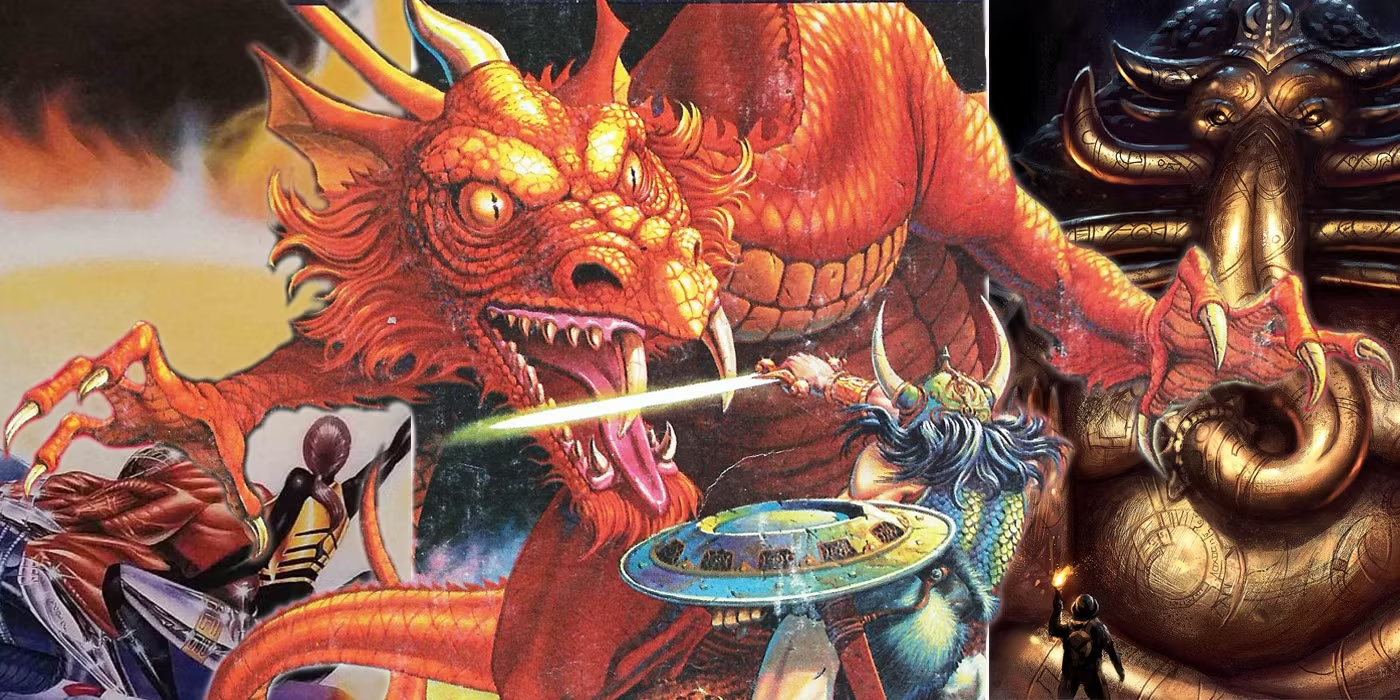
One of the unexpected perks of hurtling toward the half-century mark, aside from creaky knees and reading glasses, is having grown up with the world’s greatest roleplaying game: Dungeons & Dragons. For as long as I can remember, this game has been a part of my life, sometimes in the background, sometimes front and center, but always there, like an old friend ready to spark the imagination.
And one of the greatest joys of D&D is passing it on to others and watching them discover the game as I did in my youth.
This summer, my family escaped to the sun-drenched hills of Tuscany, where we rented a villa nestled among vineyards and olive groves for two blissful weeks. It was an Indian summer, the air thick with heat, our days melting away by the pool. But as the sun dipped behind the cypress trees and the cicadas finally fell silent, a new tradition emerged. Dungeons & Dragons by moonlight.
My players ranged in age from 12 to 20, kids from my extended family, including my own, and for many of them, this was their first taste of the game. We cracked open the Essentials Kit and plunged into Dragons of Icespire Peak. Our first evening began with character sheets and dice, laughter and name-picking, as we stepped into the legendary Forgotten Realms on a quest to slay a dragon.
To be honest, I wasn’t sure how it would go. This is a generation raised on iPads and X-Boxes, a digital world of instant gratification. I half expected eye rolls or short attention spans.
What I got instead was lightning in a bottle.
From the very first session, the spark caught. D&D didn’t just become part of our vacation routine; it became the reason to clear dinner plates faster than ever before. The excitement was palpable. The story, the characters, the dice rolls, they were hooked. It was electric.
For them, it was magic. For me, it was something deeper. Watching them discover the wonder of tabletop storytelling in real time was like watching fireworks go off behind their eyes. There’s something incredibly moving about seeing a new generation fall in love with something that shaped your own youth.
In a word, Pure magic.
A Game About Rules You Don’t Follow
When introducing Dungeons & Dragons to a new group, especially adults or seasoned gamers, there’s a sacred ritual: session zero. You take your time. You explain the rules. You build characters thoughtfully. You lay down the groundwork for the campaign like a careful gardener planting seeds.
But when your players are kids?
They just want to fight the dragon!
Their impatience was a jolt, a glorious, chaotic reminder of what D&D really is. Yes, it has rules. Yes, there are mechanics and modifiers and sourcebooks full of fine print. But none of that matters if you’re not having fun pretending to be a sword-swinging, ale-guzzling hero with a questionable moral compass.
There have been a few different starter sets for 5th edition Dungeons and Dragons, but I think the Essentials Kit is one of the most complete and arguably the most flexible. It includes rules for creating your own characters, a campaign that takes players through 6th level, and has additional material like cards and a DM Screen. Most importantly it’s an adventure about fighting a dragon, which I think is sort of on point with new player expectations.
The kids didn’t care about encumbrance. They didn’t ask what armor class was or how spell slots worked. What they did care about was choosing the coolest-looking helmet (even though modern D&D doesn’t have rules for helmets) and ordering a frothy mug of tavern ale (because pretending to be drunk is, apparently, hilarious).
They wanted to dive headfirst into the fantasy and so we did.
We built 1st-level characters lightning-fast: 4d6, drop the lowest, straight down the line. Four classic classes—Fighter, Rogue, Cleric, Wizard. No agonizing over feats or backstory minutiae. In less than 20 minutes, we were on the road from Neverwinter, headed toward the sleepy frontier town of Phandalin, backpacks light, coin purses jangling, stomachs growling.
I told them they were running low on rations, poorly equipped, and unprepared for the dangers ahead. They ignored all of it. Naturally. Because five minutes later they stumbled upon the corpse of a murdered merchant, Orc tracks leading off into the woods and that was all the motivation they needed.
They were in.
There is a new starter set coming out later this year called Heroes of the Borderlands based on the classic 1st edition adventure Keep on the Borderlands. This robust set clearly targets a younger audience and looks like it will be quite perfect for introducing new players to the game with lots of visuals and extras to help make the introduction as easy as possible.
They didn’t know the rules. They didn’t need to. What they did know was that something had happened. Something bad. And these make-believe heroes were going to chase those orcs into the forest and make them pay, because they knew what Orcs were, they had all seen The Hobbit.
It was everything D&D is meant to be: danger, mystery, and bold, messy heroism.
Every face was locked in. Eyes wide, pencils nervously chewed, dice clutched tight. When I asked, “Who’s tracking the orcs?” and introduced the very first Survival check, you could feel the energy spike like a lightning bolt hitting the table.
The Rogue rolled a natural 20.
They followed the trail right to a clearing where a band of orcs sat around a campfire, drinking and laughing. Before anyone could strategize, the Fighter slammed their fist on the table and shouted, “I attack the Orcs with my Axe!”
One of the other players protested, but it was too late.
“The Fighter takes off running. The rest of you better catch up”, I told them.
Boom. Chaos. Laughter. Screams of delight.
Pure D&D magic.
What is D&D?
When I first sat down to write this article, I wasn’t sure what it was going to be about. I just wanted to tell the story, because even the act of writing it out stirred something in me. A kind of quiet, emotional tremor. Watching those kids, my kids and nephews, discover Dungeons & Dragons the way I once did was more than just heartwarming. It was life-affirming.
I’ve spent my life playing games. Role-playing games, miniature games, board games, you name it. And if you’re like me, you know the looks you get. The raised eyebrows. The half-smirks from people who have never had a gaming table in their lives. Even my wife, who’s known me for over 25 years, has often looked at me with a kind of affectionate confusion.
Why does a grown man care so much about all this?
But this time… I saw something different in her eyes.
She watched what was happening around that table, not just the game, but the way the kids leaned in, eyes wide, hanging on every word and I think, for the first time, she really got it. And then something happened that neither of us expected.
One day, the adults decided to go on a wine tour through the Tuscan countryside. It was going to be a long day of vineyard-hopping and child-free relaxation. No D&D that night, the kids would be left to their own devices. There was some grumbling, of course, but we kissed them goodbye and set off for a day of indulgent day-drinking.
When we returned, we braced ourselves for the usual post-unsupervised chaos. But there was no chaos. No screens. No locked bedroom doors.
Instead, the kids were all gathered around the table again, playing Dungeons & Dragons, on their own.
Dungeons and Dragons in my day was a big mystery; it was not a very approachable game, but the vivid art combined with that mystery of discovering the game through the many books printed for it was absolutely irresistible to me.
My son had taken the mantle of Dungeon Master. Despite barely knowing the rules, he was narrating a story, guiding the others through improvised adventures. They were telling tales, fighting monsters, completely immersed in a world they’d decided to build together.
No one told them to do it. No one handed them a script. They just wanted to.
They’d even drawn portraits of their characters, hoping, of course, to earn some extra XP from me when the campaign resumed. And before I could even step fully through the door, they were on me with rapid-fire questions:
“Why didn’t you tell us about Saving Throws?”
“There’s a Paladin class? What about Barbarians?, Why didn’t you tell us!?”
“Why didn’t you tell us about D&D Beyond!?”
It was… stunning. These screen-savvy, digital-native kids had unplugged themselves. They weren’t mindlessly scrolling, or zoning out, or retreating into the isolation of algorithms and apps. They were creating. They were collaborating. They were lighting up a part of their brains and their hearts, which too often lies dormant in today’s world.
And that, right there, is what D&D is. That’s what it’s always been.
It’s not just dice and rules. It’s freedom. It’s pure creative expression. It’s a primal kind of joy, something ancient and instinctual that lives inside every person. Some people find it in books. Some in painting, or sculpting, or dancing. But when you sit down at a table, look your friends in the eye, and say, “What do you do?”, you’re unlocking something sacred.
D&D is a release valve for the imagination. A bridge to wonder. A reminder that we are all still storytellers, no matter how old we get.
So, if there’s a takeaway from all this, it’s simple.
In the last year, I realized something about my gaming habits and preferences that perhaps I should have, but never did notice. I seem to be a bit of a gaming hipster!? I think…
When I think about the sorts of games I like, regardless of category or genre, I find my tastes are a bit unusual compared to pretty much anyone I know around me. In fact, it’s kind of a problem because I very rarely get to actually play the games I would play if it were exclusively just up to me. Part of this I think, has to do with my age, I have been playing games for nearly 4 decades at this point, at least 2-3 decades more than most of my peers, which might explain my tastes to some degree; nostalgia and all that.
Regardless, in the spirit of Hipsterism, I thought I would talk about my preferences a bit, which, by default, has produced a kind of Hipster list!
What I will do is choose a genre of gaming, and for each genre, I will assume that I have a gaming group raring to play this weekend. Which game would I choose!?
Role-Playing Game
I’m going to split Role-Playing into three sub-genres because I do see RPG’s as something of a quirk of mine and picking just one game just won’t do.
Fantasy – 1st Edition AD&D
The classics in their original form can still be enjoyed thanks to the Wizards of the Coast reprints.
Here’s the thing: I love fantasy RPG’s—truly. I could spend hours agonizing over a top 10 list, shuffling titles around, and second-guessing myself. But one thing is certain: Classic 1st edition Advanced Dungeons & Dragons is one of the most robust and compelling RPG traditions ever created for fantasy storytelling. Hands down.
Note, I did not call 1st edition AD&D a game, because to me, it’s always been more than just that, nor would I exactly escribe it as an RPG by today’s standards. AD&D is unique, a game with a very special approach and essence which did not exist before it in any game and has not been replicated in any games since. Every version of D&D that followed lost sight of this hidden essence, that magic that exists between the game as a rule set and the tradition that was born in Gygax’s definitive work. AD&D as a gaming tradition, an activity, and a collaborative storytelling tool, far exceeded the presumed simplicity of being a rule system and a game. I don’t know that Gygax intended for this to be true about his game, quite to the contrary, I think he was trying to create just that, a definitive rule set with AD&D, but like any art form, happy accidents happen. That happy little accident would never again be repeated, and every edition of the game has tried but failed to recapture the magic of the original.
Mind you, this is not for the lack of trying; in fact, I think most editions of the game have tried very hard to mirror the magic of AD&D, but the truth is that most designers even today can’t fully explain why this original version is different. I don’t think I could fully explain it either; it just is. An intangible quality exists in AD&D that is simply ineffable. As ineffable as it may be, I feel obligated to at least try to explain it, but I say this here and now, this is NOT about nostalgia.
Why do I gravitate toward this strange and inexplicable classic? Because I’ve always believed (as did Gygax) and still do that the most powerful, memorable role-playing happens when players don’t know the rules inside and out of how it’s done behind the screen. In the case of AD&D, it’s mostly because the rules are unknowable, thanks to the cryptic way in which they are described in what I consider the most important book in the RPG hobby ever written, the 1st edition AD&D Dungeon Master’s Guide.
The 1st edition Dungeon Masters Guide is one of the most unique books ever written. It doesn’t just guide you through the process of creating worlds for players to live in, but it teaches you how to present that world in a way that will inspire players to believe in it.
Don’t get me wrong, it’s not a critique of AD&D. Every player, given the chance, will lean into what they know; it’s only natural that when you know the rules of a game, you start using those rules to your advantage as a game. True magic happens when players don’t know how the game works. The less they know, the more they have to trust their natural instincts at the table. Not knowing the rules activates your imagination, and players start acting like people living in a story rather than characters moving through a system. They make choices that feel right, because they don’t have the option to make sure their choices are mechanically sound. This is the magic of AD&D, it refuses you the foundation of rules upon which to make decisions, leaving you to your collaborative imaginations. Some (in fact, most) would argue this is bad game design, but I would argue that it’s perfect game design. It makes the act of role-playing the only avenue for all participants. There is no game here upon which to hang your hat.
And that’s where the magic happens.
Especially in fantasy, where gods walk the earth, monsters lurk in the dark, and magic bends the very fabric of reality. Not knowing how everything works is a feature, not a bug. It creates a sense of wonder, of discovery, of trying things to see what they do. Players aren’t just learning about the world, they’re learning how its very physics of the world operates.
There were many versions of Dungeons and Dragons, both official and unofficial, but every book that followed 1st edition AD&D strived to be a rulebook first, presenting the game as a mechanical architecture for creating a game at the table that everyone, especially players, could understand. Only 1st edition AD&D saw itself as a creative toolkit for collaborative storytelling, targeting the DM as its master.
For me, 1st Edition AD&D will always be my first love and for that it can be easy to write it off as nostalgia and often with old school games this is the case with me, but not so with AD&D. If I had the chance, I’d run a classic game exactly as I believe it was always meant to be played: with a little mystery, a lot of imagination, and just enough chaos to keep everyone guessing.
Science-Fiction – Alternity
I was this close to picking The Aliens RPG by Free League Games. It’s a fantastic system for intense, edge-of-your-seat one-shots. But let’s be honest: once the xenomorphs are out in the open, the mystery that is the Alien movies vanishes, and with it, a lot of the drama. It’s hard to stretch that tension into a long-term campaign without it wearing thin, despite the fantastic game design that went into the Aliens RPG. I love it, but a good foundation for a long term RPG campaign – it’s not. It is a one-shot, nothing more, nothing less.
If Gygax is the pioneer of fantasy RPG’s, there is no question that Bill Slaviscek and Richard Baker were the pioneers of science-fiction RPG’s. Alternity is a master class in how science fiction should be approached as a storytelling game.
So in the end, it came down to a real heavyweight match: Star Wars RPG by West End Games versus Alternity by TSR/Wizards of the Coast. And while both hold their own with style and substance, I give the edge to Alternity for one reason only: The Stardrive campaign setting.
The setting designed by Richard Baker, one of the sharpest minds in the business, pushed Alternity over the top for me. It’s original, ambitious, and packed with the kind of rich lore that inspires long-term storytelling.
The Stardrive campaign setting is an epic tale of humanity’s rise to the stars, and despite being written in the late 90’s, the history of this setting rings more true today than it did back then. It’s a fascinating read, almost as if it’s a prediction.
But Alternity as a system is more than just a great way to bring a setting to life. It’s the unsung pioneer of the d20 era. Before 3rd Edition D&D made the mechanic mainstream, Alternity was already out there, blending class-based progression with skill-based freedom in a way that felt sleek and forward-thinking. It wasn’t just a set of rules, it was a toolkit for building any kind of science fiction world you could dream up. It’s the tragedy of the 21st century that Wizards of the Coast would take the d20 system invented with such perfection and completely botch it over the course of 3rd, 4th, and 5th edition D&D. They had the perfect model for a perfect system and decided to foolishly ignore it, but I digress.
Need spacefaring starships, cybernetic upgrades, rogue AIs, mutant powers, alien civilizations..the list goes on and on! It’s all there. Not just as a flavor, but with clean, well-designed mechanics that make it all sing at the table. There is no science-fiction setting that has ever been or ever will be created that you can’t replicate with perfection with the Alternity RPG.
I still believe that West End Games take on Star Wars is the best version of a Star Wars RPG to date. In effect, it makes Star Wars feel more hard science fiction, unlike the movies that pushed the setting into science fantasy.
Alternity gave us a framework where science fiction didn’t just feel possible, it felt limitless. That’s why, for me, it’s the gold standard for sci-fi roleplaying.
If I was going to run a science-fiction game today, there is no question it would be Alternity. The only exception I would make is for Star Wars, in that case, it would be the West End version of the game.
Other – Mage The Ascension
Over the past thirty years, I’ve run World of Darkness chronicles more times than I can count, and every single one stands out in my memory. There’s something about this universe that sticks with you. It comes in many shades: vampires brooding in neon-lit alleys, werewolves howling at the edge of the apocalypse, and wraiths lost in their own sorrow. But the default flavor has always been Vampire: The Masquerade.
And don’t get me wrong, Vampire deserves its fame. It’s probably the most iconic and approachable entry in the World of Darkness line, and for good reason. But if you came to me right now and said, “Run a World of Darkness game,” I know exactly what I’d pick: Mage: The Ascension.
Like Vampire, Mage puts players in the shoes of powerful supernatural beings. But where Vampire centers on politics, survival, and control over the mortal underworld, something players can more easily connect with, Mage reaches for something far more abstract and far more profound.
One of the big burdens of Mage The Ascension is that it’s focused on a wide range of unique takes on belief systems. It’s one of those RPG’s where everyone needs to read it cover to cover to really understand it, it’s difficult to present it as a GM. White Wolf games require a lot of self-reading because so much of the games storytelling is buried in the details of the setting and aesthetic backdrops, but nowhere is this more true than Mage.
In Mage, your faction isn’t just a club or a bloodline, it’s a belief system. A worldview. And the war isn’t over turf or influence, it’s over control of reality itself.
The Technocracy reigns in the modern age, shaping the world through science, reason, and the rigid laws of physics. But the twist is that, this version of reality is just another kind of magic, one that’s been accepted by consensus. Other mages, the ones who Awaken to alternate truths (the players), fight back not with bullets or blades but with paradigm-shattering ideas. The conflict is philosophical, spiritual, and metaphysical; the journey I can only describe as a mind-bending acid trip.
When you run Mage, you’re telling a story about characters who don’t just cast magic, they reshape the fabric of existence. And the more they push, the more the world pushes back. It’s a game where players don’t just feel powerful, they begin to believe in the power of belief itself.
To this day, I’ve never had the chance to run a full Mage chronicle—and I’ve been itching to do so for years. I love this setting. I ache for the chance to guide a group through its mysteries. If the opportunity ever came up? Let’s just say I’d be all in.
Boardgames
When it comes to board games, the number of categories is ridiculous, and I could make a solid argument for any of them. If, however, you forced me to pick three, forsaking all others, I think this would be the list.
Lifestyle Games – Twilight Imperium
Without question, the single best boardgame ever designed…period.
If I could conjure up a dedicated group of Twilight Imperium fans with the snap of my fingers, I’d be running a weekly game in a heartbeat, and I doubt I’d ever get tired of it. I know because I once had that, and it was and still is to this day, the best boardgaming experience I have ever had. It’s an irreplaceable memory that I will always chase because, in my view, Twilight Imperium is a one-of-a-kind masterpiece.
Twilight Imperium isn’t just a board game. It’s a commitment, a journey, and for those willing to invest the time, it becomes something greater: a lifestyle. This is a game with layers on top of layers. What looks at first like a complex 4X space opera transforms into an ever-evolving, deeply human drama of ambition, alliances, betrayals, and vision.
Yes, it’s long. But that time investment isn’t a drawback it’s what allows the story to breathe. The game unfolds like an epic saga, each session an emergent narrative shaped by the choices, fears, and aspirations of the players around the table. It’s a game that brings out raw human drama, both imagined and real at the table. I have seen how passionate players can get about this game and I thirst for those experiences.
On the surface, Twilight Imperium is a combination of a civilization builder and war game, filled with rich lore, factions with asymmetric powers, and galactic conquest. But dig deeper, and you’ll find a game of psychology, political maneuvering, negotiation, and strategic bluffing. As I like to call it, the real game behind the mechanical one. Every move is loaded with meaning. Every word spoken a ploy. Every silence held can shift the balance of power.
You don’t just play Twilight Imperium, you live it for the duration of the game. You embody your faction’s ethos. You forge uneasy alliances, backstab former friends, and navigate the ever-turbulent currents of the Galactic Council. You calculate every vote, every trade, every fleet deployment with a mix of tactical precision and raw gut instinct.
With two dozen unique factions, dynamic objectives, modular galaxy maps, and endless human variables, Twilight Imperium offers infinite replayability. It’s a true modern masterpiece, an epic that’s far too often overlooked because of its scale and length. But for those who make the leap, the rewards are unmatched.
This used to be a game I played all the time and I can’t think of any gaming experience I miss more, it’s right up there with 1st edition AD&D and Battletech!
Tactical Games – Battletech
Its a cross between boardgaming, miniature gaming and role-playing.
Some might call BattleTech a miniatures game and sure, technically it is. But to me? It’s always been a dice-chucker board game disguised as a tactical miniature game, dressed up in pewter and plastic, pretending to be part of the miniatures crowd while doing its own brilliant thing as a role-playing game. It’s a strange mixture but it works.
BattleTech is incredible for three big reasons.
First, the lore. It’s a sprawling, obsessively detailed tapestry of interstellar warfare, dynasties, betrayals, and battle mechs the size of small buildings. You can trace the fictional design history of a single ‘Mech model, who built it, where it was deployed, how it evolved with more depth and nuance than many real-world war machines. We’re talking more lore than Warhammer 40k, and I don’t say that lightly. If you’re a story-driven gamer like me, this universe is an absolute goldmine of narrative potential. It’s a robust setting that rivals most role-playing games.
Second, the game itself. The core mechanics of BattleTech have remained remarkably intact for over 40 years. In a world where games are constantly rebooted, patched, streamlined, or gutted for new editions and marketing cycles, BattleTech is a white elephant. Buy a rulebook or a miniature in the ‘80s, and your game is still valid today. Still playable. Still awesome. That kind of long-term commitment to players and collectors is practically unheard of in the tabletop world. And here’s the kicker: as of 2025, BattleTech is the third-highest-grossing miniatures game in the world. Proof positive that you don’t need to screw over your fanbase with constant reinvention for a cash grab to make a living in the industry.
But honestly, those first two reasons are just icing on the cake. The real reason you should play BattleTech is this:
It’s a glorious, chaotic, beer-and-pretzels dice chucking tactical slugfest. A crunchy, customizable, story-driven war game where everything that can go wrong probably will — and that’s the fun of it. Yes, there’s tactical play, but this isn’t chess. This is a cinematic, slow-motion trainwreck of overheating engines, ammo explosions, critical hits, and desperate Hail Mary maneuvers. It’s a game where you feel the damage, as your mech gets carved apart limb by limb in a ballet of ballistic fire and reactor meltdowns.
Only one other game I’ve played, Warmachine, gets anywhere near the same granular feel of mechanized combat. Unfortunately, like most miniature games, the constant rule changes, reboots, and updates completely ruined Warmachine. Battletech has stayed the course and remains all about managing your loadout, balancing your heat, and watching as your prized war machine limps across the battlefield, missing an arm and trailing smoke. That’s peak drama. That’s BattleTech.
I love this game. Always have. It’s one of the few on my shelf where pieces I bought in the ‘80s can legitimately still hit the table, no updates needed, no strings attached.
Sadly, like many of my hipster gaming passions, BattleTech isn’t exactly mainstream in my circles. I rarely get to play these days. But if someone asked me to drop everything for a match?
Hell yes. I’d be there in a heartbeat.
Event Games – Western Empire (Advanced Civilization)
The original Avalon Hill version of this game was quite ugly, like many games back then, they lived in your imagination which was kind of the point of table top gaming in general.
If you’ve followed this blog for any length of time, you already know War Room is one of my favorite event games. It doesn’t make the hipster list, though, mostly because I actually get to play it and I believe it to be a well-designed modern game, there is nothing hipster about it. My friends are kind enough to indulge me once a year (usually around my birthday), and while it’s big, bold, and unique, at the end of the day, it’s still an Axis & Allies descendant.
Now Western Empires, or as I still instinctively call it, Advanced Civilization, is hipster gaming royalty.
Shut up and sit down, I think did the best and most honest review of this game I have ever seen, flaws and all, but they their is one observation that they sort of failed to make which is that what they saw as flaws in the game from a gamers perspective are very intentionally designed features. It’s sort of like accusing Star Wars of having too many lightsabers.
I’ve talked about this game plenty before, and for good reason. It’s a sprawling, epic beast of a board game. Designed for a minimum of five players, though let’s be honest, it really wants nine (yeah you heard that right). Clocking in at a cool 12 to 15 hours, it’s less a game and more a full-day historical event. It is, without exaggeration, one of the hardest games to actually get to the table.
To put it in perspective, I haven’t played a live game of Advanced Civilization in over 20 years. Two decades. And yet, I’ve always kept a copy on my shelf. Just in case. Always hopeful that one day this one will get its moment in the sun.
At its core, Western Empires is a game of historical empire-building and economic maneuvering. There’s trading. There’s a touch of area control. Sometimes, it even pretends to be a war game. But really, it’s about managing the wild, unpredictable chaos of history. You stretch your reach, you push your luck, and you try to outmaneuver your rivals not with brute force, but with sharp wits and sharper tongues.
One of the biggest reasons this game rarely hits the table, aside from the sheer time investment and player count requirements, is that modern gamers often expect strategy games to reward clever, clean moves. Western Empires doesn’t care about your strategic brilliance. This is not a game of perfectly calculated efficiency. It’s a game of negotiation, adaptability, and psychological warfare. The best players aren’t the ones with the most optimal city placement, unit movement or strategic planning. They’re the ones who can read a room, spin a trade, and deliver a betrayal with a smile while staying the course of the inevitable and uncontrollable ups and downs of the game’s natural ebb and flow.
You don’t play the game, you play the players. That’s where the real magic is.
There’s really nothing else quite like it. The closest modern comparison might be Small World, and that’s a real stretch for a comparison, as it matches only some of the subtle nuances of mechanics. Western Empires occupies a weird, wonderful niche all on its own.
And that’s why it’s here, on the hipster list. I know full well this kind of game isn’t for everyone. Hell, it’s barely for anyone. Finding eight other souls who are all willing to commit an entire day to a relic of the 80s is an impossible task in most gaming circles. But if I ever found the right group, you better believe I’d make this a yearly tradition, right up there with War Room.
Quirky, chaotic, and criminally underplayed. That’s what the hipster list is all about.
Euro Games –
Miniature Games
When it comes to miniature games I would argue there are also quite a few different ways these games can be categorized, but I think a simple way to do it would be to split it between casual games and competitive games. It’s a broad, but it’s easy to distinguish way to do it. I would only add one third category, which I would call semi-miniature games, in which I would place miniature games that don’t have a miniature painting hobby component at all.
Casual – Warhammer 40k
40k is an all-encompassing hobby, stretching far beyond simply playing the game, and that is kind of the point of it. It’s a bit like loving Star Wars.
Ironically, in 2025, playing the most popular miniature game in the world might be the most hipster thing you can do.
Why? Because the moment Warhammer 40k comes up in conversation, it’s almost guaranteed someone will start rattling off a list of games that are “better in every way” and listing all the things that are wrong with 40k. And they’re not wrong, there are more balanced, more strategic, more thoughtfully designed games out there, lots of them. But sticking with something you know could be objectively replaced by a dozen superior alternatives? That’s peak hipster energy!
But let’s talk about the most fascinating part of the 40k experience: the community.
Across the globe, the Warhammer 40k community treats the game like a competitive titan, and to be fair, it is the largest and most active competitive tournament scene in all of tabletop gaming, by a long shot. The sheer scale of organized play is staggering.
And yet… Games Workshop, the company behind 40k, doesn’t seem to agree. At all.
To GW, Warhammer 40k is primarily a miniature line, secondarily a source of lore and novels, and somewhere far down the list, it’s technically a game. Their support for competitive play feels more like a reluctant nod to what the community chooses to do with their game, than a purposeful commitment or intent for it. The rules are often unbalanced, the game systems are regularly reworked or mismanaged, and it’s clear that game design is not what drives the brand. What we have here is a competitive community built on a system that was never meant to bear the weight of serious play. And somehow… it thrives on that very thing.
In a word, I would argue that Warhammer 40k is not a great competitive game, and when people trash-talk it, that’s really what they are talking about. But it’s a fantastic hobby and a super fun, casual experience, aka, exactly what it’s designed to be.
It’s a beer-and-pretzels dice-chucker in a gothic sci-fi shell, where the real joy comes from painting your army, crafting your own narrative, and then putting it all on the table to roll some dice and blow stuff up. The rules are often clunky, the strategy is there only to a point, but largely buried under layers of “smoke and mirrors.” Winning isn’t about mastering a perfect system, it usually comes down to how well you roll the dice.
And despite all that? I love it.
The mission system is genuinely dynamic, with flavorful objectives and varied scenarios that keep the game feeling fresh. The list-building is wide open, full of creative options and wild combos. But at its core, this is a casual game through and through, one that thrives on the atmosphere around the table and the lore on which it’s based, not in the pursuit of perfection of its gameplay.
Warhammer 40k is about collecting and painting miniatures, swapping war stories, and diving into the endless supply of pulpy, over-the-top lore of a universe where everything is grim, dark, and somehow still gloriously silly.
It’s a hobby. A vibe. A lifestyle, even. Flaws and all, I wouldn’t trade it for anything else.
Competative – Songs of Ice and Fire
I would argue that Songs of Ice and Fire the miniature game is the only rank and file miniature game ever made that actually works well as a game rather than a terrible history lesson about how boring war on the battlefield actually is.
I’ll be the first to admit: I don’t play A Song of Ice & Fire much these days. It’s had a rough road, marred by some truly questionable management decisions over the years and plagued with availability problems. But even with all that baggage, I still consider it one of the most compelling competitive miniature games out there.
This is very much a game that lives in the “I wish” category. I wish it had been better supported, wish it had stuck the landing in balance and they did it all much faster, and wish it still had a place at my table. There’s a part of me that’s still hopeful it’ll stabilize and find its footing again, maybe even make a comeback in my group.
I went in deep on this one. Despite its flaws, I found A Song of Ice & Fire to be one of the most engaging strategy games to hit the miniature scene since Star Wars: Armada. At its core is a genuinely smart design, layered list-building, unique unit interactions, and some fascinating sub-war game mechanics like the NCU board and tactical card play. When it clicked, it really clicked.
Except when it didn’t.
To be fair, most of the problems I ran into weren’t with the design itself — they were with the balance. And yes, you could argue that design and balance go hand in hand (and you wouldn’t be wrong), but I still think there’s a meaningful distinction. A game can be brilliantly designed but hampered by poor balancing decisions, one can be fine-tuned, the other is just a flaw. That’s A Song of Ice & Fire in a nutshell: great foundation, uneven execution.
Now, I haven’t kept up with the latest updates, so maybe things are better these days. But in my local scene, the damage was done, people moved on, and getting a game back into circulation after a group loses faith in it is no small feat.
And then, there’s the personal hurdle: painting.
This one’s tough for me. Being a mass army game, ASOIAF demands batch painting. Lots of similar models, unit after unit, rank after rank. And repetitive painting is my kryptonite. I just can’t stay motivated painting the same miniature ten times in a row. It sucks the joy out of the hobby for me, and ASOIAF is particularly brutal in that regard with no list building avoidance some games offer.
All that said? I still think this is a fantastic game. It deserves recognition. It’s competitive, it’s clever, and when it’s running smoothly, it offers a rich tactical experience that not many miniature games can match. That’s why it earns a spot on the hipster list, a flawed gem that still shines when the light hits just right.
That said… its time may be running out. Modern miniature design is evolving fast, and with games like Warcrow on the horizon, strong contenders are lining up to take this slot permanently.
The Most Fun – Star Wars: X-Wing
In my mind, Star Wars X-Wing is still one of the best miniature games ever made. PERIOD.
When talking about the miniature game hobby, there’s always one title that sparks debate, some say it barely qualifies as a miniatures game at all. I’m talking about X-Wing. And frankly, I don’t buy the skepticism. Slap those sleek ships onto a sprue and suddenly there’d be no doubt where it belongs.
Yes, it’s pre-painted. Yes, it’s more accessible than most. But that doesn’t disqualify it, it redefines the space. X-Wing was designed to walk the tightrope between a serious competitive game and a relaxed casual experience, and it succeeded. Brilliantly. This game brought three key advantages to the table that most miniature games either ignore or fail to execute well. And those three factors are why X-Wing stood tall in the market for years, even managing to shake Games Workshop out of its golden-era complacency.
First, the pacing. X-Wing matches are quick, typically 45 minutes. That’s practically warp speed in miniature gaming terms. It made the game ideal for tournaments and casual nights. You could run multiple matches in an evening, try out a bunch of new lists, and still have time to argue about who really shot first. There’s no hour-long rules refresh or setup slog—just “Hey, want to play?” and you’re in. That kind of approachability is rare in the hobby.
Second, it’s Star Wars. That’s not just thematic dressing—it’s a gateway. The brand brings in people who’ve never even looked twice at a miniature game. You don’t have to explain the appeal of piloting an X-Wing. You show someone the TIE Fighters screaming across the table, and they’re already halfway sold. I’ve never seen a non-gamer pick up Warhammer 40K on a whim. But X-Wing? That’s the one that brings in the curious, the casual, the movie fans, the dads and uncles and kids who just want to fly the Falcon.
Third, and maybe most importantly, X-Wing made high-level tactical play accessible. The rules were simple on the surface, but the depth was staggering. Movement planning, arc dodging, list synergies, action economy, there was real meat on those bones. You didn’t have to learn 200 pages of codex lore to be competitive. But if you wanted to go deep, the game rewarded you. It hit that perfect balance: easy to learn, hard to master.
X-Wing wasn’t just another miniatures game. It was a lightning-in-a-bottle moment in the hobby. It opened the door to a new audience, streamlined what was possible in design, and reminded the rest of the industry that a game could be both fast and deep, fun and tactical, cinematic and competitive.
Whether you play it today or remember it from its heyday, X-Wing deserves its place in the conversation, not just as a miniature game, but as one of the best games to ever grace a tabletop. In my personal opinion, its the single best miniature game that we have gotten in the 4 decades of I’ve been around.
Best Design – Star Wars Armada
When first announced, everyone thought that this would be X-Wing but with capital ships. It certainly looks the part, but Star Wars Armada is an entirely different and far heavier game that demanded a lot more from its audiance.
One final entry I’d like to sneak onto the hipster list—and I say this with as much objectivity as a subjective opinion can carry—is my pick for the best-designed miniature game out there.
To take this crown, a game has to meet a singular, uncompromising criterion: skill must reign supreme. Like chess, where grandmasters fall only to their peers, this kind of game leaves no room for chance to decide the victor. It must be a pure contest of mastery, where the dice are just accessories, not arbiters of fate. And in the world of miniatures, that game is Star Wars: Armada.
Sure, there are dice. But make no mistake, those little cubes only matter when two evenly matched minds clash. In Armada, outcomes are forged not by luck, but by foresight, precision, and relentless practice. It’s a game that rewards not just play, but study. The kind of study that turns casual fans into hardened tacticians.
But here’s where it gets really compelling: Armada doesn’t just test you on the battlefield. It demands mastery before the first ship even hits the table. The list-building is deep, nuanced, and packed with options that will make your head spin if you’re not ready for it. Understanding the shifting meta, anticipating counter-play, these are not fringe skills, they’re the bedrock of victory. The game is highly deterministic, which means your preparation matters as much, if not more, than your moment-to-moment decision-making at the table.
That it’s set in the Star Wars universe, with massive capital ships slugging it out in glorious slow-motion ballet? That’s just the sweet, sweet icing on a very dense, very intimidating cake. But fair warning: Armada is not a casual fling. It’s a demanding, often unforgiving beast that can feel downright brutal if you approach it half-heartedly. You don’t play Armada, you train for it, like a chess grandmaster gearing up for the championship board.
The Gilded Griffon stands at the village’s edge, deep in the unexplored frontier, its weathered stone walls are bathed in torchlight, the sign of a majestic griffon hanging above the door. Inside, the scent of roasting meat and exotic spices fills the air, while shadows dance across scarred oak tables. A grand hearth crackles, its mantle adorned with ancient weapons and relics of past adventures. Patrons from distant lands murmur in hushed tones, and a minstrel’s haunting melody drifts through the room. Behind the bar, a silver-haired barkeep watches with a knowing eye, recognizing you with a nod as adventurers looking for work.
DM: What do you want to do?
This is the moment, this is how D&D kind of started for me. Not this exact start, but it’s how I imagined it. I was 10 years old, it was 1985, I was for the first time invited to a D&D game, I had my 1st level fighter (Darius) character sheet in front of me and all I knew about the game I was about to play was that my job was to pretend I was this fighter in a fantasy world in which terrible monsters existed.
It was a magical moment, one that would define how I would spend my free time over the next 4 decades. It made me a prolific reader, it drove a lifelong passion for creativity, and resulted in the most memorable friendships of my life.
As far as the game went there was an important discovery that I would not make until nearly 40 years later about how and why this moment was not only unique but why I would spend the next 40 years trying to re-create it every time I sat at a gaming table.
See the magic of this moment is not about nostalgia, it’s not really about old-school gaming, or the OSR, or something about the “edition of the game” or game mechanics specifically either. There were many theories I and others would come up with that would try to explain this moment and why D&D back then was different than today and what has changed and why but they would all turn out to be dead wrong.
The magic of this moment it turns out was simply that, I didn’t know what was about to happen and I was not following any script filled with assumptions. There was nothing that happened before the game other the mechanical work of producing an abstract character which we knew nothing about except a race and class and maybe a name. Meaning, I had virtually no information about the game I was about to play. All I knew was that I was a “Fighter” and that meant I knew how to use weapons and armor, a generalization at best. I knew that the goal of the game was to explore the game world (somehow) and we were told by the DM that “you can do whatever you want, go wherever you want”.
The question was “Why”? Why would I go anywhere? I was instructed that as a 1st level fighter, I was not very good at fighting yet, that I would need more experience (which notably I was unsure how to get), and that the world outside of the tavern was dangerous and you could die easily.
Here was the thing, It was scary and though I just made this character, I was already quite attached to Darius. The act of writing down his name on a funny looking, but intriguing page called a character sheet had built him up in my head, he wasn’t just a “character”, he was a person I cared about and I didn’t want him to die, I didn’t want to do anything “stupid” that would put him at risk. The DM was well known for cruelly tearing up character sheets of dead characters right there at the table, we had all heard this rumor, so I knew and believed in the danger of the game.
One of the tricks of the trade among DM’s in the early days of D&D was that they did not reveal much to the players. It would be several months before any of us even realized that we were actually near the City-State of Greyhawk, a famous place in the D&D “world” we would eventually have the pleasure to visit.
But the DM of course did not make my life easy. He said, “You are hungry and thirsty and tired as you have traveled many weeks to get here and are low on supplies”. The DM told me that you can die of thirst and hunger and you can even die from exhaustion. So we did the natural and perhaps predictable thing, (we being a couple of my friends in similar situations with similar characters in our adventuring party) we walked into the tavern, ordered food and drink, and asked for rooms so that we could rest. It seemed logical and it was our idea, our plan, we made the decision to do that, our first act as role-players. It felt powerful, even though it was very simple.
The DM then, in the voice of the tavern keeper told us that this would cost 2 silver for the food and drink and 3 silver for a night in a room. And in that moment, that split second of pretending to exist as characters in a fantasy world, we all realized what this game was really about. We were about to spend the rest of the money we had collectively together just to eat and sleep for a day. If we didn’t get more money soon, we would probably die of thirst and hunger, it was the harsh reality of the game.
We….. needed money!
And so a purpose was born, we were adventurers, fighters, clerics, and thieves and we needed money because we were just about out of it and we had no jobs and no way to make more and so the game truly began. We were promptly approached by an old thief who had a treasure map of a ruin nearby and offered us 100 gold, not to explore it, but just to find the entrance hidden somewhere in the nearby forest. You can’t imagine what an exciting moment that was. We had a mission..ney, a quest and it felt real, it felt important. We were role-playing and it didn’t take much to get us there.
The 1st edition AD&D DMG had a lot of very strange rules, but of course, none of us ever looked inside of it. It was only sometime in 1992 when I became a DM that I finally read this book, getting my own copy. It never occurred to me that the game we were playing really didn’t have any firm rules and was built on abstract philosophies like 1 gold = 1 XP, things that defined the metagame, but were mere suggestions at best, not really rules.
There was no session zero, no elaborate rules or explanations, no backstory writing, and no “defining” anything about what was about to happen. We relied on our natural and very basic instincts and imagination to create a game of make-believe that we would make every bit as real to us as the world we lived in. We were playing Dungeons and Dragons, a magical fantasy world of pretend, not rules.
This was Dungeons and Dragons to me from 1985 well into 1995. That little gaming group was together for over 10 years and though my fighter from that first session would quickly perish in a terrible incident with a Gelatinous Cube as did many characters that followed, I will never forget him, his adventures, or any of the characters I played in Dungeons and Dragons during these years. Oddly, I never wrote a single word about them down, yet I remember each with crystal clear clarity. I remember their deeds, their adventures, how they grew into power and often how their story ended tragically in some dungeon as we (the avatar and I) pursued our ambitions in the game.
This is Fantasy Adventure, this is what D&D was and I have to be honest and this will make me sound like an old Gronard, but it was so much better, so much more fun and narrative than anything that happens at a gaming table in the modern day. A fact that would plague my group for the many years that followed.
Is it possible to learn this power?
In 1995 my group had been together for 10 years, we had played through 1st and 2nd edition AD&D and while we loved our games, like all gamers do we started noticing that there were “other games” and everyone wanted to try their hand at some new stuff. After all, we loved D&D and we loved role-playing so, doing it with other settings and rule systems sounded awesome. It sounded amazing to be a Jedi in the Star Wars universe, or a Highlander or a Star Trek Captain. The opportunities of other games were very attractive to us and we began exploring them.
For about 5 years we went through what I would call a sort of “role-playing ring around the rosy”. We played everything that wasn’t D&D you could think of. All the world of darkness stuff, various science-fiction games and every system under the sun from GURPS to Warhammer Fantasy. You would be hard-pressed to name a game my group and I didn’t try, we did it all, and nothing was off the table.
It was fun, and I really want to nail this point home here that no one was disappointed, we really enjoyed these games, but….. We all realized by around 1998 that we didn’t get together as often, campaigns didn’t last as long, people got bored and often games died when people didn’t show up to sessions, and really, the entire “magic” of D&D that kept our crew fully dedicated for 10 years prior was missing from all of these games. These games were all a bit empty, absent of the magic and wonder that we found in D&D. By 2000 we barely even played RPG’s anymore.
Then 3rd edition D&D came out and we of course got excited again. We all got back together with fresh new books in hand, everyone read every rule, cover to cover and we were ready to play, invigorated by the hopeful return to those amazing and magical D&D games which at this point were distant, nostalgic memories. There was a promise of a new golden age, a return to the wonderful world of Dungeons and Dragons that we all missed, that in our eyes was “true role-playing”, the only game that ever really gave us that intangible gaming experience.
I think we had all hoped that 3rd edition D&D would bring the magic back to the table, but as I discovered many years later, the problem wasn’t the game system so much as gaming culture that led game design. I don’t want to suggest that AD&D was the only way to create magic at the table, but it was the only game that didn’t get in the way of the attempts to do so. 3rd edition had too many explicit rules that defined what characters could and could not do, a trend that would catch on and became the methodology for game design. It was in a way, the death of role-playing as I knew it. Games no longer lived in our imaginations, we could no longer “do whatever we wanted”. Games now lived on the table with very strict rules about what was and was not possible and we would spend most of our time arguing about whether these rules were good or not rather than playing D&D.
By 2002, role-playing in our group was all but over. 3rd edition D&D, even though it was Dungeons and Dragons and felt very familiar just had no magic in it, that much was clear. There was no excitement, no mystery, and no mystical spirit in the game. The rules were convoluted and far too explicit and we argued about their abstracted representation of the game worlds living in our head constantly. These rules killed the imagination because they sought to place it with game mechanics.
In many ways, the rules of the game became the only point of any conversation about D&D between us, we no longer wondered about what D&D was, or what mysteries were hidden within its intangible imaginary words. We spent an ungodly amount of time instead trying to fix the rules as we fought among ourselves and the world (internet) over them. To put it plainly, it just wasn’t fun anymore, the year was 2002 and Dungeons and Dragons was over, it was dead and 3rd edition would create 2 decades of terrible game design that would slowly drown out any life D&D had in it. I know that is cruel to say and one might even challenge its accuracy given the popularity of 5th edition, but, modern D&D is popular in the same way McDonalds is popular. It’s a processed and manufactured game for the masses, reduced to the most basic, lowest common denominator. When I tell people about the intangible magic of D&D, they call be a Gronard, a relic that doesn’t know what he is talking about. For a time, I almost believed it.
Our group was pretty much fully disbanded by 2003 and I would not play D&D or anything else with any of those guys until nearly 2 decades later. I did continue playing with other groups myself though. As much as I enjoyed the many people I shared RPG experiences with over the years the games were simply never as good as those original AD&D experiences of the mid 80’s and 90′.
In fact, most of the time I was quite bored and have continued to be quite bored with most role-playing games since, it’s really a rare game that even marginally excites me these days even though I’m constantly chasing that dragon. I still like playing them, I still enjoy the pursuit, but more in a conceptual and philosophical way rather than actually playing. When I play, most of the time, I’m just disappointed that these games are just not as good, not as much fun and lack that intangible spirit of the classic D&D that we played for over a decade in the 80’s and 90’s.
So what really happened? What is the problem with other games? Why is there no magic, no spark, no heart in any of these other RPG including the latest and greatest versions of D&D from Wizards of the Coast? Why did Dungeons and Dragons die around the 00’s? Did it die or did I change?
Not from a Jedi..
I have contemplated this for years, I have researched, I have reflected, I have tested a wide range of theories to try to understand what was so special, what it was that was so unique and/or different that altered the experience and made it so much better in those 80’s and 90’s D&D games that I find missing in modern RPG’s and the modern RPG experience?
For a time I wrote it off as nostalgia and my age. I was between 10 and 20 years of age when I played AD&D, I’m nearly 50 now, it was during a much simpler time in my life and I just presumed that back then I just had more imagination, more energy, and more appreciation that today I lack. The game didn’t change, I changed.
It seemed like a fair and reasonable assessment, one I could accept, but…. then something magical happened. Almost like a fairy tale, as if some genie appeared out of thin air and granted me the wisdom I needed to understand and to find perspective and of course a little help from a little show, maybe you heard of it “Stranger Things”.
One of the oddest elements of Stranger Things is that it’s a show driven by classic D&D tropes and specifically 1st edition D&D fantasy adventure which is played and represented on the show. The very game and very experience I had and missed was right there on the screen, yet oddly enough modern fans would take this inspiration and instead of playing AD&D they would play 5th edition that does not in any, way, shape or form represent what you see on Stranger Things. It’s bizarre to me.
A friend of mine called me up, an old friend from my old gaming group and said “Hey, the old crew wants to get back together and play some D&D, we want to do an AD&D 1st edition one-shot”.
I thought to myself, holy shit yes.
I have the high ground..
In the first 30 seconds of our first session, I was back in 1985 as a 10-year-old playing Dungeons and Dragons for the first time. It required nothing more than the DM using the old formula, the most basic introduction and the simplest core element of D&D to bring it all back.
There was nothing to it, we made characters, essentially randomly generating them as one would in AD&D. Made some basic choices about equipment and who would play what roles, we gave our characters names and we were dropped into the game world with a very basic plot hook to “investigate the evil temple”. It all fell perfectly into place like dominos.
That moment I realized that this game had more story, those characters had more meaning and this game had more role-playing magic than everything I have done at the table for the last 20 years combined. I recall writing entire books of lore, of story, players writing 20-page backgrounds in preparation for a game, doing session 0’s, and endlessly preparing mass plots for my players and none of it compared to the simplicity of the game we were about to play. By comparison, those experiences were lifeless husks, meaningless, about the equivalent of doing your taxes for fun.
So, what was the secret? How did I go from RPG’s feeling dead inside to being back in 1985 as a 10-year-old playing and feeling Dungeons and Dragons again? What did this magical DM do to bring it all back?
Actually, it was pretty simple. It turns out, that it’s not nostalgia, it’s not age or some sort of expertise of the DM, there is no secret knowledge or method. It wasn’t even the system or an edition of the game really, though I do hold that 1st edition AD&D allows classic Fantasy Adventure to happen a lot easier. In the end it was just the simplicity of the role-playing philosophy the system brought to the forefront, plain and simple. It didn’t need to be AD&D and you didn’t need weird old-school rules, what you needed was a system that just got out of your way. That cleared the path for the imagination and allowed you to experience the world in your mind without a lot of input and rules to govern your thoughts and instruct you about what you can and cannot do.
In our game we didn’t have skills and feats and countless “buttons” to press. We had to make decisions, use our imagination, and form plans and our actions weren’t mechanical executions, they were narrative ones. This is what Fantasy Adventure was and in a sense, I feel always should be. I was filled with regret because I realized in that moment that we could have been doing this all along for the last 20 years. There was nothing keeping us from playing this way, but we got distracted and wasted 20 years of gaming out of stubbornness.
For years I had been playing every system under the sun, every game, under every DM, every format, every style, using every method you could imagine. Oddly enough, it never occurred to me to pick a system that just did a lot less, I always thought the more robust the mechanics and infrastructure of the game the more direction you had. So it was just about finding that right system that had the right balance of mechanics. It never occurred to me that the only thing that I actually ever had to do was just to apply the old Gygaxian philosophy about running an RPG, good old 1st edition AD&D thinking was all that was needed.
The feeling, the intangible quality, and the wonder of that moment that made D&D this unique, one-of-a-kind experience, it was all right there perfectly preserved and it wasn’t in rules so much as it was just a philosophy, a way to think and a method to approach the game.
Make a character, give them a name, drop him into the world and see what happens. That’s it…. that’s the magic.
The dark side of the force is a pathway to many abilities some consider to be unnatural..
It’s true and I have to be honest about this, it was awkward. Playing 1st edition AD&D after years of modern mechanics felt strange but It was the philosophies of AD&D that made all the difference, which in modern game design and modern gaming culture are seen as barbaric and out of date. Hell some even consider using such philosophies antimine to role-playing, as if using them somehow makes you a terrible person.
Does that mean I like THAC0? Am I fan of descending armor class or 1 gold = 1 XP? Am I ok with female characters having reduced max strength or racial ability scores?
hmmm… I want to say no, I really do. I feel like AD&D is like the dark side of the force, that lures you to it by some dark power, some evil energy that is quick, dirty, and easy to attain. That somehow by using this game I have become a lesser man… but then I think about it and realize that…. well, it’s only a game and I think that is the trouble I have always had.
You see, in around the 90’s “being a role-player” became this very serious thing. It was an identity and there was a definitive “right way” to role-play and the right way to setup an RPG campaign. You had to write a really big backstory for your character, it was absolutely paramount. Your DM was expected to take those backstories and write a massive plot with twists and turns that incorporated your backstory into the campaign. You needed to have many many books of rules and options to make sure that the players could “fine-tune” the vision of their characters. There were so many new cultural RPG requirements, things that still persist to this very day that if you don’t follow you are not really role-playing, you are not a good GM or player and, probably you should just not be playing RPG’s if you can’t follow these cultural norms. It is considered virtuous to play this way, it makes you a better person. This is the weird mindset of modern gamers.
More than that, in modern gaming it has become synonymous with using old game systems like AD&D to be a bigot, sexist and homophobic, so not only are you not a virtuous person for not buying into modern gaming cultural norms and expectations, but you are clearly an evil person if you play these old games that teach this old philosophy.
I realized recently however that this is a hobby, I do it for fun, and I think a big part of the reason why I and so many role-players feel kind of lost in finding the game is that we have created way too many rules for ourselves as barriers to entry. Both culturally and literally. I mean as players and GM’s we have far too many expectations, and place far too many demands on the games and as gamers, we demand way too many rules and mechanics to “support role-playing”, a concept that should never even be part of a conversation about the game in my opinion. We have sort of broken the spirit of the original D&D game and modern games never really tried to understand, how and what this spirit was and so it never found its way into other RPG’s. We sort of killed the magic with our own ignorance and pride.
What I want is to feel the energy and the magic of D&D, that thing that Gary Gygax and his cohorts invented not how the pretenders that followed him tried and failed to re-invent. I want to have THE D&D experience and the only way I know how to do that is with these older systems like AD&D and B/X systems which have that magical simplicity instilled in them, but I don’t think that is the only way to do it.
Today gamers and game designers are making the same discoveries and it catching on. ShadowDark for example won 4 Ennie awards, a game that instills the classic gaming philosophies and uses a modern, digestible system to do it and actually does a masterful job of bringing that magic to the table.
For many years the only way to get the true Fantasy Adventure experience of old was through the original game or retro-clones, but today you have amazing new game designs that are modernizing the game while ensuring that the magic of D&D fantasy adventure is firmly built in. Its a great time to be a D&D fan.
I am Vinz, Vinz Clortho, Keymaster of Gozer. Volguus Zildrohar, Lord of the Sebouillia. Are you the Gatekeeper?
It’s the original, it’s the classic, it’s the only true D&D experience and this is not conjecture, it’s not opinion, it’s not even objective truth, it just is AD&D and games that follow its philosophy like ShadowDark. I know that sounds like gatekeeping but it really isn’t.
To gatekeep you have to want to keep people out and I’m trying to do the opposite, I’m trying to let people in on this strangely kept secret. There is a game that exists and you probably haven’t played it, even if you have been playing role-playing games for years, even if you have been playing D&D. It’s truly a magical experience but it only exists under one philosophy, using one very specific playstyle built into the classic game of D&D. Its a very explicit act to play AD&D and games like it, it doesn’t follow any of the cultural gaming rules of modern RPG’s and lives outside of the sphere of influences on which most modern RPG’s actually function today. Modern RPG’s are not based on AD&D, they are based on 3rd edition D&D which is an entirely different thing.
For this magical, intangible experience, there is only one path, only one way and it lays between the pages of the 1st edition Advanced Dungeons and Dragons Dungeon Masters Guide. It took me 40 years to realize it, hopefully, you won’t have to wait that long and thankfully that magic is finding its way into other modern games so you don’t even have to go out searching for copies of 1st edition AD&D.
Among the OSR, Shadowdark is a household name already. An old-school style RPG built in the style of classic 1st edition B/X D&D but using modern 5th edition D&D rules. It won several Ennie’s including Best Design last year and stands as one of the premier OSR games for the modern era.
What makes Shadowdark special in my eyes is the fact that it brings back that classic “Dungeon Survival” playstyle popularized by classic 1st edition D&D, but without all the weird (funky) rules that make most modern gamers eyes roll to the back of their head.
This is for the most part a very stripped-down version of 5th edition Dungeons and Dragons, which means that if you are a 5e player or have a 5e group, you could run Shadowdark with minimum explanation required.
Shadowdark is supported by the arcane library, a fantastic site with tons of great material already published for this specific game. If you’re like me and you need a bit more “umf” than most OSR games offer, here you can find tons of additional classes, races and options to give this very simple game a little extra juice.
Shadowdark also borrows heavily from the brilliant editing done on other modern OSR translations like Old School Essentials giving us this amazing book that is table-ready. An easy-to-use reference that allows players to go from “I know nothing” to “Having fun playing an RPG” with virtually no effort.
Considering modern games like the 2024 Edition of Dungeon and Dragons are going the other way with its 600+ page player handbook, personally I think the timing of Shadowdark is impeccable. Right now players and GM’s are faced with the daunting task of having to figure out another D&D ruleset that has more instructions than a Boeing 747 flight manual. In contrast, Shadowdarks pick up and play ultra-light ruleset is looks very attractive by comparison.
If you are a 5e player and you are looking for something a bit lighter, with a bit more focus on rulings over rules and some clear meta-game goals, Shadowdark may be the right game for you and since the basic book is a free PDF, it costs you nothing to check it out!
In the last 30+ years, I have experienced a wide range of role-playing games both from the perspective of the GM and the perspective of a player. Many were successful, but quite a few were not while some only marginally so.
Today I’m going to talk about what I think separates a great campaign from a mediocre one, the pitfalls and traps that lead to failed campaigns, and perhaps most importantly what a good GM should be doing to ensure their campaign starts and ends on good footing.
Now I will admit that I have a very unique take on running role-playing games, it definitely does not fall into the “normal” advice category. I would imagine in fact that the instinct of most GM’s as they read this article will be to disagree and that is fine, it’s just an opinion in a sea of opinions. More advice is better than less advice, so I humbly submit my take on the subject, do with it what you will.
Role-playing games are not about story
We start with the most controversial but in my opinion, most objectively true thing about role-playing games and the universally hardest truth to bare for GM’s. Good role-playing games are never about good stories. They are always about gaming systems.
So here is the thing, if you ask any player why they want to play a role-playing game almost all will tell you “for the story” and in large part, I would imagine it’s also why most DM’s would claim they want to run a role-playing game. It’s the greatest lie always told, but it is always pure, unadulterated, utter and complete bullshit.
The test is quite simple, pick a system a player or group doesn’t like and see if they still want to play. They won’t want to play that game and even if they do, the game will fail no matter how good the story is. Why? If the game is about a story, why would what system you pick matter or cause your campaign to fail if you have done a great job on the story? Why do so many people choose D&D and not GURPS? Why do people pick complex systems like Pathfinder 2e, rather than simple systems like 1st Edition Basic?
If role-playing games were truly just about the story, systems like Pathfinder 2nd edition could simply never find success. There is absolutely no reason anyone chasing an RPG for story would ever need a 650 page rulebook to tell it. Any pathfinder player who tells you they play RPG’s for story is completetly full shit.
The answer is simple, system is everything. Role-playing games are first and foremost games, it’s the systems that get people to sit at the table, it’s what is exciting about the gaming experience and hobby that is role-playing. If I propose running 1st edition Basic to a 5e group, they will reject that game and likely viciously attack me for even suggesting that their precious 5th edition D&D could be replaced by another system. Vice versus, if I walk into an OSR group of old school gamers and suggest that we play Pathfinder 2e their would be absolutely no chance. They would simply rather burn all of their books and never play a role-playing game for the rest of their lives again, than play in a modern gaming system. System matters a lot to people, its not just a game often times, its practically an ID card, your identity as a role-player. People don’t just have strong opinions about what systems and playstyles they like, they are irredemably loyal to them.
Why? I’m a great DM, I have been running games for my gaming group that they themselves without any prompting from me called “the greatest role-playing experience of their lives”. Why would my group with so much faith in my ability to run a great role-playing experience outright reject a game I want to run based on the system I’ve chosen if the game is in fact about story?
The reality is that story is a byproduct, an important albeit side benefit of playing a role-paying game. We all love story, I do not question that, it’s very much a core desire/outcome of the game and why we are drawn to the game, even so far as to stretch the truth and claim it to be the main reason for wanting to play to begin with. The harsh reality is that RPG hobbyists are gamers first and foremost and the game mechanic is a central component of what creates the experience at the table. The story lives as a layer that becomes the output/outcome of the experience, but no one can ever be excited about entering into a gaming social contract without a system they are excited to execute it with. The story will never save your game, a good system always will.
Realistically if story was the most important element of RPG’s to everyone, GURPS would be the worlds only RPG. It has the simplest and most consistent core mechanic of any game in existance, its completetly scalable and functions with all genres. You buy one book and you can write and play any story, any setting, anything you can imagine forever.
Why is this important knowledge for any GM? It’s very simple. Never, under any circumstance convince yourself that the system you want to run is going to create a good role-playing experience for your players unless they are excited about the system as well. Your players have to choose the system, they have to be excited about it, and they have to love it and bare its torch. If a group has even the most minor complain about the system you have chosen, your campaign is already dead and you will never be able to do resolve that. It’s the single most important decision you will make that will define whether your campaign will find success or failure. The system matters that much, more than any other choice you make.
System and setting are often synonymous in RPG’s because most RPG’s are designed for a specific setting, but the same rules apply. If a group isn’t excited and in love with the setting, nothing will save your game. Run a Star Trek Adventures for a group of trekkies and its magic, talk a group of non-trekkies into playing it and neither the system or the story will save the game. A hard lesson I learned first hand. No matter how good of a GM you think you are, no one is that good.
Remember that, accept it, and embrace it. You can write a shitty, linear story in a system your players love and it will be a booming success, alternatively, you can write a masterpiece for a system your players hate and the game will fail miserably. Never forget that, it’s the best advice I can offer after 30+ years of running games. There is no fix for this and the reality is that most games that fail, fail because of this one reason. Don’t let it happen to you.
The busier the system, the shorter the campaign
Most GM’s, when they sit down to create a campaign for their players imagine playing it for years, spinning an epic tale that puts the players on a journey of discovery with twists and turns, exciting reveals, epic battles, shocking events and so on. We all dream about running that Lord of the Rings epic for the ages.
The issue is that the overwhelming majority of systems out there are very specifically designed not to allow that and the reason is quite simple, there is no money in it.
To give an example, I ran a nearly 3 year Vampire The Masquerade campaign for which all I ever purchased was a core rulebook and a setting book. That was it, that’s all white-wolf managed to get out of me for what amounted to hundreds of hours of entertainment. If a gaming group of 5 only buy 1 or 2 books every three to four years, all role-playing publishers become completely unsustainable, and even if they are set up for a low volume, they are not getting rich doing it.
As such, most modern systems are setup to be complex, with tons of design space to create “options” and that is the name of the game for modern RPG’s. Selling option books requires you to be constantly re-starting new campaigns, so you can create new characters and buy new adventure books and so on, all so that you have a desire for more options. It’s a cycle.
Wizards of the Coast and TSR with D&D are probobly the most famous examples of companies that produce a game designed to make sure campaigns fail and have to start over so that they can sell more books. No version of D&D has ever produced a game in which characters of 10th level or more were sustainable in a campaign. The shelf life of a typical D&D campaign is extremely short.
The reality is that complex systems with tons of options will usually result in what I like to call “dead system stops”. This means the system kills your campaign because it lacks the stamina and structure to survive a long campaign as power advancement is at the center of the core mechanic. This is particularly true for most class/level systems that become unwieldy and unbalanced as you rise in level. It is particularly a problem with these systems not just because the increases in level creates unbalance, but because the players have an expectation to constantly level up. They effectively push for the inevitable power creep that will end the campaign early. Play D&D for three months without leveling up and your players are going to start complaining.
The best systems are those that have progression without major impact and are simple so that the character sheet is just a “log” of your character, rather than an elaboration of what your character is and isn’t, or what they can and can’t do. What I mean by that is that if your players are constantly looking at their character sheet to see “what they can do” they are also finding a list of things “they can’t do”. You are playing in a busy system that is designed to create options for players so that they can do stuff, out-level the game and start over.
Original D&D probobly could not have predicted how leveling up, the class structure and focus on experience points would years later become the reason long campaigns would become unsustainable for D&D. In big part it was because these older versions of D&D had a high mortality rate and the high levels where more a carrot than anything anyone had any expectation to actually achieve. In short, high level campaigns were never supposed to be a thing.
A good role-playing system is not going to be about what the system does or doesn’t let your character do, it should be about what your players want their characters to do. It’s not about action economy, but about telling a story, taking “actions” should not be a mechanic in a role-playing system. What characters do should be a story definition, a conscious thought of a player imagining a scene and doing what comes naturally to them with any mechanical elements being customizable and reactive rather than something governed by strict (you can and can’t) rules.
Such systems are becoming rarer and rarer these days, people simply don’t make them that much anymore, which is why we have the OSR because there was a time in the hobbies history when all RPG’s were designed to be free-flowing and free-form story games. The character sheet was an outline of the player’s imagined avatar and it did not define them in any certain terms, it was just a sort of categorization, a layer upon which a player would create their character’s story and what actions they took had nothing to do with the system.
You picked “Fighter” and that could be anything from a Samurai to a Swashbuckler. You did not pick background, you created backgrounds through direct writing or through gameplay. You didn’t select feats and fighting styles, you imagined those things and brought them to the table through the narrative of your character’s interaction with the world. What your character could do was as much an invention of the story as the plot created by the GM. We talk about players always claiming to want the game to be about story, yet, they often choose systems that deny them the opportunity to be creative.
A system like that has no beginning or end, your character is the person you imagine and create and while they will have subtle growth in such a system, it will not offer much in the way of unlocking powers, actions or other gaming gymnastics. Your character is your avatar in such games, the one you created at the start and their progression is their story in the world they occupy, not the mechanical power level they achieve.
In such a system, your campaign can theoretically run forever.
While most players want D&D to be the never ending campaign game, the truth is that D&D is the absolute worst of the dead stop games, in fact, even as early as 1st edition AD&D, the concept of a “long campaign” was dead in the water and impossible under the system. The closes you would ever actually get was 1st edition BECMI, its power progression and advancement was so slow that campaigns could go on for a decade before things got out of hand.
My suggestion is that if you want to run a long campaign that stays healthy no matter how long you run it, stay away from systems that see character progression as a “power” element. That is usually the sign of a busy game not made for longevity, if advancement = power, the game has a definitive beginning and end and the faster that power creep is, the shorter the campaign will be.
At the very least you should asses the system and calculate how much life it will have, at what point you reach the dead stop so that you can plan for the campaign’s inevitable end.
Meta Gaming Is Where Good Stories Come From
As a long-time GM, one of the oddest gaming culture developments that has taken place over the last 30 years is player and GM attitudes towards meta-gaming.
For posterity, we should define what Meta-Gaming is, as there are quite a few definitions and variations of the term. To me, meta-gaming is the act of the players using player information to influence results in the game world. Meaning, the player knows what a typical Orcs AC is and they use that information to their advantage to illustrate the most basic of examples. More commonly the use of meta-gaming is less about the game mechanic and more about the game’s story. For example, a player knows that the prince is secretly a vampire, but their character doesn’t, however, they use their player knowledge to expose him as a vampire breaking the continuity of the game world. Their character is behaving as if they have information that they don’t, because the player does. A more complex example, but typically more along the lines of what people mean when they say meta-gaming.
The modern attitude and culture towards meta-gaming is that it is associated with a really negative result. Meaning, people get pissed about it and the insinuation is that it’s akin to cheating at role-playing.
I’m here to tell you that meta-gaming is the most positive thing you can add to your game and here is why.
The object of a role-playing game is to tell a cool story, but cool stories can’t be told consistently out of a vacuum or through random dice outcomes. Cool stories come from our imagination and that requires a certain level of control. Meaning if you want to make cool things happen, you simply need to decide that they do and this is the collaboration that should take place at the table between players and between players and the GM.
There is a very natural resistance by both players and GM’s to simply side with the system, despite any insistence that the story comes first. Often players and GM’s alike want to side with the dice results or with realism (what would really happen in a situation) or worse of all, with the intent to control the path of the story so as not to derail the pre-ordained set of events. In this struggle, gaming culture has vilified meta-gaming as a negative, but it’s meta-game information that actually allows cool things to happen.
The meta game argument is really old, I was 10 years old and watching this cartoon the first time I had it and I’m 50 now and it still comes up at my tables all the time.
What’s more interesting, a player having to pretend and act intentionally ignorant to the fact that the prince is actually a vampire, or a cool scene where the character appears to be a brilliant investigator and makes the discovery creating a feel-good and heroic moment? Who or what is hurt by the latter?
I don’t know about you, but I love feel-good moments. I want the players to succeed, to do unexpected and fun things that create unique story’s and outcomes. I want large story progressions with each session, I don’t want to delay or make players impatiently wait session after session, sitting on information they have as players because things haven’t worked out for them as characters or worse yet make them feel like they are being punished for being or acting foolish in an RPG.
There is hidden meaning in this quote, but basically what he is saying is that role-playing games aren’t really games, they are storytelling tools. Rules I think are important and so did Gary, but they just don’t apply to GM’s who has the burden of making sure the story is fun.
This also ties into the concept of “yes” GMing. Meaning, creating a game in which the players, no matter how silly and outrageous the things they do are, let them progress, succeed, and move forward, let things work. I don’t want to punish players for doing something stupid, I want everything to appear to be smart, I want everything to be a “Han Solo” plan, something so crazy and outrageous that it works, no matter how unrealistic it is, no matter what the dice say. I want the characters to be the stars of the show, not the victims of circumstance.
My point is that meta-gaming is THE best tool that the GM and players have in their tool bag for creating a great story. Let the story happen and not just that, but push it to happen, resolve the story in such a way so that it’s always a feel-good moment. That doesn’t mean everything that happens is positive, but that the story feels good, like that feeling you get when you just watched a great movie, whether it’s Lord of the Rings or Shindlers List. You want that great storytelling impact at every session, in every scene. It should be happening all the time and meta-gaming is a fantastic tool that allows the players to help you on collaboration of creating that effect at the table.
The Game Has To Feel Threatening
Fear of losing your character has to be foremost on everyone’s mind, you have to make that fear real but you should rarely ever execute anyone. Make an example to prove the point if needed, but remember that the game is all smoke and mirrors,
This last point is short and sweet and self-evident, the question I think that needs to be answered is why I think this is critical enough to put on the list of advice.
Before I answer however, I will say that this advice lands in the “style of play” preference category more than the rest which I consider “general good practices and advice”. Still, I’m quite convinced that my preference here stems from my experience of trying all the different methods and landing on this one by default of it being the most optimal and practical for any RPG.
The other thing to note is that this is not a system thing, it’s not about “choosing” a deadly system, quite to the contrary, I would advise against using that as a crutch, this is more about perception which can be created with any mechanic. It’s a conscious choice as a GM to create an environment of high risk, not a gameplay thing, this danger should not be decided by dice.
Ok enough disclosures, why do I think players should fear for their character’s lives. The answer is actually quite simple, it creates tension and drama at the table that exists in the minds of the players. By creating an environment where the players have a legitimate reason to fear losing their character at the hands of their enemy every time they fight or face other dangers, these things become a tough, dramatic choice that comes with potentially the ultimate consequences and this tension rises up the longer the campaign goes on. The more attached the players are to their characters, the greater the drama.
More than that though, players will steer their characters very differently with such high stakes at the table and this draws the game that much closer to a role-playing environment instead of a mechanical one. Further still, when fights break out in a high-risk game, players will have the natural tendency, as will you as a GM, to elaborate on the events of the fight. You are going to want to squeeze out that last ounce of story when you know that the story of your character may very well end right then and there. You are going to want to make every in that fight a scene of deliberate and player-driven (rather than mechanic-driven) actions. It’s how you make fights less a miniature combat game and more of a role-playing scene, even if the system itself is a very tactically oriented one.
Setting Specific Games Are Better
The final piece of advice which I know most people will hate hearing, but systems made as generic genre games like D&D is for fantasy are never even close to as good as specific games with mechanics designed specifically to a setting, for example what The One Ring is to the middle-earth setting.
The reasons are many but it boils down to the fact that a setting-specific game only needs to think about how the rules apply to that one world, theme and atmosphere. Generic systems need to have this broad coverage and you always end up with an overcooked system which despite being overcooked is missing a lot of stuff you may need once you choose the specific setting you will use in your campaign. Its the default problem that systems like D&D have.
Setting specific systems have such an overwhelming advantage over generic systems in the design space that even a really shitty system made for a specific setting is going to be overwhelmingly superior to the best generic system. When a system is actually good and for a specific setting like Alien RPG here, its pure fucking magic.
This is particularly true if you are using a setting that is pre-defined. For example lets say you want to run a campaign in Westeros, using the story of Game of Thrones as your backdrop. Now you have a lot of detail that whatever system you choose needs to cover. Could you run D&D for example using the Westeros setting? Sure, but there are no fireballs in Westeros, in fact, very little magic at all. How do you handle running your own house? Mass combat? You get the idea. The robust and complex system you picked, suddenly has massive gaps in the infrastructure you will need to run your setting and story.
A game designed to serve a specific setting is always going to give you much better results and what you will find is that most systems, even when they are in the generic category, serve a specific styleof play best. D&D for example is great for high fantasy adventure games, it is, its bread and butter.
My advice is always to do this. Figure out what world/setting and style of game you want and then pick the system that supports that, don’t try to squeeze shit into systems that are clearly not designed to support what your looking for. This advice is very much in turn with the opening advice for this article but this is a bit more specific.